
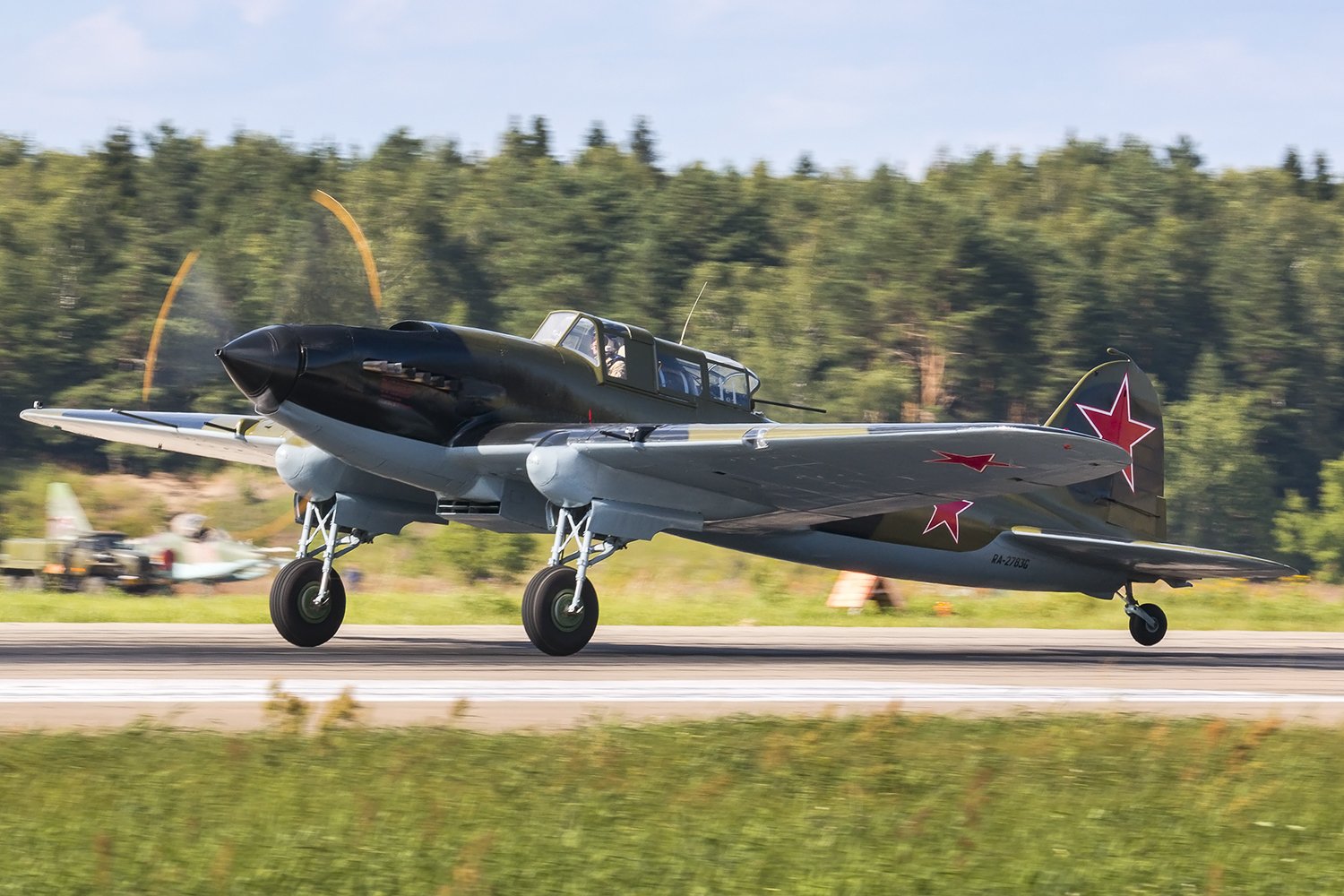
The Ilyushin Il-2 Shturmovik was a specialized armored ground-attack aircraft developed by the Ilyushin design bureau under the leadership of Sergey Ilyushin. Design work began in 1938, evolving from a project designated TsKB-55, which was a two-seat armored aircraft. The Il-2 first flew in 1940 and entered mass production between 1941 and 1945. It became the most produced aircraft of World War II, with estimates of total airframes built ranging from over 36,000 to as many as 42,000.
Engineered for ruggedness and survivability, the Il-2 featured a thick armored shell protecting the engine, cockpit, and critical systems, earning it the nickname 'flying tank.' The aircraft was a low-wing monoplane with a wingspan of approximately 48 feet (14.6 m) and a length of about 38 feet (11.6 m). It was powered by liquid-cooled V-12 piston engines from Mikulin; early prototypes used the 1,370 hp AM-35, while production models like the Il-2M utilized the 1,665 hp AM-38.
Armament was heavy and tailored for anti-tank operations. Early versions were equipped with two 23 mm cannons and two 7.62 mm machine guns. They could carry a bomb or rocket load of approximately 1,000 lb (450 kg), though later models increased this capacity to 600 kg. While the initial 1941 production version was a single-seat aircraft, the lack of rear defense led to the introduction of the Il-2M two-seat variant after the summer of 1942, which added a rear gunner armed with a 12.7 mm UBT machine gun. By February 1943, all Soviet factories were producing these two-seat versions. A further refined version, the Il-2 Type 3, replaced the Il-2M in late 1943.
Operated primarily by the Red Army Air Force, the Il-2 was instrumental on the Eastern Front, particularly between 1941 and 1943. Its ability to destroy German panzer divisions was so critical that Joseph Stalin described the aircraft as being as necessary to the Red Army as 'air or bread.' Beyond the USSR, the aircraft saw service in Poland, Czechoslovakia, Yugoslavia, Hungary, Bulgaria, and Mongolia, with some remaining active until 1954. Today, the Il-2 remains a symbol of Soviet industrial mobilization, with examples preserved at the National Air and Space Museum and the Pima Air & Space Museum.