
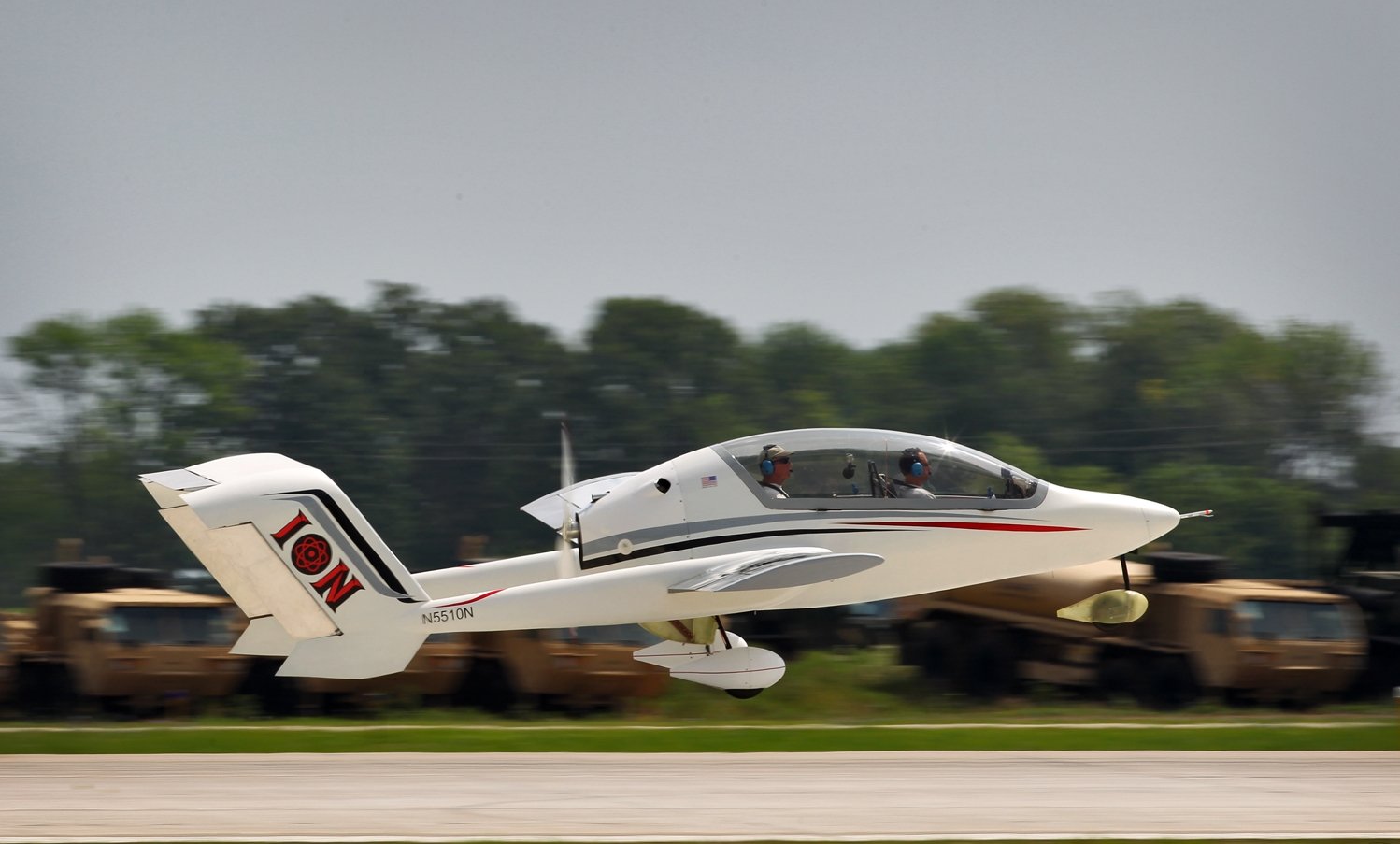
The Ion is a modern light aircraft developed by the United States-based company Ion Aircraft. Designed to meet Light Sport Aircraft (LSA) standards, the aircraft is based on the DreamWings Valkyrie homebuilt design. It features a distinctive twin-boom pusher configuration with a side-by-side two-seat cabin. The design utilizes a carbon-fiber composite fuselage and bonded aluminum wings and control surfaces. A key technical characteristic of the airframe is the absence of traditional mechanical fasteners; the primary structure relies on adhesive bonding using methyl methacrylate and Hysol epoxies, avoiding the use of rivets, bolts, or screws.
Development of the aircraft was ongoing as of 2010. By mid-2012, a flying prototype was presented at EAA AirVenture Oshkosh, having flown to the event from Minneapolis, Minnesota. During the 2012 showcase, company representatives Steve Martin and Steve Schultz indicated that the firm was producing three additional aircraft and planned to bring kits to market in early 2013. Despite these intentions, there is no verifiable evidence that the Ion ever entered full-scale serial production, and the total number of completed airframes remains unknown.
Technically, the Ion is powered by a single piston engine in a pusher arrangement. The manufacturer offered options including a Jabiru engine or a 100 hp Rotax motor converted to throttle-body injection. The aircraft's performance specifications include a cruise speed of 152 mph at 75% power, a maximum rate of climb of 1,610 ft/min at sea level, and a stall speed of 43 mph with flaps deployed. Its structural limits are rated at +4.4 / −2.2 g. The aircraft has a wingspan of 30 feet, a length of 24 feet, and a maximum takeoff weight of 1,320 lb, aligning with US LSA landplane limits. While it served as a proof-of-concept for high-performance bonded structures in the LSA category, the Ion remains a prototype-stage design with no documented commercial or military service history.