
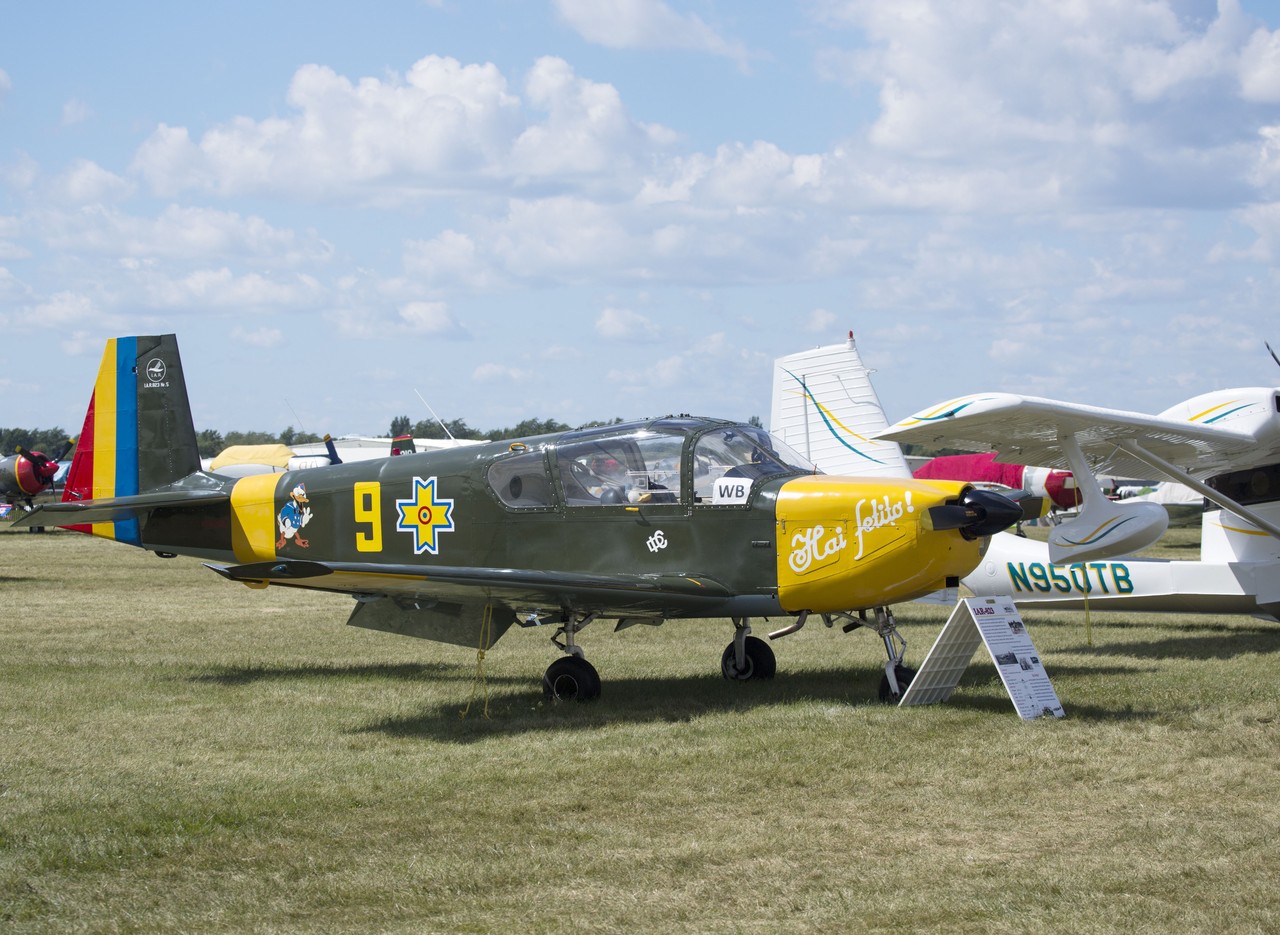
Development and Design
The IAR-823 emerged from Romania's desire to develop indigenous aviation capabilities during the Cold War era. Industria Aeronautică Română designed the aircraft to fulfill multiple roles: primary flight training, armament instruction, liaison duties, and light transport missions. The aircraft's versatility was built into its DNA, with side-by-side seating for instructor and student pilot, plus accommodation for three additional passengers or equivalent cargo weight.
The design philosophy emphasized practicality over innovation. Engineers selected a conventional low-wing monoplane configuration with retractable tricycle landing gear, providing stable handling characteristics essential for training operations. The aircraft incorporated a modified NACA 23012 airfoil across its 15-square-meter wing area, delivering predictable flight characteristics while maintaining aerobatic capability with g-limits of +6 and -3.
Powerplant and Performance
At the heart of the IAR-823 sits a Lycoming IO-540-G1D5 engine, a six-cylinder air-cooled powerplant producing 216 kilowatts. This American engine choice reflected pragmatic engineering decisions, as Lycoming's proven reliability made it ideal for training operations where engine failures could prove catastrophic for inexperienced pilots.
The engine enabled impressive performance figures for an aircraft of this class. Maximum speed reached 310 kilometers per hour at sea level, with a never-exceed speed of 400 kilometers per hour. More importantly for training operations, cruise speed settled at a comfortable 290 kilometers per hour at 60 percent power, allowing instructors ample time to demonstrate maneuvers and correct student errors. The aircraft's stall speed of 98 kilometers per hour with flaps extended provided forgiving low-speed handling.
Range capabilities proved equally impressive, with maximum range extending to 1,800 kilometers when equipped with the standard 360-liter fuel system. This endurance of six hours made the IAR-823 suitable for extended training flights and cross-country liaison missions. The service ceiling of 5,600 meters and climb rate of 7.49 meters per second demonstrated adequate performance for military training requirements.
Military Capabilities
While designed primarily as a trainer, the IAR-823 incorporated provisions for light armament training. Two underwing hardpoints could each carry 100 kilograms of external stores, supporting gun pods or light bombs for weapons training. This capability allowed student pilots to experience the handling characteristics of an armed aircraft without requiring a separate advanced trainer.
The aircraft's robust construction supported its military training role. Maximum takeoff weight of 1,500 kilograms provided a useful load of 600 kilograms, sufficient for fuel, crew, passengers, or cargo as mission requirements dictated. For medical evacuation missions, the cabin could accommodate a stretcher patient and paramedic alongside the pilot.
Production and Service
Production began in the early 1970s, with the first aircraft entering service in 1974. Manufacturing continued through at least 1985, when the final example built for the Romanian Air Club, registered YR-MEL, appeared at the Paris Air Show at Le Bourget. This aircraft represented the civilian variant of the design, demonstrating the type's adaptability beyond military training roles.
The exact production total remains undocumented in available records, though the extended production run suggests steady demand for the aircraft's capabilities. Primary operators included Romanian military flight training units, which used the type for basic pilot instruction and weapons training.
International Recognition
The IAR-823 achieved international recognition through its ICAO designation IR23, classifying it as a fixed-wing, light aircraft in the single-engine piston category. This designation facilitated international operations and demonstrated the aircraft's compliance with global aviation standards.
The appearance of YR-MEL at the 1985 Paris Air Show marked the type's highest-profile international exposure. Aviation enthusiasts noted the aircraft's clean lines and purposeful design, though it never achieved significant export success beyond Romania's borders.
Legacy and Current Status
Today, the IAR-823 maintains a modest following among aviation enthusiasts, particularly in the United States where several examples continue flying. American owners value the type as an "authentic warbird" despite its lack of combat history, appreciating its military heritage and impressive performance capabilities.
The aircraft's legacy reflects Romania's ambitious but ultimately limited aviation industry during the communist era. While never achieving the international success of contemporary trainers from established aviation powers, the IAR-823 demonstrated Romanian engineering capabilities and provided valuable service in its intended roles. Its continued operation decades after production ended testifies to the soundness of its original design and construction quality.