
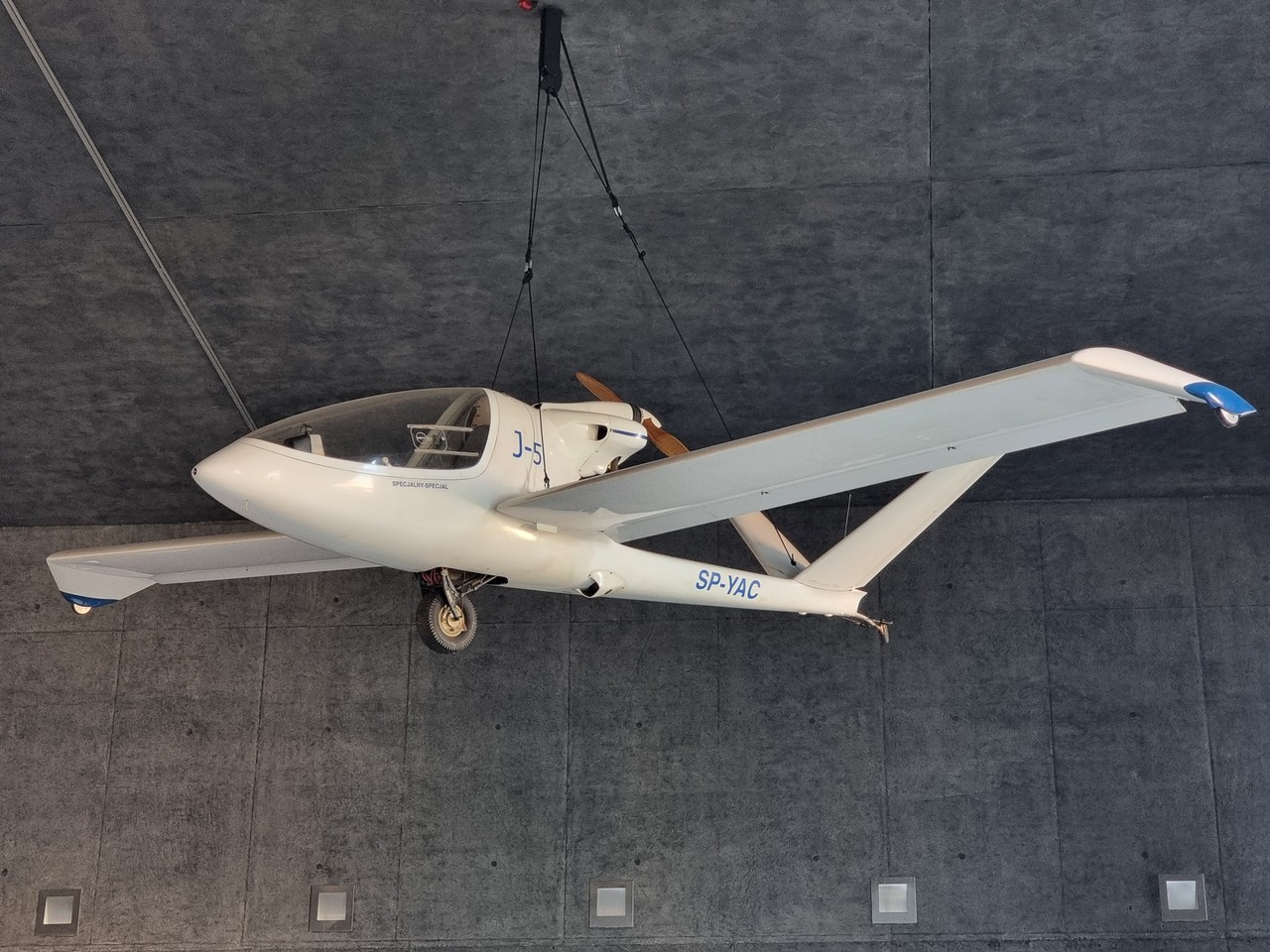
Development and Design Innovation
Jaroslaw Janowski conceived the J-5 Marco as his fifth aircraft design, marking a significant departure from his earlier pod-and-boom pusher aircraft through its revolutionary all-composite construction. Building on sailplane technology principles, Janowski created a motor glider optimized for efficiency and performance in the single-seat category. The design incorporated several groundbreaking features for homebuilt aircraft of the early 1980s, including an all-fiberglass and epoxy composite structure, constant-chord wings with full-span flaperons, mid-chord spoilers, and a jettisonable blown canopy.
The Marco's distinctive configuration placed the pilot in a streamlined pod ahead of straight, high-aspect-ratio wings, with a boom extending aft to support the butterfly V-tail arrangement. This layout, combined with the Wortmann FX67-K170/17 airfoil, delivered exceptional aerodynamic efficiency. The aircraft featured side-stick controls and retractable monowheel landing gear with wingtip stabilizing wheels, though a fixed twin-wheel configuration was also available.
Production and Manufacturing
Production commenced around 1983 at the Marko-Elektronic Factory in Łódź, Poland, continuing through the 1990s. Around 1990, the aircraft division relocated to Kraków and became Alpha, establishing the brand name that would become synonymous with the Marco. Manufacturing expanded internationally through licensing agreements, with Hewa-Technics producing kits and complete aircraft in West Germany, while Alpha/USA handled distribution in the United States.
By 1990, Aviation Farm Ltd had acquired a license to produce assembled aircraft, delivering 20 complete aircraft by 1996 with 29 additional orders in progress. Total production reached approximately 36 aircraft, including both kits and factory-built examples. The international distribution network enabled sales across Europe, the United Kingdom, and the United States, establishing the Marco as one of the more successful European homebuilt designs of its era.
Powerplant and Performance
The standard powerplant was the Italian-German IAME KFM 107ER, a 19-25 kilowatt two-cylinder horizontally opposed two-stroke engine with electric start and belt-driven reduction drive. This 50-pound engine turned a 3-foot 9-inch two-blade propeller, though many operators found the power insufficient for optimal performance. Alternative engines included the 45-horsepower Rotax 447UL two-cylinder inline two-stroke and the Hirth F-23 boxer engine developing up to 50 horsepower.
With its lightweight construction achieving an empty weight of just 364 pounds and maximum takeoff weight of 639 pounds, the Marco delivered impressive performance figures. Cruise speed reached 93 miles per hour, with maximum speeds between 106 and 137 miles per hour depending on engine installation. The aircraft stalled at 48 miles per hour and achieved a service ceiling of 10,010 feet with a climb rate of 596 feet per minute. Range extended to 340 miles, while the glide ratio of 16:1 demonstrated the design's sailplane heritage. The structure was certified for loads of +6/-3 g, enabling aerobatic flight.
Record-Setting Achievement
The Marco gained international recognition through the achievements of French pilot Alain Flottard flying F-WZUE. Between 1990 and 1991, Flottard established multiple FAI Class C-1a/0 records that remain standing today, including various speed records across European routes. These accomplishments demonstrated the Marco's exceptional efficiency and performance potential, validating Janowski's design philosophy of combining sailplane aerodynamics with minimal power requirements.
Military and UAV Applications
While the Marco never served in military combat roles, it found unexpected application in unmanned aerial vehicle development. In 2004, BAE Systems in the United Kingdom modified a standard monowheel J-5 configuration into the HERTI 1D UAV, replacing the piston engine with a turbojet and modifying the canopy area for an air intake. This adaptation served as an early autonomous drone platform, with later HERTI models utilizing the related J-6 Fregata design.
Current Status and Legacy
Production ceased during the late 1990s, with Alpha and its associated companies no longer operating under their original names. At least two examples remain active in the United States, including N491BF operated by Anthony Cirincione in Ten Sleep, Wyoming, which continues flying operations. N305DC, owned by Doug Crane, is undergoing modification as the Crane Fly J-5DC with experimental powerplant concepts.
The Marco's significance extends beyond its production numbers, representing a crucial step in the evolution of composite homebuilt aircraft. Its combination of advanced materials, aerodynamic efficiency, and practical construction methods influenced subsequent light sport aircraft development and demonstrated the viability of high-performance motor gliders in the amateur-built category. The design's adaptation for UAV applications further underscores its fundamental aerodynamic excellence and structural versatility.