
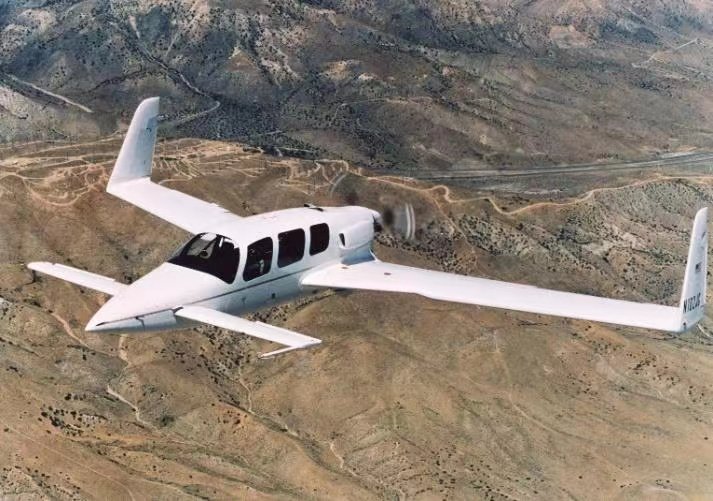
The AASI Jetcruzer was an ambitious attempt to disrupt the business aircraft market with an unconventional design. Development began in 1983 at Aerodynamics and Structures Inc. (later Advanced Aerodynamics and Structures Inc., or AASI) in Long Beach, California. The aircraft was designed as a low-cost transport capable of carrying a pilot and five passengers, targeting niches in corporate travel, medical evacuation, training, and military patrol.
Technically, the Jetcruzer was distinguished by its tailless canard layout and a single rear-mounted pusher turboprop. The program progressed through several iterations. The proof-of-concept Jetcruzer 450, powered by an Allison 250 engine, first flew on January 11, 1989. This was followed by a pre-production Jetcruzer 450 variant powered by a Pratt & Whitney Canada PT6A-27 turboprop (rated at 680 shp), which made its maiden flight in September 1992. The final evolution, the Jetcruzer 500, featured a pressurized cabin and a more powerful Pratt & Whitney Canada PT6A-66A engine flat-rated to 850 shp, driving a five-bladed Hartzell propeller.
Despite significant market interest—including 188 orders totaling over US$226 million from customers in the Middle East and Europe—the aircraft never entered certified series production. AASI attempted to stabilize the program by acquiring the assets of Mooney Aircraft Corp. in April 2002, operating under the Mooney Aerospace Group. However, the program was shelved by 2003 after nearly two decades of development without achieving certification. Only three airframes were ever produced: one proof-of-concept and two prototypes.
Performance projections for the Jetcruzer 450 included a maximum speed of 370 mph, a cruise speed of 360 mph, and a range of 1,701 miles. The Jetcruzer 500 was projected to reach a cruise speed of 555 km/h (300 kt) with a range of 2,593 km. While the original AASI venture ceased operations, the intellectual property was acquired in the 2010s by Jetcruzer International (also known as Jetcruzer Inc.). This California-based company is currently utilizing surviving airframes to develop modern hydrogen-electric and battery-electric propulsion systems, positioning the original design as a precursor to advanced air mobility.