
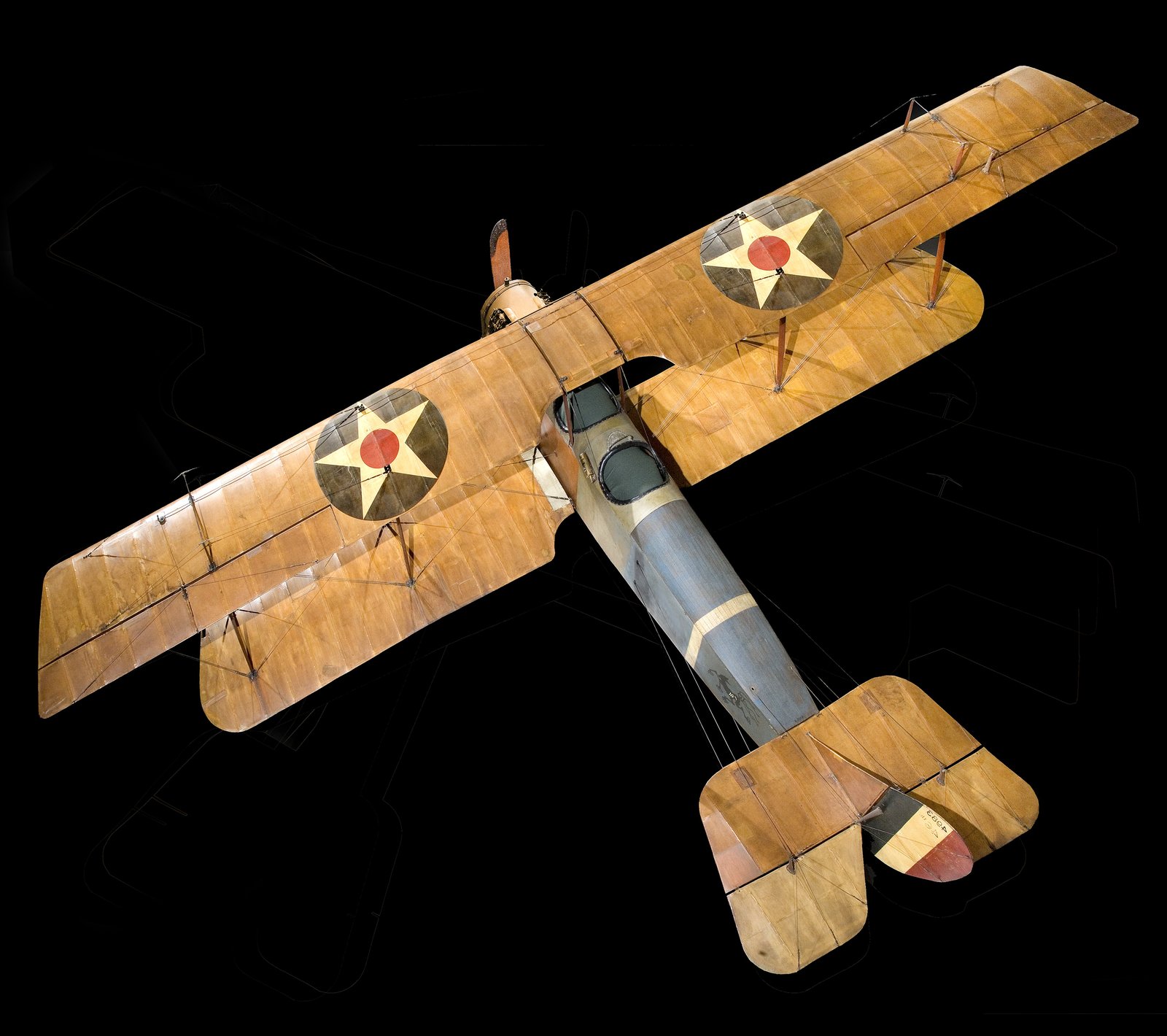
Designed between 1914 and 1915 by a team at the Curtiss Aeroplane and Motor Company, the JN-4 first appeared in 1916. It was the first American aircraft to be mass-produced and purchased in quantity by the U.S. military. Production occurred on a large scale from 1916 through approximately 1919, with some remanufacturing and licensed production continuing into the early 1920s. Total production is estimated at approximately 8,168 aircraft, including 1,260 "Canuck" variants built by Canadian Aeroplanes Ltd. in Toronto for the Royal Flying Corps. U.S. government contracts alone accounted for over 6,000 units, with some estimates suggesting more than 5,500 trainers were produced specifically for these contracts.
The JN-4 was primarily powered by the Curtiss OX-5, a 90-hp water-cooled V-8 piston engine. However, later variants like the JN-4H were up-engined with a more powerful 150-hp Hispano-Suiza V-8, often built under license by Wright-Martin. A significant design milestone was the JN-4D, which was the first U.S. aircraft to feature dual-stick controls, allowing instructors and students to operate the aircraft from tandem open cockpits.
During World War I, the JN-4 was the dominant trainer for the U.S. Army Air Service and U.S. Navy, with 90–95% of American pilots training on the type. Beyond training, it was adapted for reconnaissance, bombing, and ground attack roles. In 1919, a U.S. Marine Corps JN-4 performed the first successful dive-bombing mission during the occupation of Haiti. The aircraft also saw service with the British Royal Navy and Royal Flying Corps.
Following the war, surplus JN-4s became affordable and versatile, fueling the 1920s barnstorming phenomenon. They were used for exhibition flying, aerial photography, and general utility. Notably, the JN-4 was used to inaugurate the first U.S. airmail service in 1918, operating from College Park Airport in Maryland. Legendary aviators such as Amelia Earhart and Charles Lindbergh learned to fly on the JN-4. Today, examples are preserved at the Smithsonian National Air and Space Museum, the EAA Aviation Museum, and the Glenn H. Curtiss Museum.