
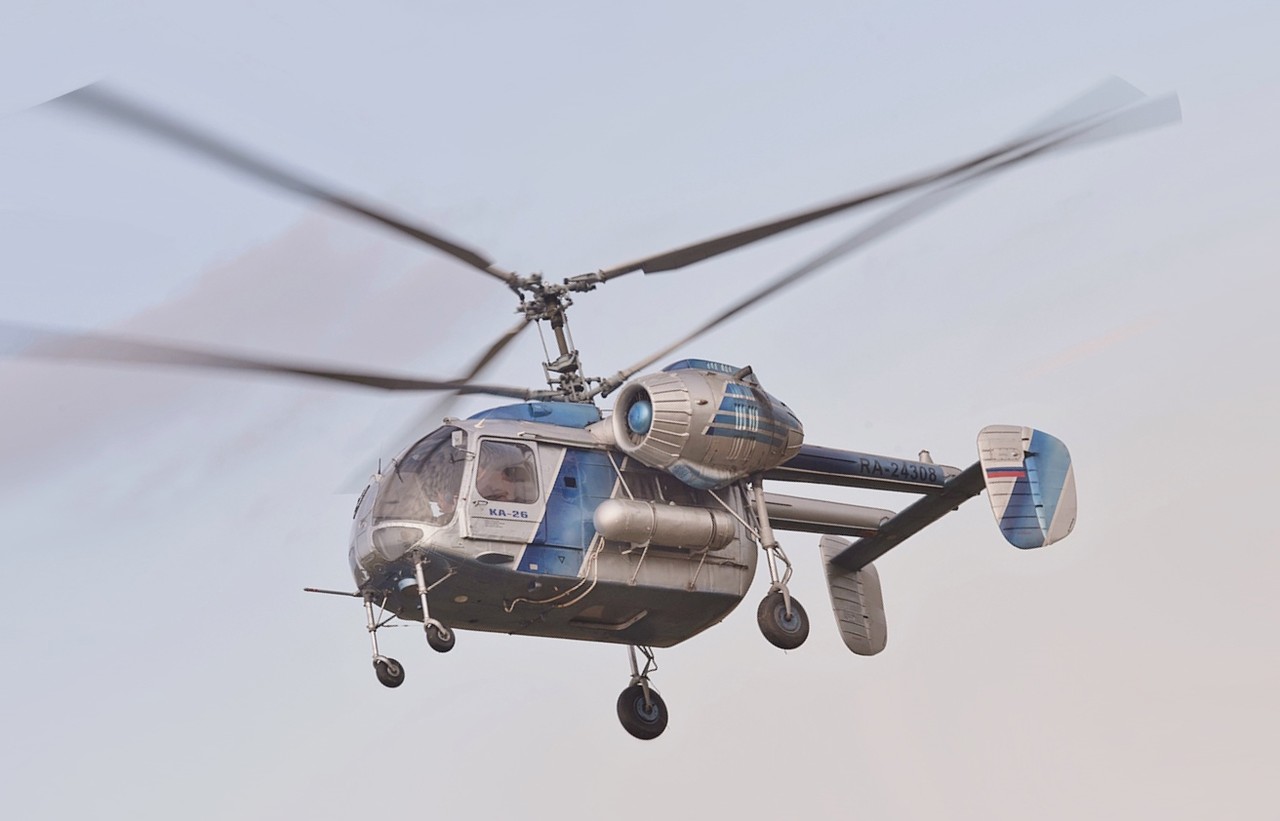
Revolutionary Modular Design
The Ka-26's greatest innovation lay in its modular construction philosophy. Unlike conventional helicopters built for single purposes, Kamov's engineers created a "flying chassis" that could rapidly transform between roles using detachable pods. A single aircraft could serve as a crop sprayer in the morning, convert to an air ambulance by afternoon, and finish the day hauling cargo—simply by swapping standardized modules beneath the fuselage.
This versatility emerged from a specific Soviet government directive issued in January 1964, calling for a multi-purpose helicopter to serve civil aviation needs. Deputy chief designer M.A. Kupfer led the development effort, with Yu.I. Petrukhin as leading designer and V.S. Dordan overseeing flight testing. Their solution placed twin engines in pods at the ends of stub wings, connected to the transmission through flexible drive shafts, leaving the entire center fuselage free for interchangeable equipment.
Production and Global Reach
Production commenced at the Kumertau aircraft plant in 1969, continuing through 1977 with 816 helicopters manufactured. The Ka-26 achieved remarkable international success for a Soviet aircraft, reaching operators in 15 countries including Mongolia and multiple Warsaw Pact nations. Aeroflot, the Soviet state airline, deployed substantial numbers across the USSR's vast territories for everything from Siberian forest firefighting to Arctic ice reconnaissance.
The helicopter's agricultural role proved especially significant. Equipped with 800-liter chemical tanks and spray booms, Ka-26s treated millions of hectares of cropland annually. Forest protection services adopted the type in spring 1972, following successful 1969 trials in Siberia where the aircraft demonstrated its ability to rapidly deploy six firefighters and their equipment to remote forest fires.
Engineering Excellence from Kamov
Nikolai Kamov's design bureau had established itself as the Soviet Union's premier developer of coaxial rotor helicopters, and the Ka-26 represented the culmination of decades of refinement. The characteristic twin-rotor configuration eliminated the need for a tail rotor, improving efficiency and reducing mechanical complexity. Thirteen-meter fiberglass rotor blades provided excellent lift characteristics while maintaining structural durability.
The powerplant selection reflected practical economics over pure performance. Twin Vedeneyev M-14V-26 nine-cylinder radial engines, each producing 325 horsepower, were manufactured by Zaporizhzhia DKB-478 under Alexander Ivchenko's leadership. While critics noted the Ka-26 appeared underpowered compared to turbine-equipped contemporaries, the piston engines dramatically reduced operating costs while still providing triple the payload capacity of earlier Ka-15 helicopters.
Operational Versatility
Pilots appreciated the Ka-26's straightforward handling characteristics and robust construction. The helicopter could accommodate one or two crew members depending on mission requirements, with passenger pods seating additional personnel for transport duties. Medical evacuation variants featured specialized stretcher installations and life support equipment, transforming the aircraft into a flying ambulance capable of reaching remote locations.
Performance specifications reflected the helicopter's utility focus rather than speed records. Maximum velocity reached 170 kilometers per hour with a practical range of 400 kilometers. The 3.2-tonne maximum takeoff weight allowed substantial payload flexibility, whether carrying agricultural chemicals, construction materials, or scientific equipment for geological surveys.
Limited Military Applications
While designed primarily for civilian use, several air forces recognized the Ka-26's potential for support roles. The Hungarian Air Force operated the type for search and rescue missions, though military analysts considered it too light for serious combat applications. The helicopter's quiet operation and ability to land in confined spaces made it valuable for reconnaissance and liaison duties in non-combat environments.
Enduring Legacy
Production ended in 1977, but the Ka-26's influence on helicopter design philosophy continued. The modular concept proved that specialized aircraft could achieve broad utility through intelligent engineering, inspiring subsequent generations of convertible rotorcraft designs.
Today, several Ka-26 helicopters survive in museum collections worldwide. The O.K. Antonov State Aviation Museum in Ukraine preserves two examples: aircraft USSR-24064 with passenger configuration and a 1977-built helicopter displaying agricultural spray equipment. The Helicopter Museum maintains DDR-SPY, a 1973 example, while the Kyiv Aviation Institute uses a 1968-built passenger variant for training purposes.
The Ka-26 stands as proof that innovative design philosophy can overcome technical limitations, creating aircraft that serve far beyond their original specifications through adaptability and robust engineering.