
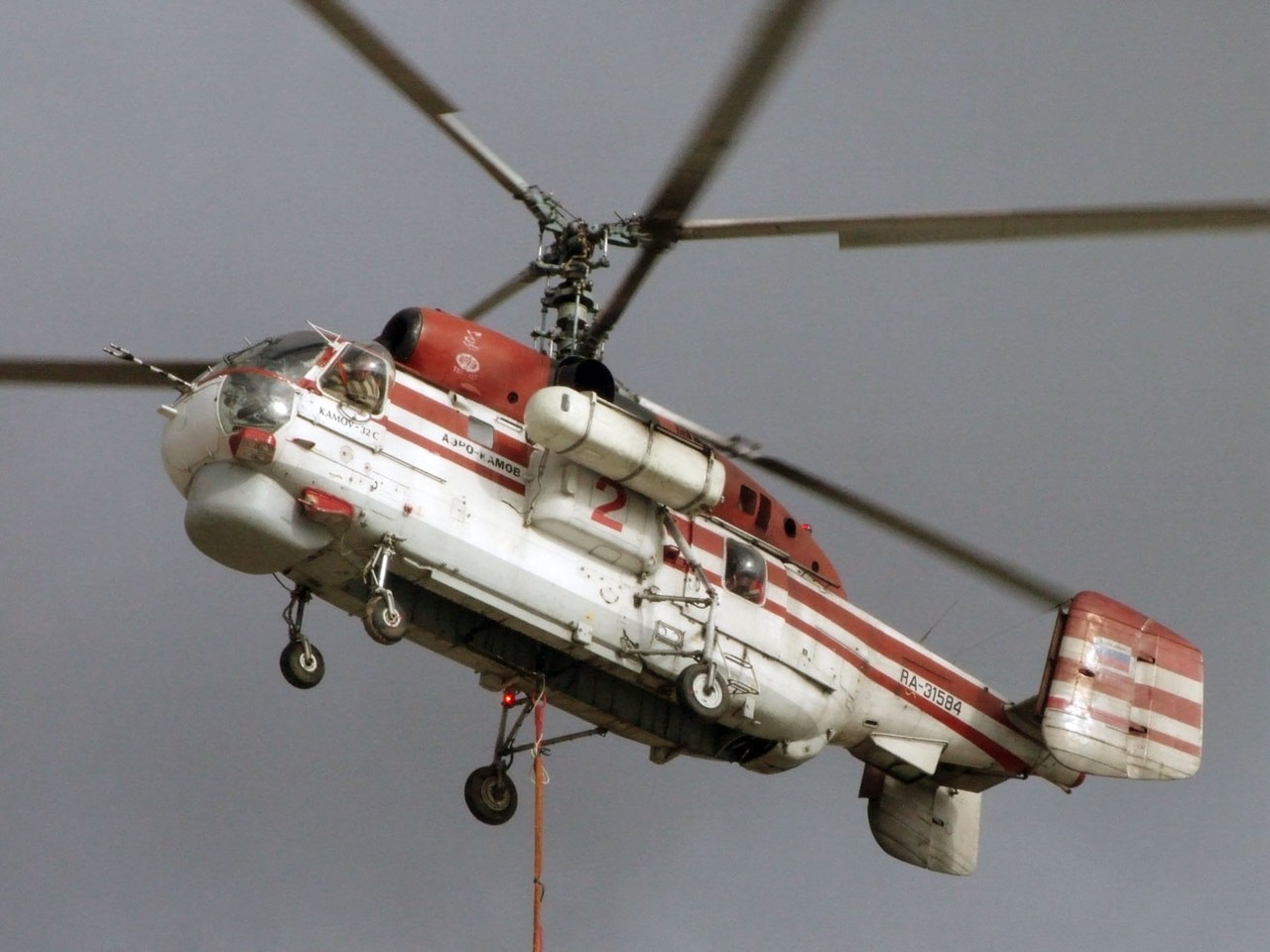
Revolutionary Coaxial Design
The Ka-32A emerged from the Kamov Design Bureau's bold vision to adapt military helicopter technology for civilian markets. Led by the design principles established by Nikolai Il'ich Kamov, the aircraft represented a civilian derivative of the successful Ka-27 naval helicopter. Development began in 1969, with the experimental prototype achieving first flight on December 24, 1973, piloted by E.I. Laryushin. The serial prototype followed on October 8, 1980, while the definitive Ka-32A variant took to the skies in September 1990.
Manufacturing Excellence
JSC KumAPP (Kumertau Aviation Production Plant) in Kumertau, Bashkortostan, launched mass production in 1985, with the cargo-focused Ka-32T entering serial production in 1986 and the search-and-rescue Ka-32S variant following in 1987. By 2006, approximately 160 units across various modifications had rolled off the production line, with total historical production reaching 188 aircraft including prototypes. The facility continues operations today, exclusively manufacturing the Ka-32A11BC variant since 2011. In 2013, an agreement with China's Yitong Corporation opened possibilities for international assembly operations.
Powerplant and Performance
Two Klimov TV3-117VMA or VK-2500PS-02 turboshaft engines, each delivering 2,400 horsepower, provide the Ka-32A with exceptional lifting capability. These engines, manufactured by Klimov as part of the United Engine Corporation, represent decades of refinement in the TV3-117 family, which has powered thousands of Soviet and Russian helicopters since the 1970s. The modular design enables rapid maintenance even in extreme Arctic conditions, while delivering the power necessary for the helicopter's impressive 5,000-kilogram external load capacity.
The aircraft achieves a maximum speed of 230 kilometers per hour, with a cruise speed of 200 kilometers per hour and an endurance of 3 hours and 10 minutes. Its 2,456-liter fuel capacity supports a consumption rate of 704 liters per hour during typical operations.
Global Service Record
The Ka-32A earned international recognition through diverse operational roles across six continents. In Canada, Vancouver Island Helicopters employed the type for demanding logging operations, while European operators including Germany's Helog and Switzerland's HeliSwiss utilized its heavy-lift capabilities. The helicopter proved particularly valuable in firefighting roles across Spain and Portugal, where operators capitalize on its 4-5 ton water-carrying capacity.
Russia's Ministry of Emergency Situations and Moscow police became major domestic operators, alongside early adoption by Aeroflot and Vladivostok Avia. International expansion included operations in Taiwan, Papua New Guinea through Heli Niugini for offshore support, Myanmar, South Korea, Japan, China, Indonesia, and Austria.
Military Applications
While primarily civilian-focused, the Ka-32A found limited military application through seven Ka-32A4 variants delivered to the Republic of Korea Air Force between 2004 and 2006. Designated HH-32A for search-and-rescue missions, these aircraft featured Israeli IAI Lahav avionics systems, representing the type's only significant military adaptation.
Certification Achievements
The Ka-32A11BC variant achieved a milestone in October 2009 by securing European Aviation Safety Agency (EASA) certification, opening European Union markets to the coaxial helicopter design. Earlier Russian and AP-29 certification in June 1993 had established the foundation for international operations. These certifications validated the aircraft's compliance with rigorous civilian aviation standards, including FAA FAR Part 29 requirements.
Operational Capabilities
The helicopter's coaxial rotor system provides unique advantages in confined area operations, eliminating tail rotor hazards while maximizing lift efficiency. Standard passenger configuration accommodates 14 travelers, expandable to 18 in high-density arrangements, while cargo operations support 3,500 kilograms internally. The design proves particularly effective in Arctic conditions, demonstrated through early operations supporting nuclear icebreaker Sibir in 1978.
Contemporary Status
Over 140 Ka-32 family helicopters remain operational worldwide, testament to the design's durability and operational effectiveness. Production continues with ongoing development, including a new prototype featuring VK-2500PS-02 engines that achieved first flight on November 15, 2021. The aircraft's legacy centers on successfully bridging military coaxial rotor technology to global civilian utility markets, establishing new standards for heavy-lift helicopter operations in extreme environments since the 1980s.