
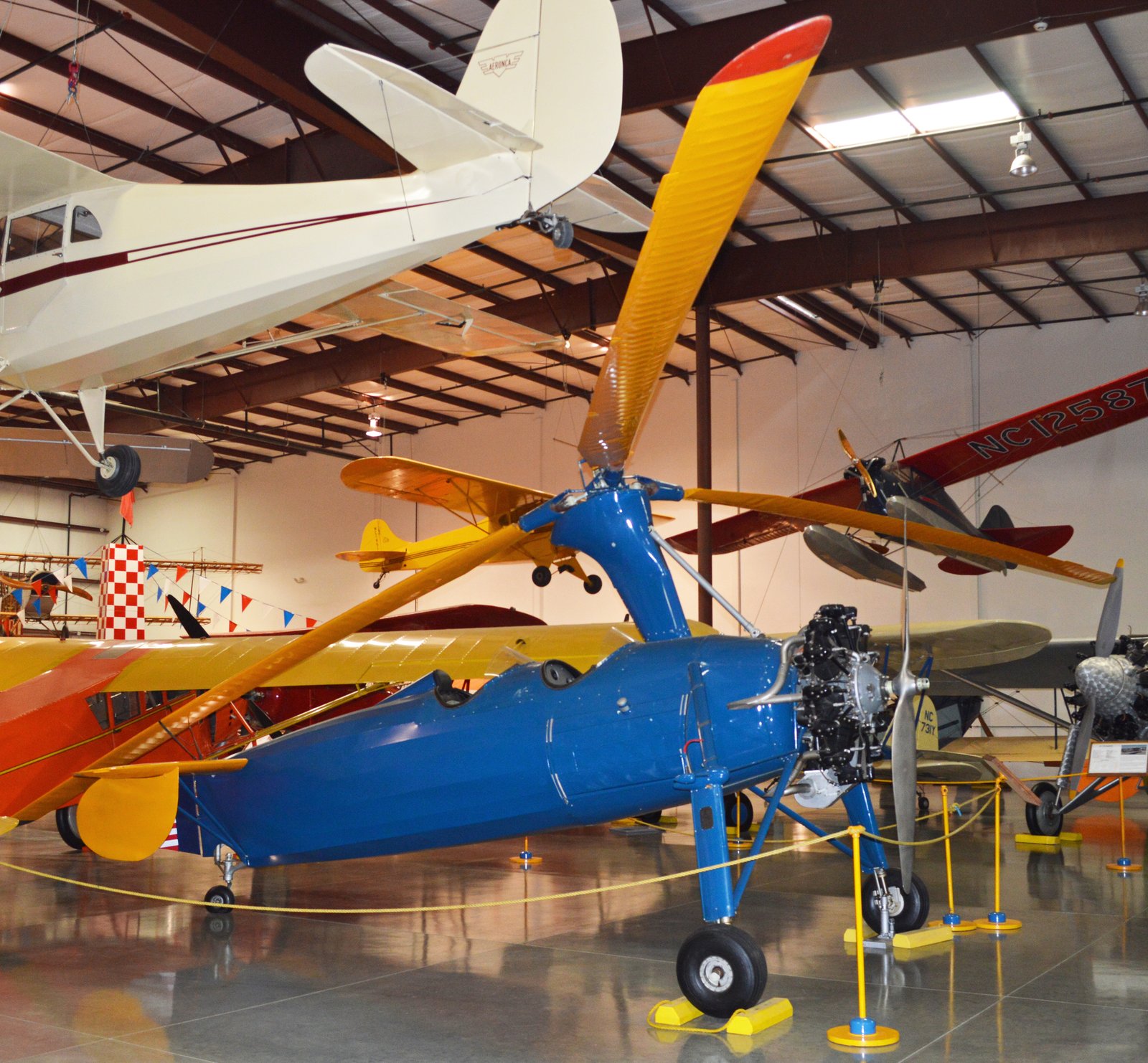
The Kellett KD-1 was a significant milestone in American rotary-wing aviation, developed by the Kellett Autogiro Company of Philadelphia, Pennsylvania. Founded in 1929, the company initially focused on licensed Cierva autogiro designs. The KD-1 emerged in late 1934, with the company announcing the KD-1/KD-1 model around 1935. While only one base KD-1 was produced, the design served as the foundation for several critical military and commercial variants.
Engineered by Kellett staff who studied the British Cierva C.30 in Europe, the KD-1 was a direct-control autogiro. Its design was characterized by a lack of traditional wings, utilizing a direct-control rotor system for maneuverability. The aircraft featured tandem open cockpits and a fixed tailwheel landing gear. Power was provided by a 225 hp Jacobs radial piston engine (identified as either the L4MB7 or L4MA7), which drove a fixed-pitch Curtiss-Reed propeller.
In 1935, the U.S. Army acquired a KD-1 for evaluation, designating it as the YG-1. This initial acquisition led to further development, including the YG-1A, which was equipped with additional radio gear, and a production run of seven YG-1B aircraft. The military's interest in the type continued into 1942, when seven more autogiros were purchased for observation roles under the XO-60 designation.
Beyond military use, the KD-1B variant entered the commercial sector via Eastern Air Lines. This version featured several upgrades over the original, including an enclosed cockpit, radio equipment, a landing light, and blind-flying instruments. On July 6, 1939, Eastern Air Lines used the KD-1B to launch the first scheduled rotary-wing air-mail service in the United States, operating flights between Philadelphia’s main Post Office and Camden Central Airport in New Jersey. The KD-1B achieved a maximum speed of 125 mph (201 km/h).
The legacy of the KD-1 is defined by its role as a proof-of-concept for practical rotary-wing operations in both government and commercial sectors. The Kellett Autogiro Company continued its operations until 1950, at which point it ceased aircraft design and manufacturing to focus on expanding its production facilities.