
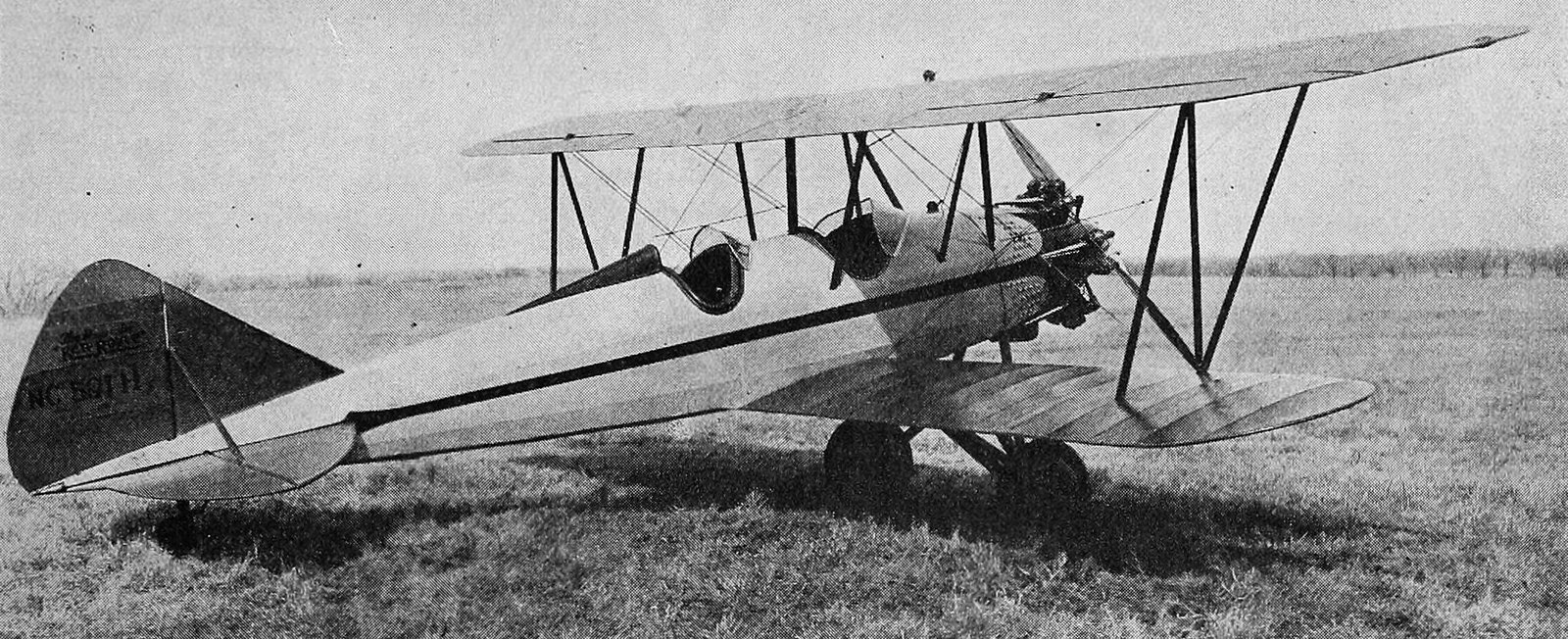
The Rearwin 2000 Ken-Royce was a three-seat sport and touring biplane that served as the first aircraft produced by Rearwin Airplanes Inc. The company was founded in 1928 by Rae A. "R. A." Rearwin in Salina, Kansas. The Ken-Royce first flew in 1929 and was designed to offer a blend of sport performance and touring comfort, featuring a single-bay, strut-braced biplane configuration with staggered wings and a fixed tailwheel undercarriage. The aircraft accommodated one pilot and two passengers seated in tandem.
Production of the Ken-Royce took place in small numbers, totaling seven airframes. The initial version, the Rearwin 2000/2000-C, consisted of one prototype and three production aircraft, all powered by a 180 hp Curtiss Challenger air-cooled radial engine. A subsequent variant, the 2000-CO, utilized a 170 hp Continental A-70 radial engine; this version included one prototype and two production aircraft. Manufacturing began in Salina, Kansas, before moving to Fairfax Airport in Kansas City, Kansas.
In civil service, the Ken-Royce was used by private owners for general aviation and sport flying. Notably, aircraft NC400V participated in the 1930 Ford National Reliability Air Tour, which helped promote the design. Military use was extremely limited, with the Honduran Air Force ordering a single Ken-Royce in 1937. There is no documented evidence that this aircraft, or any other 2000-series airframe, was used in combat operations.
Typical performance figures for the type include a maximum speed of 130–135 mph, a cruise speed of 107 mph, and a minimum control speed of 45 mph. The aircraft had a service ceiling of 24,000 ft, a rate of climb of 1,000 ft/min, and a range of 550 miles.
Rearwin Airplanes Inc. continued to evolve, acquiring the LeBlond Aircraft Engine Department in 1937 and renaming it Ken-Royce Motors. However, the original aircraft company ceased to exist as an independent manufacturer in the mid-1940s when its assets became Commonwealth Aircraft. Today, only one Ken-Royce 2000-C is known to survive; it is currently under restoration at the Pioneer Flight Museum in Kingsbury, Texas.