
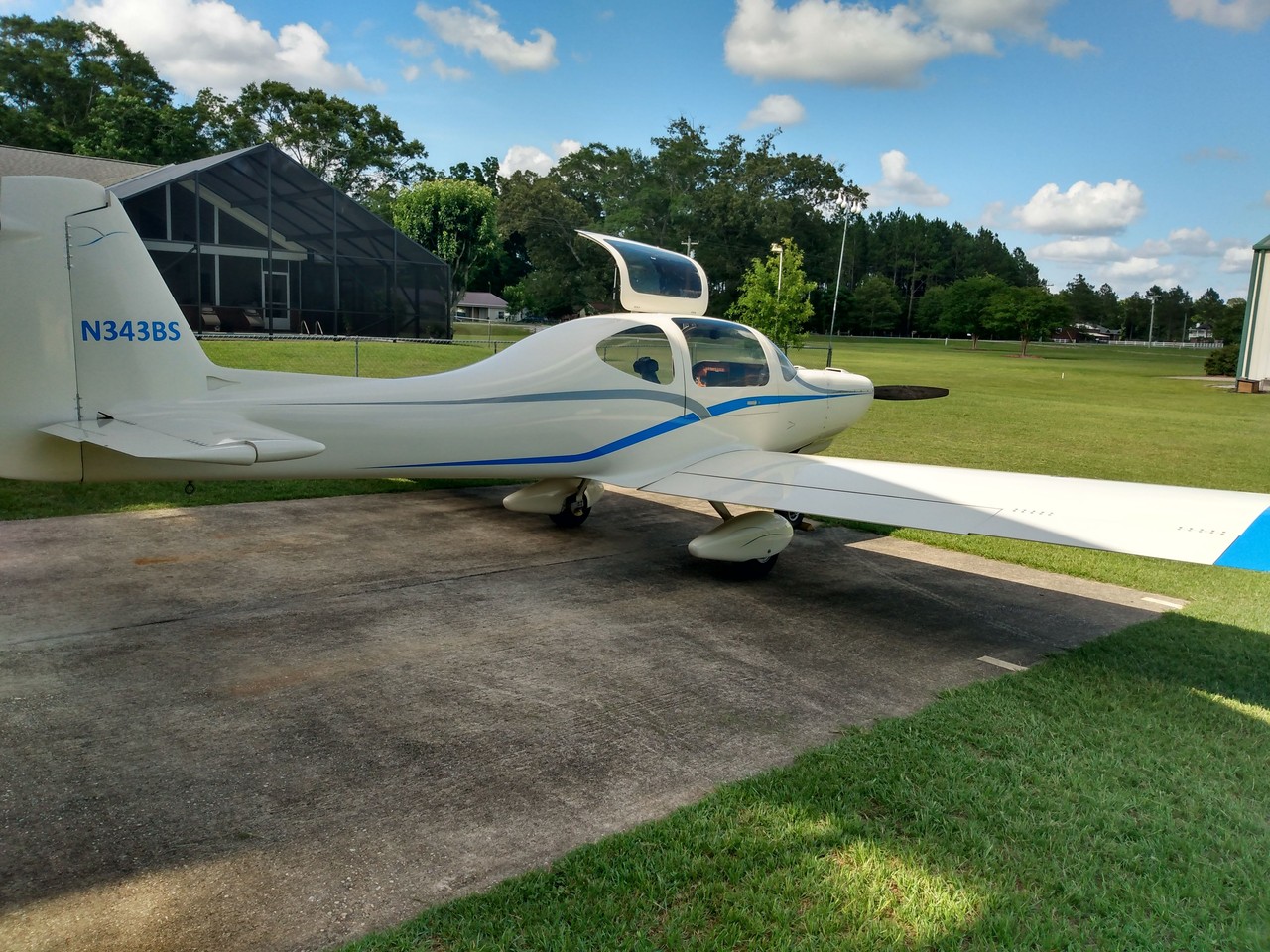
Design Philosophy and Development
Richard Trickel founded Tri-R Technologies in the early 1990s with a revolutionary concept: make composite aircraft construction accessible to amateur builders through his "Keep It Simple Stupid" philosophy. After gaining experience manufacturing composite subassemblies for established companies like Lancair and Berkut, Trickel developed his own aircraft series beginning with the two-seat KIS TR-1 in 1991.
The four-seat TR-4 Cruiser evolved directly from the TR-1's success, making its debut at the 1994 Oshkosh AirVenture. Trickel's team demonstrated the design's buildability when one builder and two associates completed a prototype in just 75 days, proving the KIS concept worked for larger aircraft.
Construction Innovation
The TR-4 revolutionized homebuilt construction through its sophisticated yet simplified composite techniques. The aircraft featured all-composite construction using high-temperature epoxy resin pre-impregnated fiberglass reinforced with carbon fiber and honeycomb core structures, all vacuum-bagged for professional results. This represented a significant advancement over traditional aluminum construction methods available to homebuilders.
The wing design utilized a thick constant-chord configuration that simplified manufacturing while providing excellent structural integrity. Dual gull-wing doors provided convenient cabin access, while fixed tricycle landing gear reduced complexity and maintenance requirements compared to retractable systems.
The Manufacturer
Tri-R Technologies operated from Oxnard, California, from the early 1990s until 2001. Richard Trickel's company focused exclusively on the homebuilt market, producing approximately 60 TR-4 kits during its seven-year production run. The company had sold around 140 total kits across all KIS models by the end of 1998.
In 2001, Tri-R Technologies sold the TR-4 program to Pulsar Aircraft Corporation of El Monte, California. Pulsar developed several variants but eventually ceased operations, ending all production and support for the design. No current manufacturer produces the TR-4, and parts support remains limited.
Engine and Performance
The standard TR-4 Cruiser utilized the 180-horsepower Lycoming O-360 four-cylinder horizontally-opposed engine, a proven powerplant that entered production in 1955 with over 60,000 O-360 series engines manufactured. Alternative engine options included the 160-horsepower Lycoming O-320 and the 210-horsepower Continental IO-360.
The Super Cruiser variant featured the Continental IO-360 with a constant-speed propeller, stronger nose gear, and enhanced performance capabilities. This configuration delivered the aircraft's maximum speed of 185 mph and cruise speeds between 165-175 mph.
Performance specifications included a service ceiling of 17,000 feet, climb rate of 1,200 feet per minute, and range capabilities between 700-1,065 nautical miles depending on configuration. The aircraft required takeoff runs of 1,900 feet and landing distances of 1,350 feet, making it suitable for most general aviation airports.
Pilot Experience
Pilots appreciated the TR-4's docile handling characteristics and spacious four-seat cabin layout. The aircraft's stall speed of 55 mph provided comfortable approach speeds, while the fixed landing gear eliminated the complexity of retractable systems. The composite construction resulted in smooth external surfaces that contributed to the aircraft's impressive cruise performance.
The wing loading of 17.78 pounds per square foot provided stable flight characteristics suitable for family transportation. With an empty weight of 1,200 pounds and maximum gross weight of 2,400 pounds, the TR-4 offered a useful load of 1,200 pounds including its 43-gallon fuel capacity.
Global Operations
While most TR-4s operated in the United States, the design attracted international builders. Notable examples include three aircraft registered in New Zealand: ZK-TEL (construction number 4017) completed its first flight on March 3, 1999, built by Roger Ramsay, Peter Elwood, and Geoff Sheehan. ZK-TUF (construction number 44) was registered to Laurie N. Tuff on April 10, 2000, with first flight occurring ten days later.
ZK-PLN (construction number 4009) represents the aircraft's international appeal, originally built in South Africa by David P. Bullen-Smith and registered as ZU-BLN on December 22, 1997, before importation to New Zealand on April 24, 2004.
Legacy and Current Status
As of 2015, at least three TR-4s remained airworthy in New Zealand, though the global total of active aircraft remains unknown. FlightAware continues tracking the KIS4 type code, indicating ongoing private operations worldwide. The aircraft's significance lies not in production numbers but in its pioneering role advancing composite construction techniques for amateur builders.
The TR-4's legacy continues influencing modern homebuilt aircraft design, proving that sophisticated composite construction could be simplified for amateur builders without sacrificing performance or safety. Despite production ending over two decades ago, the KIS philosophy established by Richard Trickel continues inspiring homebuilt aircraft developers seeking to balance performance, buildability, and affordability.