
Service History
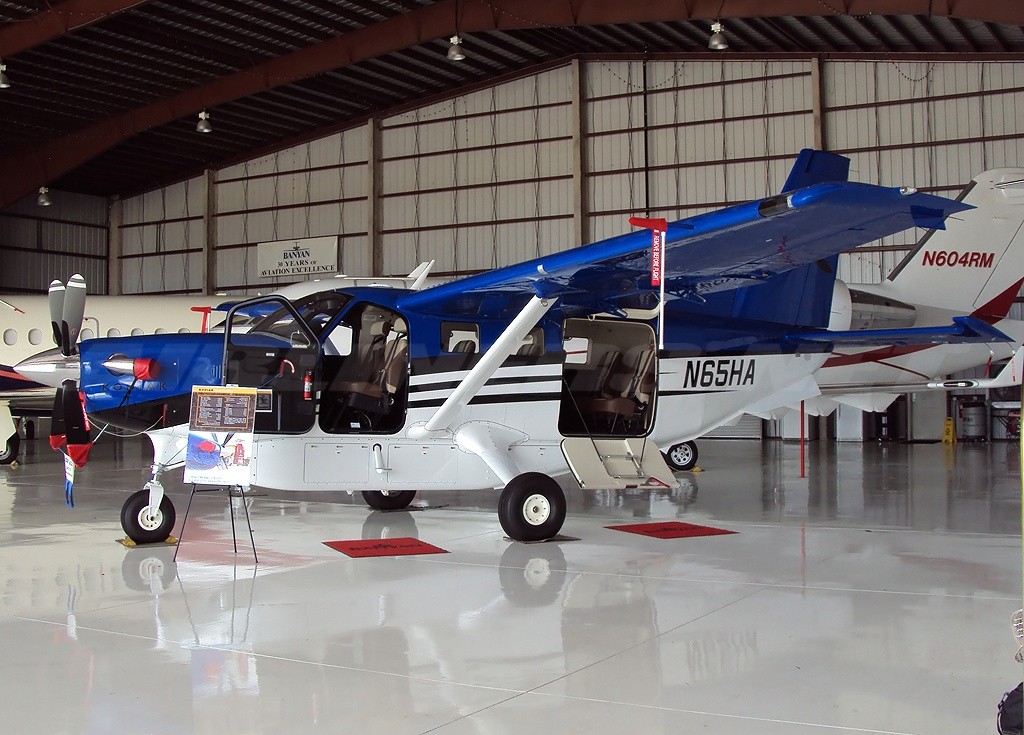
The Kodiak 100 revolutionized humanitarian aviation by providing capabilities that surpassed the aging de Havilland Otter fleet. By 2021, the 300 aircraft delivered had accumulated more than 278,700 flight hours, demonstrating the type's reliability in demanding operations. Approximately 50 percent of the fleet operates within the United States, while the remainder serves overseas missions in challenging environments worldwide.
Mission Aviation Fellowship and JAARS became early adopters, utilizing the aircraft's exceptional short-field performance for remote airstrip operations. The Quest Mission Team program sells one in every 11 aircraft at cost to humanitarian organizations, significantly expanding access to isolated communities. Spirit Air became the first commercial customer in January 2008, followed by charter operators who appreciated the aircraft's versatility and modern avionics.
The Manufacturer
Quest Aircraft Company originated from Idaho Air Group, established in 1998 by Tom Hamilton and David Voetmann. The founders formally created Quest in 2001 with the specific mission of developing a rugged STOL aircraft for humanitarian operations. The company constructed a 27,000 square foot manufacturing facility in Sandpoint, Idaho, in 2002 and grew to employ 184 workers by 2015.
Ownership of Quest changed hands twice during the 2010s. Japan's Setouchi Holdings, previously a Kodiak dealer, acquired the company in February 2015. French aerospace manufacturer Daher purchased the operation in June 2019, renaming it Kodiak Aircraft Company. Daher, a top-10 business aircraft manufacturer that also produces aerospace components for Airbus and Boeing, continues production today at the original Idaho facility.
Engine & Technical Innovation
The PT6A-34 turboprop engine provides the Kodiak's exceptional performance characteristics. This powerplant, flat-rated at 750 shaft horsepower in ISA+7°C conditions, drives a 96-inch Hartzell constant-speed reversible propeller. The PT6 series, first produced in 1963, has accumulated over 55,000 units across all variants, establishing an exceptional reliability record with few in-flight failures.
Quest's design team incorporated several innovations that distinguished the Kodiak from competitors. The aluminum construction provides durability while maintaining reasonable weight, enabling a useful load of 3,530 pounds at the maximum takeoff weight of 6,750 pounds. Standard Garmin G1000 avionics, later upgraded to G1000 NXi in the Series II variant introduced in 2018, provided modern flight management capabilities previously unavailable in utility aircraft.
The aircraft's ability to operate on floats without modifications expanded its operational envelope significantly. This versatility, combined with the 4,000-hour inspection interval of the PT6A-34 engine, reduced operational costs compared to previous-generation aircraft.
Performance Characteristics
Pilots praise the Kodiak's forgiving handling characteristics and impressive short-field performance. The aircraft achieves takeoff distances of less than 700 feet at maximum gross weight, with some operators reporting even shorter ground rolls under favorable conditions. Initial climb rates exceeding 1,500 feet per minute allow rapid clearing of obstacles near short airstrips.
Cruising at 170 knots, the Kodiak provides respectable speed while maintaining fuel efficiency. The aircraft carries 1,200 pounds of fuel in its 320-gallon capacity tanks, providing substantial range for remote operations. External baggage compartments offer 248 cubic feet of additional storage capacity, though weight is limited to 62 pounds in this configuration.
Production Evolution
FAA certification came on May 31, 2007, with first delivery occurring in January 2008. Production milestones include delivery of the 100th aircraft to Sunstate Aviation in September 2013, followed by the 200th aircraft in December 2016 during a record production year of 36 units. The 250th aircraft rolled off the Sandpoint production line in 2018.
Daher introduced the Series III configuration in 2021 with modernized systems and interior options. The company expanded the product line with the Kodiak 900, which received certification in 2022 following its first flight on February 28, 2020. This larger variant consumes 58 gallons per hour compared to the Kodiak 100's 45 gallons per hour fuel burn.
Legacy and Current Operations
All 300 aircraft delivered by 2021 remain airworthy, testament to the type's recent introduction and robust construction. The highest-time aircraft had exceeded 5,000 flight hours by 2018, while experienced pilot Mark Brown has logged approximately 8,000 hours in the type across multiple aircraft.
Production continues at approximately three aircraft per month under Daher ownership. Recent aircraft command prices between $1.5 and $1.91 million, positioning the Kodiak as a premium utility aircraft. The type has successfully filled the niche previously occupied by the de Havilland Otter, production of which ended in 1967 after 466 examples. This modern turbine-powered successor provides the reliability and performance required for 21st-century humanitarian and commercial operations in the world's most challenging environments.