
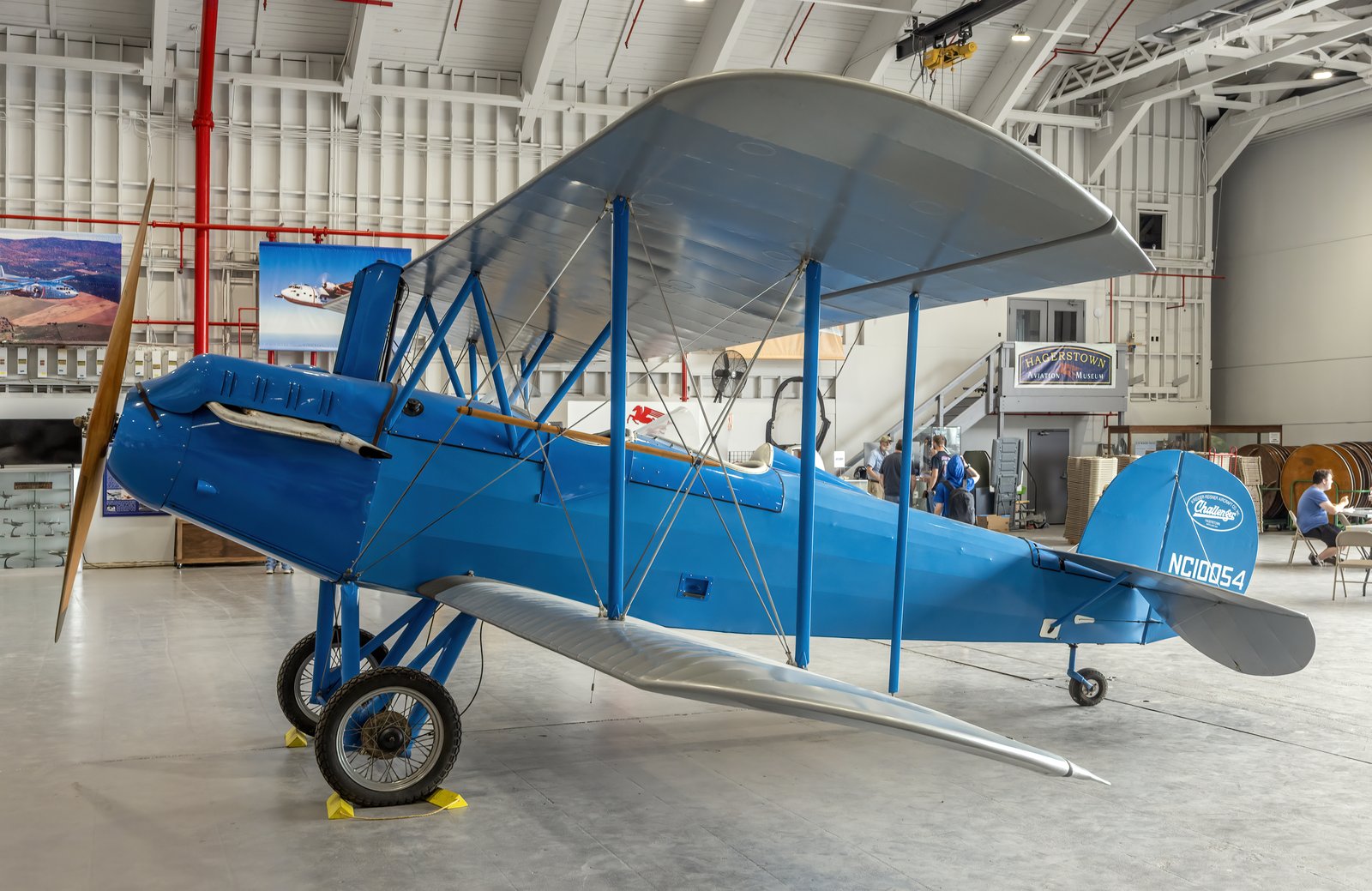
The Fairchild KR-21 was a small, two-place open-cockpit sport and training biplane developed during the transition of the American light-aircraft industry in the late 1920s. The aircraft was originally designed and produced by the Kreider-Reisner Aircraft Company in Hagerstown, Maryland. A prototype of the KR-21 first appeared at the end of 1928, and the type certificate for the aircraft was officially issued on August 26, 1929. Following the acquisition of Kreider-Reisner by Fairchild Aircraft in 1929, the model continued to be produced in Hagerstown under the Fairchild Airplane Manufacturing Corp., often marketed as the Fairchild KR-21 or simply the Fairchild 21.
In terms of production, the KR-21 was not a high-volume aircraft, with approximately 46 units built. Production records and surviving aircraft, such as serial number 1011 (NC107M), indicate that series production spanned roughly 1929 to 1930. The design is characterized by its sturdy construction and refined lines, featuring tapered wings in the Kreider-Reisner "C-6" style and fixed tailskid landing gear. While the specific lead designer is not documented, the aircraft is attributed to the design staff of the Kreider-Reisner Aircraft Company.
The KR-21 was powered by air-cooled five-cylinder radial piston engines manufactured by Kinner. Early versions of the aircraft utilized 90 hp engines, while other examples, such as NC107M, were equipped with 100 hp Kinner engines. Later upgrades included the Kinner B-5 engine, which produced 125 hp. With the B-5 engine, the KR-21 achieved a maximum speed of 105 mph and a cruise speed of 90 mph. The aircraft measured 21 feet 6 inches in length with a wingspan of 28 feet 3 inches.
Primarily used for civil sport flying and flight training, the KR-21 saw no formal military or wartime service. However, it is linked to a significant aviation tragedy: on March 12, 1930, Canadian World War I ace Major William George Barker VC was killed while performing a demonstration flight in a KR-21 (serial 1021, registration CF-AKR) at Rockcliffe Air Station near Ottawa. Today, the KR-21 is remembered as a standout example of early American craftsmanship, with a restored 1930 model (NC235V) preserved in the Caldwell Collection.