
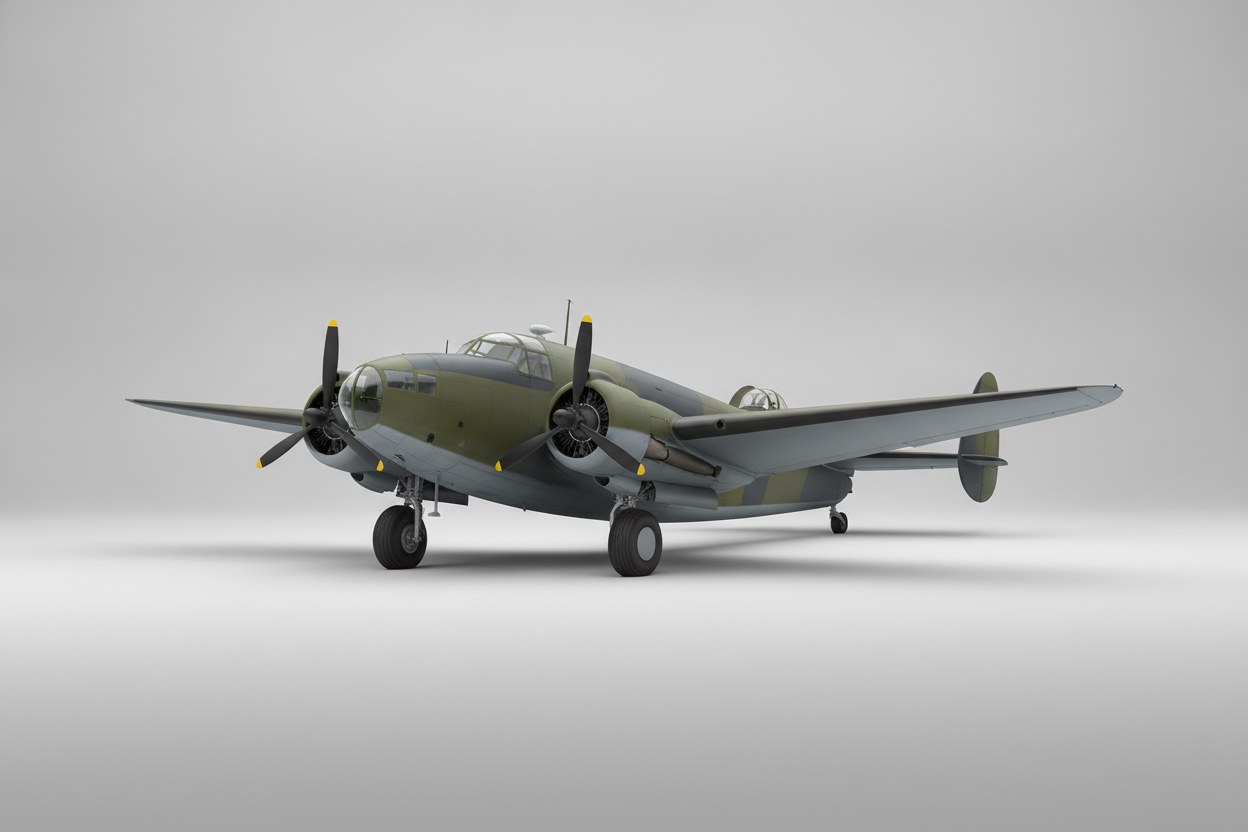
Service History
The Hudson series dominated RAF Coastal Command operations from 1939 through 1945, representing Lockheed's first major military contract and a crucial lifeline for Britain's maritime defense capabilities. When alternative patrol aircraft production lagged behind wartime demands, the Hudson filled the gap with over 2,500 units delivered across all variants. The initial RAF contract signed on June 23, 1938, called for 175 aircraft expandable to 250, with Lockheed delivering the first 250 units seven and a half weeks ahead of the December 1939 deadline.
Wartime Operations
The Model 414-MKIII served extensively in World War II primarily as a light bomber and coastal reconnaissance platform with RAF Coastal Command beginning in mid-1939. Beyond the RAF, operators included the Royal Australian Air Force, Royal Canadian Air Force, US Army Air Forces (designated A-28/A-29 and C-56/57/59/60/66), US Navy (PBO-1), US Coast Guard (R2O/R3O), and the Argentine Navy. The aircraft proved particularly valuable in Battle of the Atlantic anti-submarine operations, where its 2,000-mile range and maritime patrol capabilities helped close coverage gaps in Allied convoy protection.
Notable variants included the Hudson Mk III with Wright GR-1820-G102A engines, the Mk IV featuring Pratt & Whitney R-1830-45S powerplants, and the Mk V equipped with R-1830-S3C4-G engines. Licensed production occurred internationally, with Japan's Kawasaki producing 55 units and Tachikawa manufacturing 64 additional L-14 variants for Japanese Army Air Force service starting in 1940.
The Manufacturer
Lockheed Aircraft Corporation, founded in 1926 by Allan and Malcolm Lockheed, established its reputation as a major military contractor through the Hudson program. Operating from their primary facility in Burbank, California, the company rapidly expanded its workforce to meet Hudson production demands, with additional parts assembly subcontracted to Rohr Aircraft Corporation in San Diego to accelerate output. The Hudson contract marked a turning point for Lockheed, transforming it from a relatively small aircraft manufacturer into a significant defense industry player.
The company evolved through several corporate incarnations, merging with Vega Aircraft in 1934, becoming Lockheed Corporation in 1977, and finally merging with Martin Marietta in 1995 to form Lockheed Martin. Today, Lockheed Martin Aeronautics continues as one of the world's largest aerospace and defense contractors.
Engine & Technical Innovation
The Model 414-MKIII Hudson variants utilized different Pratt & Whitney R-1830 Twin Wasp configurations depending on the specific mark. The Mk IV employed R-1830-SC3G engines, while the improved Mk V featured R-1830-S3C4-G (R-1830-61) powerplants. These air-cooled, supercharged, two-row 14-cylinder radial engines displaced 1,829.4 cubic inches and featured a 6.7:1 compression ratio, generating between 1,000 and 1,200 horsepower through Hamilton-Standard propellers.
Design leadership came from Clarence L. "Kelly" Johnson, who headed the team responsible for converting the 14-seat civil Super Electra into an effective military platform. Key innovations included high wing loading design, massive Lockheed-Fowler flaps, NACA 23018/23009 airfoils, single main spar construction using 24SRT duralumin, and the integration of military equipment including nose, dorsal, and ventral gun positions armed with .303 machine guns.
Performance Characteristics
The Hudson's operational capabilities centered on its maritime patrol mission requirements, with a maximum speed reaching 300 mph and service ceiling of 25,000 feet. Its 2,000-mile range proved essential for extended ocean patrols, while the internal bomb bay accommodated up to 1,000 pounds of ordnance. The aircraft required a crew of four to five, typically including pilot, navigator/bombardier, radio operator, and gunner positions.
The prototype Hudson (designated B-14L) completed its maiden flight on December 10, 1938, from Union Air Terminal in Burbank, with RAF Squadron Leaders James Addams and Randle at the controls. Following successful trials, deliveries commenced on February 15, 1939, just months before Britain's entry into World War II.
Production Legacy
While exact production figures for the specific Model 414 designation remain unclear within broader Hudson series documentation, the overall program totaled approximately 2,500 units manufactured primarily between 1938 and 1941. The Hudson's rapid development and deployment demonstrated the feasibility of converting successful civil aircraft designs for military use, establishing a pattern that would influence wartime production throughout the conflict.
Today, no Hudson aircraft remain in flying condition, with most examples retired shortly after World War II ended. Notable museum displays include Hudson Mk IIIA A16-199 (construction number 414-6464, built September 1942) at the RAF Museum Hendon in England. The Hudson's historical significance extends beyond its operational record, representing a crucial bridge between peacetime aviation development and wartime production capacity that helped sustain Allied operations during the conflict's most critical early phases.