
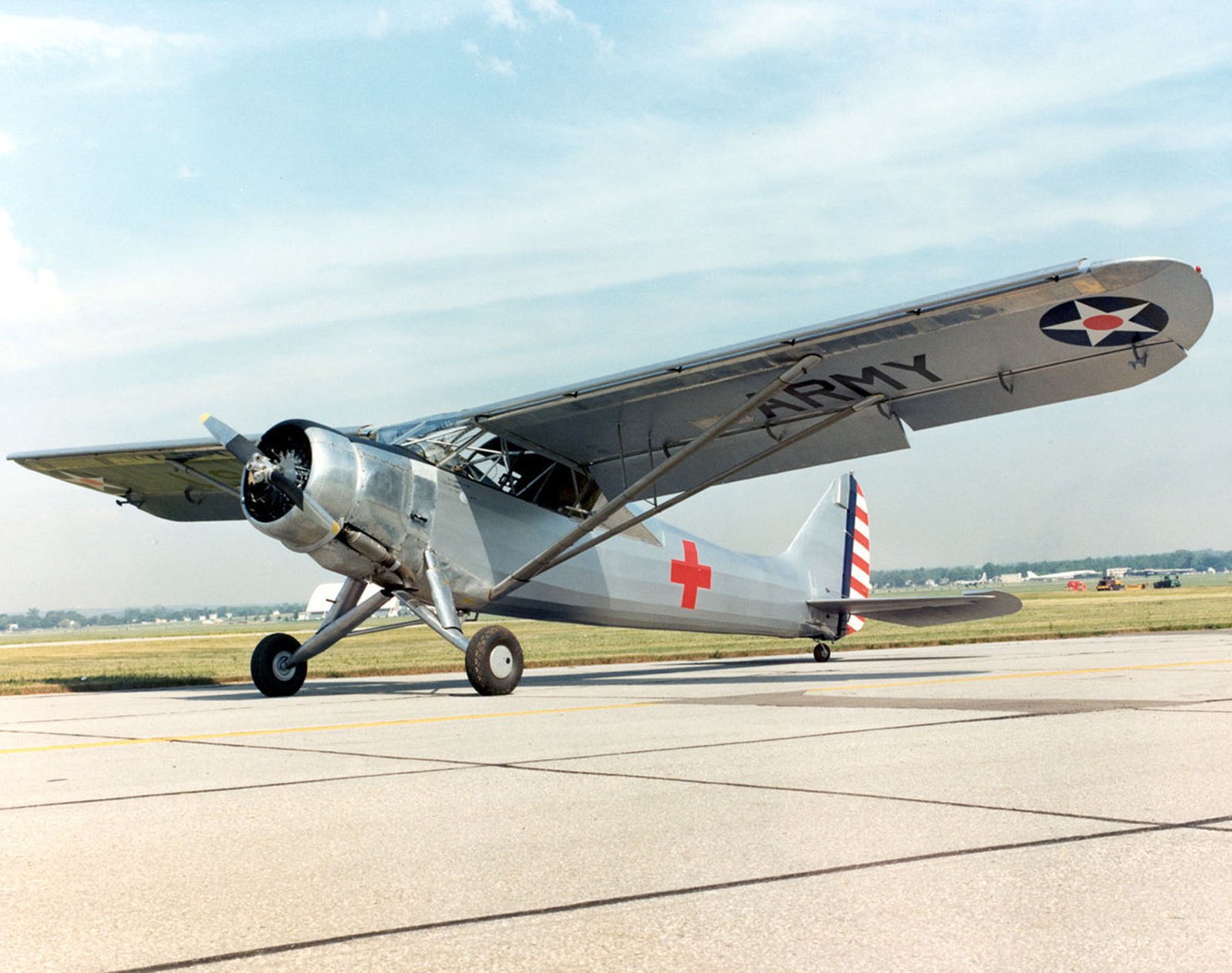
The Stinson L-1 Vigilant (Model 74) was a specialized STOL liaison and observation aircraft developed in the early 1940s. It is historically significant as the first aircraft to receive the U.S. military's 'L' (liaison) designation, serving as a transitional design between the larger observation aircraft of the 1930s and the lighter 'grasshopper' planes of World War II. The L-1 first flew on July 15, 1940, and became the largest liaison aircraft employed by the U.S. during the conflict.
Designed by the Stinson Aircraft Company of Wayne, Michigan, the aircraft was produced between 1940 and 1942. During this period, Stinson became a division of the Vultee Aircraft Corporation, and production was carried out at the Vultee-Stinson facility in Nashville, Tennessee. A total of 324 aircraft were built, consisting of 142 L-1 and 182 L-1A variants. The design was characterized by its high-wing, braced monoplane configuration, featuring pilot-operated slotted flaps and full-span automatic leading-edge slats to achieve extreme short-field performance.
Power was provided by a single Lycoming R-680 nine-cylinder air-cooled radial engine, rated at approximately 295 hp. This propulsion system allowed for a maximum speed of roughly 130–135 mph and a service ceiling of 17,000 to 18,000 feet. With a maximum take-off weight of approximately 4,000–4,100 lb, the Vigilant was capable of operating from rough, improvised forward strips, making it ideal for medical evacuations and special operations.
During World War II, the L-1 served in Europe, Africa, Asia, and Alaska. Primary operators included the U.S. Army Air Corps (where it was initially designated the O-49) and the Royal Air Force, which used the L-1 and L-1A as the Vigilant Mk I and Mk II, respectively. Its roles were diverse, ranging from artillery spotting and courier duties to glider towing and espionage missions behind Japanese lines. Notable service included the use of an L-1 by General Harry Crerar of the First Canadian Army. In Burma, a crash involving Technical Sergeant Ed “Murphy” Hladovcak in an L-1A led to one of the first recorded helicopter combat rescues in April 1944.
Post-war, some L-1s entered civilian service. One L-1E was used as a camera plane for Hollywood productions, including Disney's Boatniks and The Great Waldo Pepper. Today, several examples survive in museums, including the National Museum of the United States Air Force and the Fantasy of Flight collection, while the Alamo Liaison Squadron has worked to preserve the type at Cannon Field, Texas.