
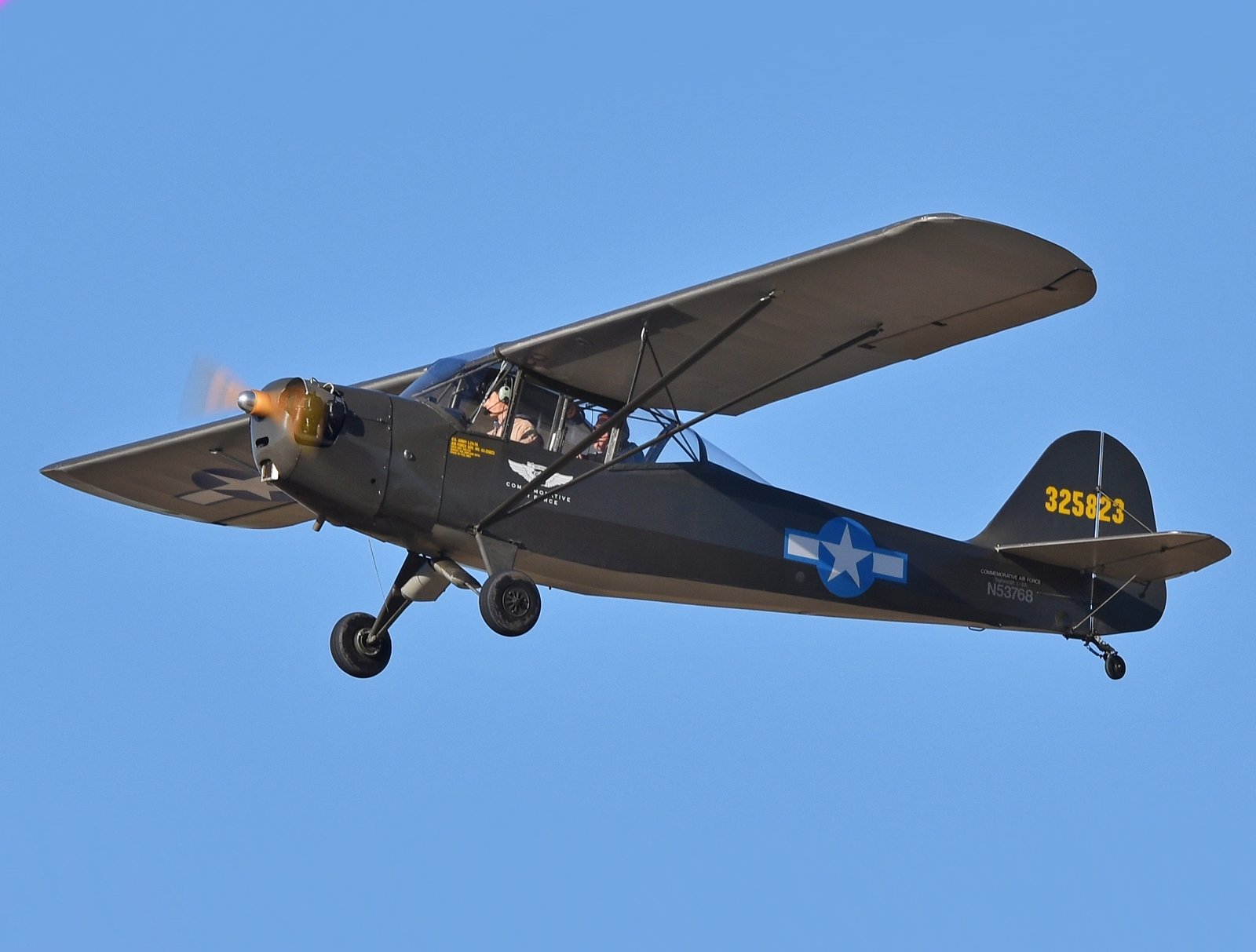
The Taylorcraft L-2 Grasshopper was a light, two-seat liaison and observation aircraft developed for the U.S. Army Air Forces. It was derived from the pre-war Taylorcraft Model D, also known as the Tandem Trainer. The aircraft's military journey began in 1941 when the Army ordered four YO-57 evaluation aircraft. These prototypes were tested during the summer of 1941 during Army maneuvers in Texas and Louisiana. The type entered series production as the O-57 before being redesignated as the L-2 Grasshopper in March 1942. Production continued through 1944 at the Taylorcraft Airplane Company facility in Alliance, Ohio.
Designed as a rugged, austere platform, the L-2 featured a high-wing braced monoplane configuration with a tandem cockpit. A notable evolution was the L-2M variant, which incorporated wing spoilers to significantly enhance short-field landing performance. This capability allowed the L-2 to operate from roads, open fields, and improvised landing strips, filling a tactical role previously served by observation balloons. The aircraft was powered by a 65 hp Continental O-170-3 four-cylinder horizontally-opposed piston engine. Technical specifications included a wingspan of 35 ft 5 in, a length of 22 ft 9 in, and a maximum takeoff weight of 1,300 lb. Performance figures cite a maximum speed of 92 mph and a service ceiling of 12,000 ft, with range estimates varying between 227 and 303 miles.
During World War II, the L-2 was employed for courier duties, light transport, and short-range reconnaissance. Its primary tactical utility involved spotting enemy troop concentrations and directing artillery fire. General Innis P. Swift, commander of the 1st Cavalry Division, is credited with coining the nickname "Grasshopper" after observing one of the aircraft make a bumpy landing. While some sources, including the National Museum of the USAF, state the L-2 was used exclusively for domestic liaison pilot training and not deployed overseas, other records describe its general operational roles in the field. Beyond the U.S., the aircraft saw post-war service with the French Navy, the Haiti Air Corps, and the Royal Netherlands East Indies Army Air Force.
In the civilian sector, many L-2s served with the Civil Air Patrol during the war. Following the conflict, surplus aircraft were sold in 1944 and 1945 for under one thousand dollars, leading to a popular post-war civilian career. Many were converted to the Model DCO-65 standard for private use. Today, several L-2s remain airworthy. Notable preserved examples include an L-2M at the National Museum of the United States Air Force, which previously served at the McFarland Flying Service Contract Pilot School in Kansas, and another L-2M exhibited at the Pima Air & Space Museum.