
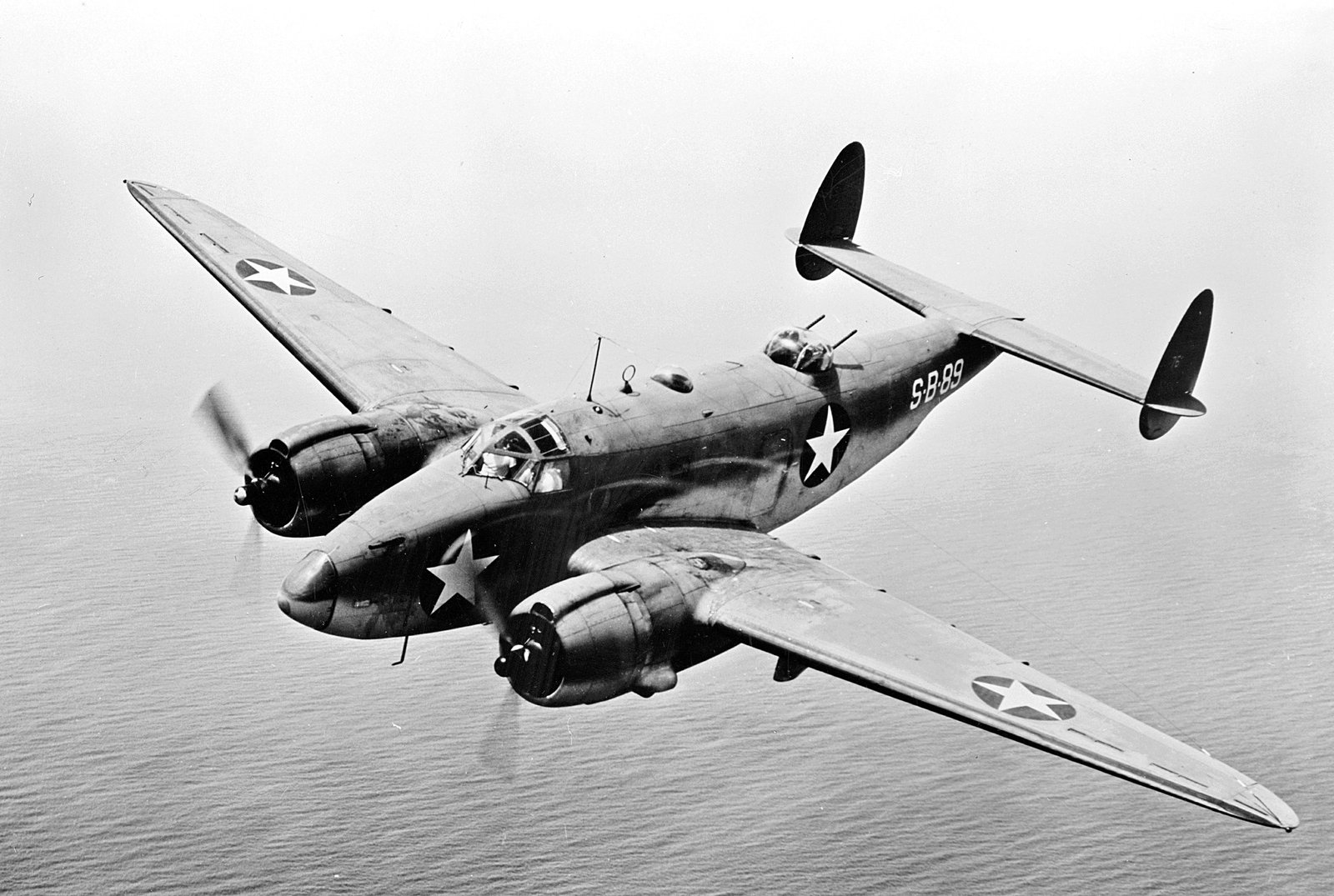
Service History
The Ventura entered combat service with the Royal Air Force on November 3, 1942, initially intended as a replacement for the aging Bristol Blenheim and Lockheed Hudson. However, early daylight bombing missions revealed the aircraft's vulnerability to enemy fighters, prompting the RAF to reassign most Venturas to night operations and coastal patrol duties. The type found greater success with the U.S. Navy, where PV-1 variants conducted anti-submarine warfare in the Pacific Theater and became the first land-based bombers to attack the Japanese home islands from the Aleutian Islands in January 1944.
Wartime Operations
Operational across multiple theaters, the Ventura served with eight nations including the RAF, U.S. Army Air Forces, U.S. Navy, Royal Canadian Air Force, Royal Australian Air Force, and South African Air Force. The aircraft operated under numerous designations: RAF Ventura I and II models focused on bombing missions, while U.S. Navy PV-1 variants excelled at maritime patrol and anti-submarine warfare. The extended-range PV-2 Harpoon, with 470 units built, provided long-range patrol capabilities in the Pacific. U.S. Army Air Forces operated limited numbers as B-34 Lexington reconnaissance aircraft, receiving only 18 of the 550 originally ordered.
The Manufacturer
Lockheed Corporation entrusted Ventura production to its subsidiary Vega Airplane Company, established in 1937 specifically for light aircraft manufacturing. Founded by brothers Allan and Malcolm Loughead in 1912, Lockheed had emerged from near-bankruptcy in 1932 under the leadership of Robert E. Gross to become a major World War II aircraft producer. The company simultaneously manufactured the P-38 Lightning fighter and Constellation airliner while Vega handled Ventura production at Plant A-1 in Burbank, California. Lockheed merged with Martin Marietta in 1995, forming Lockheed Martin, which continues as a leading aerospace and defense contractor today.
Engine & Technical Innovation
Powering the Ventura were two Pratt & Whitney R-2800 Double Wasp radial engines, each delivering up to 2,000 horsepower through 18 air-cooled cylinders. These engines, manufactured by United Aircraft Corporation (now RTX Corporation), represented cutting-edge technology with features including two-stage supercharging for high-altitude performance. The R-2800 powered numerous World War II aircraft including the P-47 Thunderbolt and F4U Corsair, with over 125,000 units produced during its 20-year production run from 1940 to 1960. The Ventura's crew typically consisted of five to seven members including pilot, co-pilot, bombardier, and defensive gunners operating up to six machine guns in nose, dorsal, and ventral positions.
Performance Characteristics
The Ventura achieved a maximum speed of approximately 300 mph with a service ceiling exceeding 21,000 feet and range of more than 1,000 miles, extended significantly in the PV-2 variant. Its bomb bay accommodated up to 2,500 pounds of ordnance, representing a substantial improvement over its Hudson predecessor. The aircraft's defensive armament varied by model but typically included combinations of .303 and .50 caliber machine guns in powered turrets. Despite its impressive specifications, the Ventura's size and relatively modest speed made it vulnerable during daylight operations against determined fighter opposition.
Production Legacy
Manufactured from 1940 through September 27, 1945, when the final unit was delivered to the U.S. Navy, the Ventura family totaled exactly 3,028 aircraft across all variants. The largest production run comprised 1,113 to 1,600 PV-1 patrol bombers for the U.S. Navy, while RAF variants included 188 Ventura I, 487 Ventura II, and 200 Ventura IIA aircraft. Many Ventura II aircraft were diverted under Lend-Lease arrangements, with 264 becoming R-37 transports for the U.S. Army Air Forces and 27 serving as PV-3 trainers with the U.S. Navy.
Current Survivors
Fewer than ten Ventura airframes remain airworthy today, with most examples preserved in static museum displays worldwide. Notable survivors include aircraft at the Bomber Command Museum in Canada and various locations throughout the United States and United Kingdom. The type's historical significance extends beyond its combat record to represent a crucial evolutionary step in military aviation, demonstrating how transport aircraft designs could be successfully adapted for combat roles while pioneering anti-submarine warfare tactics that proved essential to Allied victory in World War II.