
Development and Design
The L-4 emerged from Russia's post-Soviet aviation renaissance, developed by engineers at an offshoot of the Trod Kuznetsov aircraft engine plant in Samara. Design work commenced in August 2004 with the ambitious goal of creating a compact twin-engine amphibian for private operators. The engineering team collaborated with prestigious Russian aerospace institutions, including the Siberian Aeronautical Research Institute (SibNIA) for flight testing, Samara State Aerospace University (SSAU) for wing design, and the All-Russian Scientific Research Institute of Aviation Materials (VIAM) for carbon fiber reinforced polymer structures.
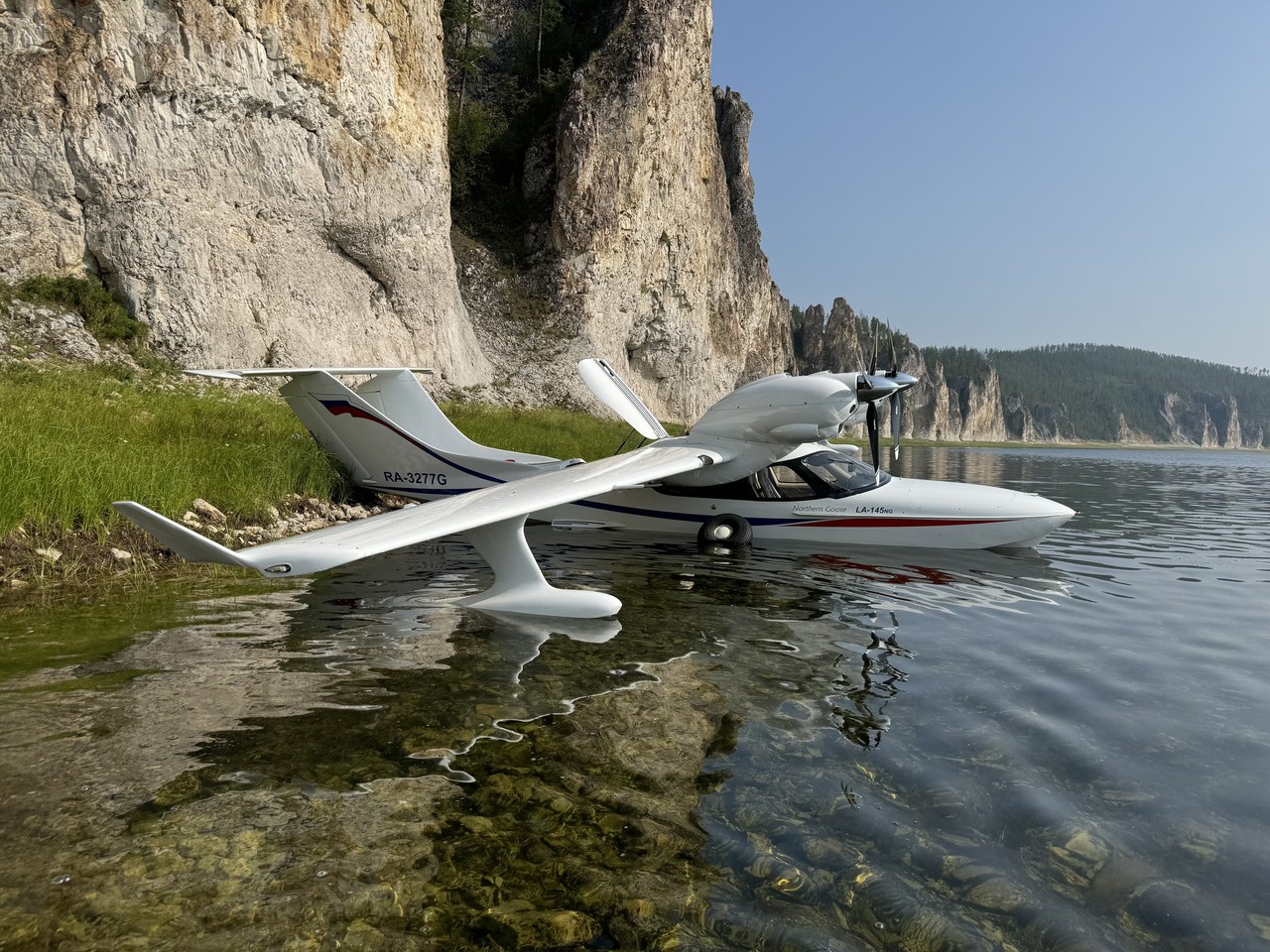
The aircraft's configuration reflected innovative thinking in light amphibian design. The distinctive V-tail arrangement featured twin fins with a trapezoidal tailplane and trim tab, while the retractable tricycle undercarriage included a water rudder for maritime operations. A unique fuselage spine served as a shore-access walkway, demonstrating the designers' attention to practical amphibious operations.
Manufacturing and Production
Chaika, officially known as Aircraft Design and Production Company "Chaika," began L-4 production in the mid-2000s following the successful first flight in June 2005. The company's roots traced back to light aircraft development work beginning in 1986, with formal commercialization occurring in 1999. By mid-2008, combined sales of the L-4 and related L-6 models reached 14 aircraft, establishing the foundation for what would become Russia's dominant four-seat amphibian family.
The manufacturer strategically evolved the design through successive variants. The L-42 entered production in 2005, followed by the turbocharged L-44 in 2009, marketed under the SeaBear Aircraft brand. More recent developments included the L-65 variant, representing continuous refinement of the original L-4 concept. Today, more than 30 examples of the entire family remain active, primarily serving Russian private operators.
Powerplant and Performance
The L-4's propulsion system utilized proven Austrian Rotax technology, initially equipped with Rotax 912 ULS engines producing 73.3 kW (98.6 hp) each. Later variants adopted the turbocharged Rotax 914, delivering 84.5 kW (113.3 hp) per engine for enhanced high-altitude performance. The most recent L-65 variant features Rotax 915 iS powerplants, representing the latest evolution in light aircraft engine technology. All variants employed three-bladed Airmaster AR332 propellers optimized for amphibious operations.
Performance specifications positioned the L-4 as a capable regional transport. The aircraft achieved a maximum speed of 220 km/h (140 mph) and cruised efficiently at 180 km/h (110 mph). Service ceiling reached 4,000 meters (13,000 feet), while maximum range extended to 1,598 kilometers (993 miles) with full fuel capacity of 230 kilograms. Takeoff performance proved impressive for an amphibian, requiring only 250 meters (820 feet) of runway or water surface.
Operational History
The L-4 found its niche serving private operators requiring versatile land-water capability. Russian owners particularly valued the aircraft's ability to access remote locations inaccessible to conventional aircraft, utilizing both prepared airstrips and natural water bodies. The type's reputation for reliability and ease of maintenance contributed to steady demand throughout its production run.
Chaika actively promoted the L-4 family at major aviation exhibitions, including the prestigious MAKS airshow at Zhukovsky in the Moscow Region and the specialized Gidroaviasalon seaplane gathering at Gelendzhik, organized by the Beriev Aircraft Company. These appearances, beginning in 2000, helped establish the aircraft's reputation within Russia's growing general aviation community.
Technical Innovation
The L-4 incorporated several advanced features uncommon in light amphibians. The wing design, engineered by SSAU, optimized lift characteristics for both land and water operations while maintaining structural efficiency. VIAM's contribution of carbon fiber reinforced polymer components reduced weight while enhancing durability in marine environments.
The aircraft's power-to-weight ratio of 8.64 kg/kW compared favorably with international competitors, contributing to its strong performance characteristics. The retractable landing gear system, unusual in light amphibians, improved aerodynamic efficiency and reduced water drag during maritime operations.
Legacy and Continuing Production
While original L-4 production ceased in favor of improved variants, the aircraft's fundamental design principles continue through the L-42 and L-44 models. Chaika remains active in 2024, providing manufacturing, maintenance, and upgrade services while conducting ongoing research into aerodynamics, materials science, and structural improvements.
The L-4's significance extends beyond its modest production numbers. As the progenitor of Russia's most successful four-seat amphibian family, it demonstrated that post-Soviet Russian aerospace companies could develop competitive general aviation aircraft using international components and advanced materials. The type's continuing evolution reflects the enduring validity of its original design concept, providing private operators with reliable amphibious capability in a compact, efficient package.