
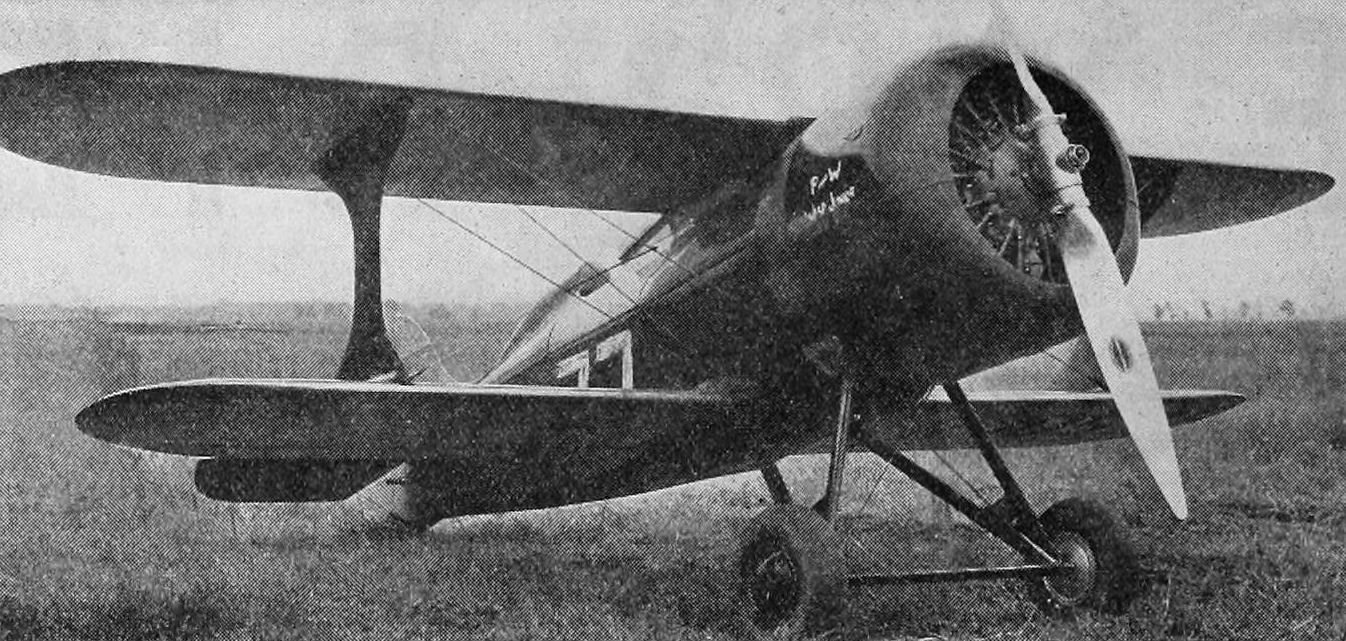
The Laird LC-R Speedwing was a specialized development of the earlier LC-series biplanes, emerging in 1928 as an upgraded configuration designed by Emil "Matty" Laird. The aircraft was characterized by the "Speedwing" concept, which utilized a reduced-span wing to enhance performance for racing and stunt flying. This design philosophy aimed to bridge the gap between general sport biplanes and the highly refined racers of the early 1930s. The LC-R was produced in very limited quantities, with documentation indicating a total population of only two airframes. One of these two aircraft was specifically configured as a single-seat racer for competition in 1930.
Manufacturing took place in Chicago, Illinois, under the E. M. Laird Airplane Company. The firm, founded by Emil Laird in 1923, operated out of locations including Ashburn Field. While the company remained active as an independent builder through the late 1930s, its operations shifted significantly by 1941, when the Chicago plant was converted to produce B-24 subassemblies in LaPorte, Indiana, effectively ending the production of civil aircraft under the Laird brand.
Technically, the LC-R represented a significant power increase over its predecessors. While earlier LC models often utilized OX-5 or Curtiss C-6 engines, the LC-R was primarily upgraded with a 220 hp Wright J-5 "Whirlwind" nine-cylinder air-cooled radial engine. Other documented engine installations included a 160 hp Curtiss C-6 liquid-cooled inline engine and a 200 hp Wright radial. According to ICAO Doc 8643, the aircraft featured a wingspan of 10 meters, a length of 7.2 meters, and a maximum take-off weight of 1.3 tonnes.
In service, the LC-R was utilized for private sport, exhibition, and racing roles. It is associated with the era of high-performance barnstorming and record-setting, such as the 1928 inside-loop record achieved by Charles "Speed" Holman, although the specific subtype used for that record is not explicitly confirmed. The LC-R lineage continued with the LC-R300, which incorporated NACA low-drag engine cowlings for further aerodynamic refinement. No original LC-R airframes are known to survive in museums or private collections today.