
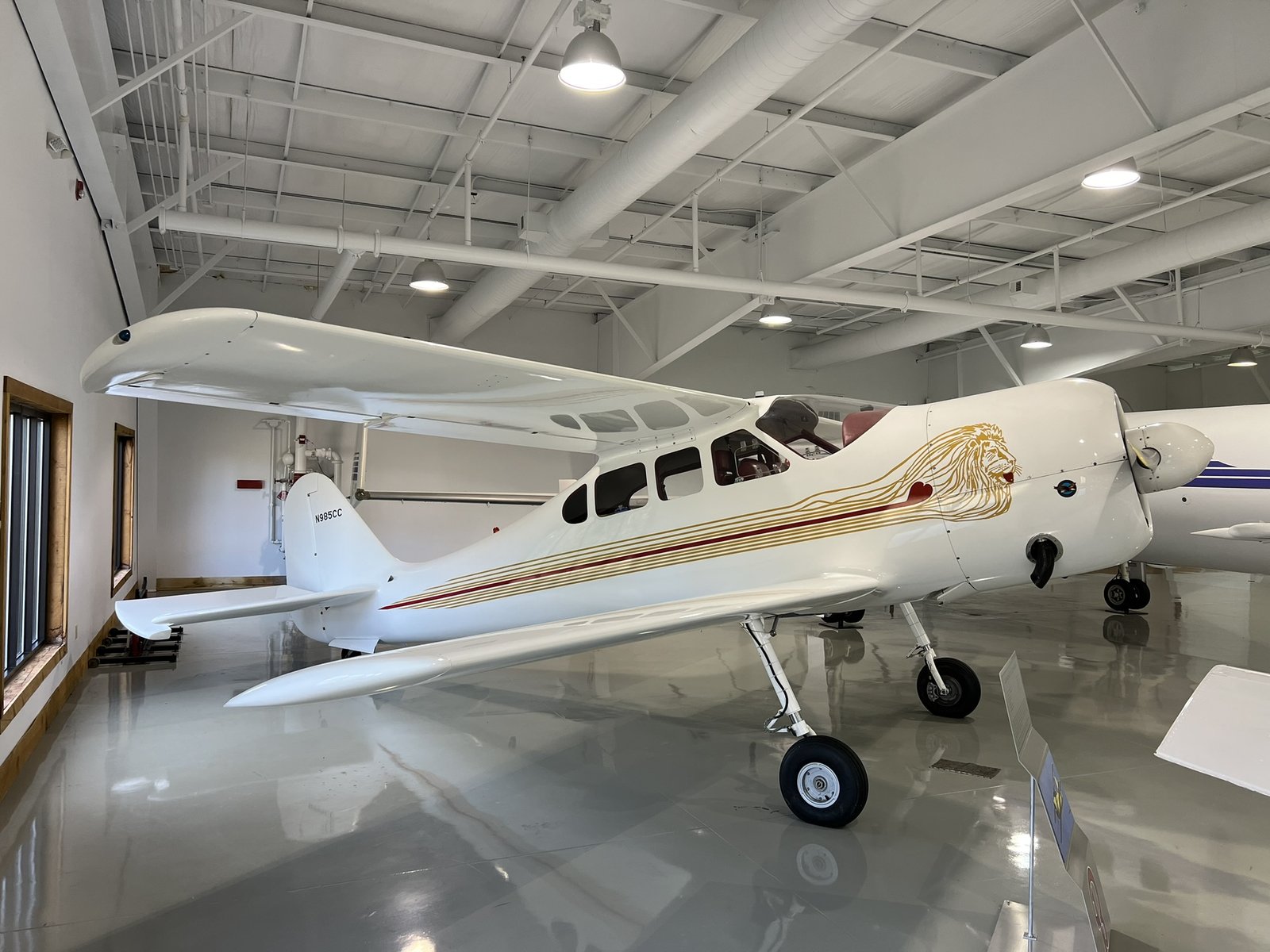
Design and Development
The Griffon Lionheart was conceived as a passion project by Larry French, who sought to create a cost-effective executive transport aircraft inspired by the classic Beechcraft Model 17 Staggerwing. To achieve this, French utilized modern materials, constructing the primary structure from high-temperature carbon fiber composite molded in precision production tooling. This advanced rigidity allowed the design to omit traditional wing uprights, simplifying the external bracing of the stagger-wing biplane configuration. The aircraft was designed as a cabin-class machine capable of transporting six full-size adults, featuring an enclosed cabin and a side entry door.
Production and Manufacturer History
The project led to the establishment of Griffon Aerospace, Inc., based in the Huntsville and Harvest areas of Alabama. The prototype Lionheart completed its maiden flight on July 27, 1997, and made its public debut shortly thereafter at EAA AirVenture Oshkosh. Following the first flight, Griffon Aerospace sold five kits within a nine-month period. While kits were offered during the late 1990s and early 2000s, they are no longer in production. According to reports from AOPA, a total of six aircraft were completed. By late 2015, the factory demonstrator was identified as the only remaining airworthy example, a status echoed by a 2004 listing for an aircraft built by Obert Neal.
Technical Specifications and Performance
The Lionheart is powered by a 450 hp Pratt & Whitney R-985 Wasp Junior nine-cylinder air-cooled radial piston engine, driving a three-bladed propeller. This high power-to-weight ratio provides the aircraft with strong short-field performance, including a takeoff distance of approximately 1,050 feet and a landing distance of 1,300 feet. The aircraft has a gross weight of 5,200 lb and an empty weight ranging between 3,100 and 3,300 lb. Performance figures include a maximum speed of 230 mph, a cruise speed of 210 mph, and a stall speed of 56 mph. It is capable of reaching a service ceiling of 20,000 feet with a rate of climb of 2,500 ft/min and a maximum range of approximately 1,950 miles.
Legacy
As a civilian homebuilt aircraft, the Lionheart saw no military service. Its significance lies in its unique position as a late-20th-century recreation of a golden-age aviation icon, blending 1930s luxury with composite engineering. Despite its limited production run, it remains a notable example of modern kit aircraft design and served as the foundational product for Griffon Aerospace.