
Service History
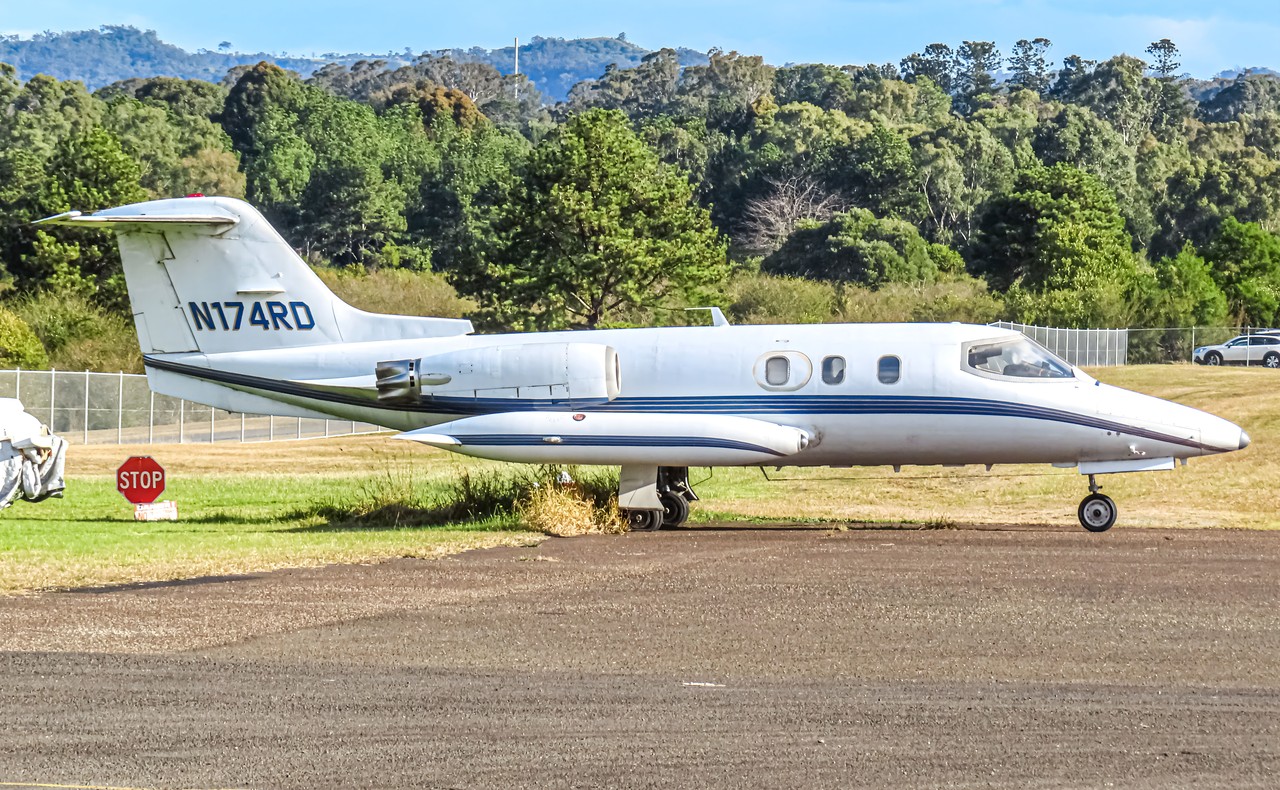
The Learjet 24 dominated the executive aviation market throughout the 1960s and 1970s, with 259 aircraft delivered over its eleven-year production span. By the mid-1970s, Learjet had captured a significant portion of the business jet market, with the Model 24 serving corporations, wealthy individuals, and charter operators worldwide. As of 2001, 210 Learjet 24s remained in active service, demonstrating remarkable longevity for an aircraft design that predated modern turbofan technology.
The aircraft's capabilities were dramatically showcased in May 1966, just months after certification, when a Learjet 24 circumnavigated the globe in 50 hours and 20 minutes of actual flight time. This publicity flight established the aircraft's reputation for speed and reliability in the emerging business aviation sector.
The Manufacturer
Learjet Corporation was founded by aviation innovator William Powell "Bill" Lear, who had previously made fortunes in automobile radios and aircraft autopilot systems. Lear established his aircraft company in the early 1960s with the vision of creating a fast, efficient business jet for corporate executives. The company's Wichita, Kansas facility became the birthplace of the business jet industry.
In 1970, Gates Rubber Company acquired Learjet Corporation for $21 million, renaming it Gates Learjet Corporation. This acquisition provided the financial stability necessary for continued aircraft development while maintaining Bill Lear's engineering vision. The Learjet brand continued operations for over five decades until Bombardier announced the end of Learjet production in 2022, marking the conclusion of one of aviation's most recognizable names.
Engine & Technical Details
The Learjet 24 utilized twin General Electric CJ610 turbojet engines, with different variants employing increasingly powerful versions of this proven powerplant. Early 24A models featured CJ610-4 engines, while later variants progressed through the CJ610-6 to the final CJ610-8A engines, each producing 2,950 pounds of thrust. These pure turbojet engines, without the bypass fans of modern turbofan designs, provided the distinctive high-pitched whine that became synonymous with early business jets.
The aircraft required a two-person crew and could accommodate four to six passengers in its pressurized cabin. Maximum takeoff weight reached 13,512 pounds on later variants, representing a significant improvement over the earlier Learjet 23's 12,500-pound limitation. This weight increase translated directly into improved payload and range capabilities that made the aircraft commercially viable for business operations.
Design Evolution
Bill Lear's design team created six distinct variants of the Model 24, each incorporating progressive improvements. The 24A, certified on November 9, 1966, established the baseline with 81 aircraft built. The 24B followed in December 1968 with upgraded engines and improved performance, accounting for 49 units. The most successful variant proved to be the 24D, certified July 17, 1970, with 99 aircraft featuring extended range and distinctive angular cabin windows.
The final variants, the 24E and 24F introduced in 1976, incorporated the revolutionary "Century III wing" design. This cambered wing configuration reduced stall speeds and improved low-speed handling characteristics. The 24F achieved the highest service ceiling of any variant at 51,000 feet, representing the maximum altitude approved for civilian aviation operations when certified on April 15, 1977.
Pilot Perspective
Pilots appreciated the Learjet 24's exceptional speed and climb performance, though the pure turbojet engines required careful fuel management compared to later turbofan designs. The aircraft's 840-gallon fuel capacity provided adequate range for most business missions, while its ability to operate at altitudes up to 51,000 feet allowed it to fly above most weather and commercial airline traffic.
The Model 24's handling characteristics reflected its clean aerodynamic design, with cruise speeds that made it competitive with much larger aircraft. However, pilots needed specific training for the turbojet engines' operating characteristics, including longer spool-up times and higher fuel consumption rates compared to modern turbofan-powered successors.
Production & Legacy
Total production of 259 aircraft established the Learjet 24 as a commercial success that validated the business jet concept. The aircraft's safety record included 39 hull losses over its operational history, a figure that reflected both the challenging operating environment of business aviation and the aircraft's extensive utilization.
The Model 24's success directly enabled development of the turbofan-powered Learjet 25 series, which began production in 1967 and eventually superseded the turbojet-powered 24. Today, surviving Learjet 24s continue operating worldwide, with many examples preserved in aviation museums as representatives of the pioneering era of business jet aviation. The aircraft's influence extends far beyond its production numbers, having established design principles and market expectations that shaped the entire business aviation industry.