
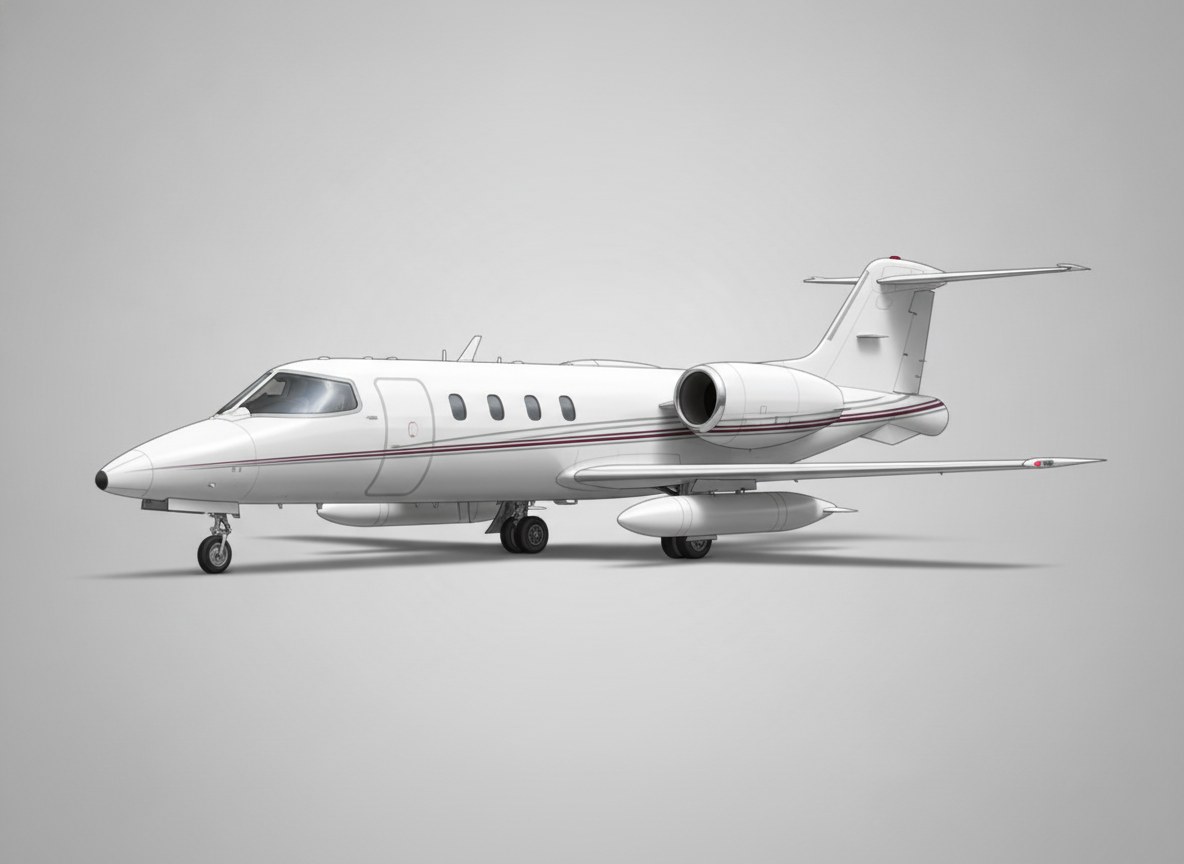
Revolutionary Design Philosophy
The Learjet 36 emerged from Gates Learjet's ambitious effort to transform business aviation through advanced turbofan technology. The aircraft evolved directly from the Learjet 25BGF demonstrator program, which first flew in May 1971 to test the revolutionary Garrett TFE731 engines. William P. Lear's engineering team stretched the fuselage 13 inches beyond the Learjet 25's dimensions while fundamentally redesigning the aircraft around the new powerplants.
The defining characteristic of the Learjet 36 was its unique cabin configuration. Unlike its sibling, the Learjet 35, which maximized passenger capacity, the 36 sacrificed 18 inches of rear cabin space to accommodate additional fuel tankage in the aft fuselage. This design trade-off eliminated the three-place bench seat found in other variants, reducing passenger capacity to 6-8 occupants while extending range by approximately 500 miles.
Certification and Production
Gates Learjet received FAA certification for the Learjet 36 on July 28, 1974, launching production at the company's Wichita manufacturing facility. The aircraft entered service during a transformative period for business aviation, when corporations increasingly demanded jets capable of transcontinental flights without fuel stops.
Production of the base Learjet 36 continued until 1976, when Gates introduced the improved 36A variant featuring upgraded TFE731-2-2B engines. The combined Learjet 35/36 series ultimately totaled 738 aircraft across two decades of production, ending in 1993-1994 under Bombardier ownership. This production run established the 35/36 family as the most successful Learjet variant ever manufactured.
Gates Learjet Corporation Heritage
The manufacturer behind the Learjet 36 underwent significant corporate evolution during the aircraft's development. William P. Lear founded Lear Jet Inc. in 1962, achieving his first flight with the Learjet 23 prototype on October 7, 1963. However, financial pressures led to Gates Rubber Company acquiring controlling interest in 1967, with the enterprise becoming Gates Learjet Corporation in 1969. Lear himself departed the company in 1967, before the 36's development began.
Bombardier acquired Learjet in 1990, operating it as Bombardier Learjet throughout the final years of 35/36 production. The Canadian aerospace giant continued Learjet operations until ceasing all production in 2021, ending nearly six decades of continuous manufacturing.
Powerplant Innovation
The Learjet 36's performance stemmed from its pioneering use of Garrett AiResearch TFE731-2 turbofan engines. Each engine produced approximately 3,500 pounds of thrust through a twin-spool, high-bypass design that revolutionized light jet aviation. The TFE731 series, certified in 1972, offered dramatically improved fuel efficiency and reduced noise compared to the CJ610 turbojets powering earlier Learjets.
These engines enabled the Learjet 36A to achieve a maximum range of 2,789 miles with 931 US gallons of fuel capacity. The aircraft's maximum cruise speed approached Mach 0.81, placing it among the fastest medium-haul business jets of its era. The reliability of the TFE731 engines proved exceptional, with the series eventually accumulating over 15,000 units produced across five decades of manufacturing.
Military Service Record
While primarily designed for civilian operations, the Learjet 36 found limited military application with the Japan Maritime Self-Defense Force (JMSDF). Six aircraft, designated U-36A, served between March 1986 and December 1993 in training, utility, and electronic countermeasures roles.
The JMSDF's Learjet 36 operations experienced two notable accidents. Aircraft 9203 crashed into water on February 28, 1991, during a low-level electronic countermeasures exercise, while 9202 crashed at Iwakuni on May 21, 2003, possibly due to bird strike during touch-and-go practice. The JMSDF retired its final U-36A on March 10, 2025, at Marine Corps Air Station Iwakuni.
Record-Breaking Achievements
The Learjet 36 captured international attention through spectacular long-distance flights that demonstrated its capabilities. Professional golfer Arnold Palmer established a round-the-world speed record in 1976, covering 22,894 miles in 57 hours, 25 minutes, and 42 seconds in his Learjet 36.
Twenty years later, a Learjet 35A (N10BD) owned by Bill Daniels achieved another circumnavigation record of 49 hours, 21 minutes, and 8 seconds in 1996. The crew included pilots Mark E. Calkins, former astronaut Charles Conrad Jr., Paul Thayer, and D. Miller. This record remained unbroken as of 2015, cementing the 35/36 series' reputation for exceptional range and reliability.
Enduring Legacy
More than 500 Learjet 35/36 series aircraft remained in active service worldwide as of 2020, testament to the design's durability and continued relevance. The type's longevity stems from its optimal balance of speed, range, and operating economics, making it attractive to corporate flight departments and charter operators decades after production ended.
The Learjet 36's influence extends beyond its operational success. It established the template for modern business jets by proving that turbofan engines could deliver airline-like performance in light aircraft. This pioneering achievement paved the way for today's advanced business jet market, where the principles first demonstrated in the Learjet 36 continue to drive innovation and design philosophy.