
Service History
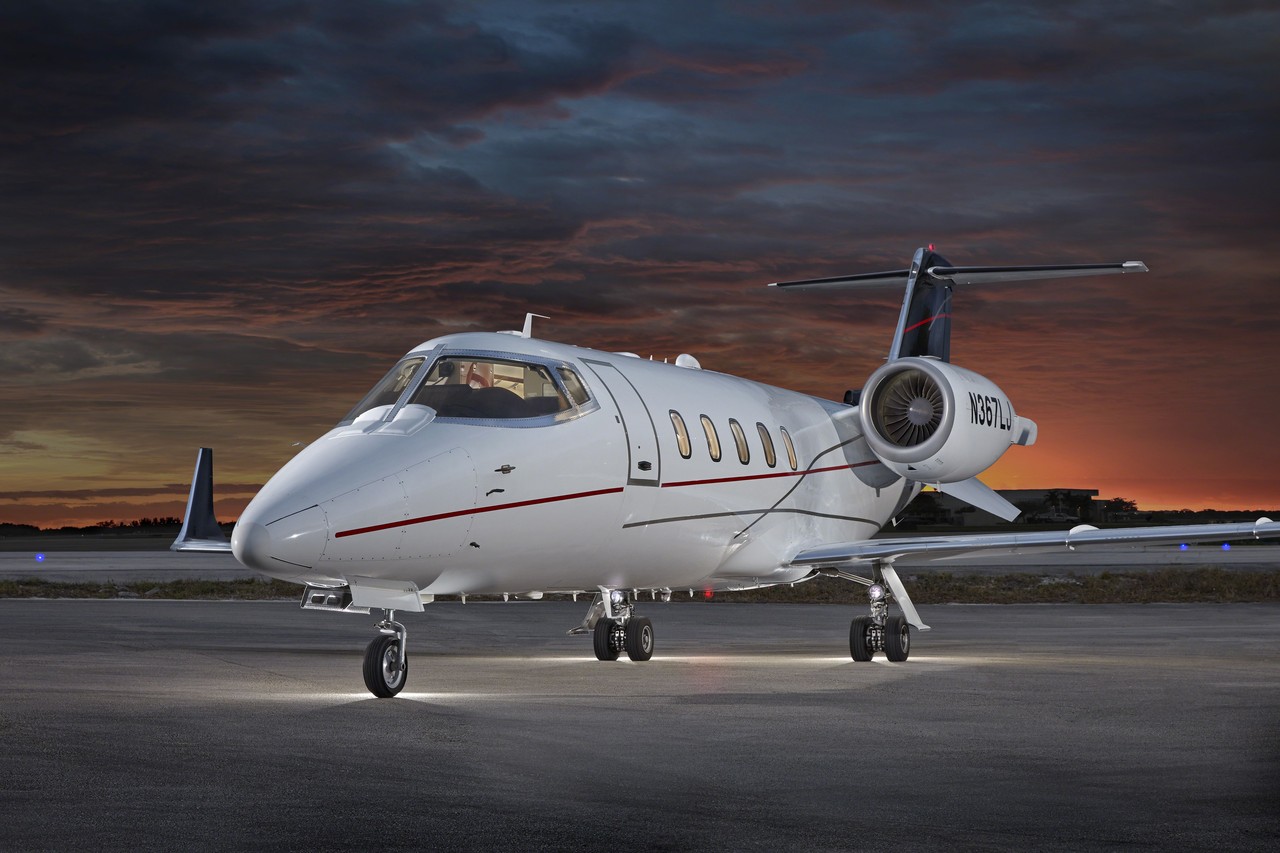
The Learjet 60 dominated the mid-size business jet market throughout its 16-year production run, establishing itself as the backbone of corporate aviation fleets worldwide. Private owners, charter firms, and corporations including Air Charter Service operated the type on routes such as London to continental Europe and Chicago to Los Angeles nonstop. With its 2,405 nautical mile range carrying four passengers with NBAA reserves, the aircraft filled the crucial gap between light jets and heavy cabin aircraft. As of 2021, 258 Learjet 60/60SE models and 109-112 Learjet 60XR variants remained active in service, demonstrating the type's enduring operational value.
The Manufacturer
Bombardier Aerospace acquired the financially struggling Learjet company from Integrated Resources in mid-1990, investing less than $100 million to develop the Model 60 for rapid certification. Founded by aviation pioneer Bill Lear in 1962, Learjet had built its reputation on innovative small jets but faced severe financial difficulties by 1990. The Canadian firm Bombardier, established in 1942 and expanded into aerospace through strategic acquisitions, saw the Learjet brand as essential to bolstering its business jet lineup. The acquisition proved prescient, as the Learjet 60 became Bombardier's first major success in the business aviation market. In 2020, Bombardier sold its business jet division to Honda Aircraft Company, which ceased all Learjet production by 2021, ending nearly six decades of the iconic brand.
Engine & Technical Details
Two Pratt & Whitney Canada PW305A turbofan engines, each producing 4,600 pounds of thrust, power the Learjet 60. Pratt & Whitney Canada, a subsidiary of what is now RTX Corporation, developed the PW300 series in the 1980s specifically for business aviation applications. The engines enabled the aircraft's exceptional climb performance, reaching 41,000 feet in just 18.5 minutes at maximum takeoff weight—a capability that became the Learjet 60's defining characteristic.
The Learjet engineering team designed the aircraft as a comprehensive upgrade to the Learjet 55, retaining the wing roots derived from Bill Lear's adaptation of the Swiss FFA P-16 military fighter design. Key innovations included new inboard wing cuffs and wing-to-body fairings that improved aerodynamics, while the 43-inch fuselage stretch provided additional passenger capacity. The aircraft maintained the classic "Longhorn" wing configuration, making it the last of Bill Lear's original design lineage.
Performance & Pilot Perspective
With an empty weight of 14,640 pounds and maximum takeoff weight of 23,500 pounds, the Learjet 60 delivered performance that defined the mid-size business jet category. The cabin measured 17.7 feet long, 5.9 feet wide, and 5.7 feet tall, providing 453 cubic feet of passenger volume for 6-8 occupants plus two crew members. An enclosed lavatory could serve as an additional seat when required.
Pilots praised the aircraft's reliability and climb performance, characteristics that made it ideal for accessing high-altitude airways quickly and efficiently. The type's ability to reach its service ceiling rapidly provided operational flexibility in congested airspace, while its range capability enabled nonstop flights across North America and throughout Europe. The later 60XR variant introduced Pro Line 21 avionics, three-rotor disc brakes rated for 450-600 landings, an auxiliary power unit, and Traffic Collision Avoidance System (TCAS).
Production & Legacy
Exactly 318 Learjet 60 aircraft rolled off the production line in Wichita, Kansas, between 1991 and 2007, with production of the upgraded 60XR beginning at serial number 319 and continuing until 2012. The Federal Aviation Administration certificated the aircraft in January 1993, validating Bombardier's strategy of incremental improvement over costly all-new development.
The Learjet 60's success proved that affordable upgrades could revitalize a struggling aircraft marque, generating record sales that validated Bombardier's acquisition strategy. As the last aircraft to carry Bill Lear's original design DNA through the classic Longhorn wing, the Learjet 60 represented the end of an era in business aviation. Used examples trade for $1-4 million as of 2021, with approximately 10 percent of the fleet on the resale market.
The aircraft's cultural significance extended beyond aviation circles, epitomizing high-performance executive travel in media portrayals and corporate imagery. Its combination of speed, reliability, and climb performance established benchmarks that influenced subsequent business jet development, cementing the Learjet 60's position as a pivotal aircraft in the evolution of corporate aviation.