
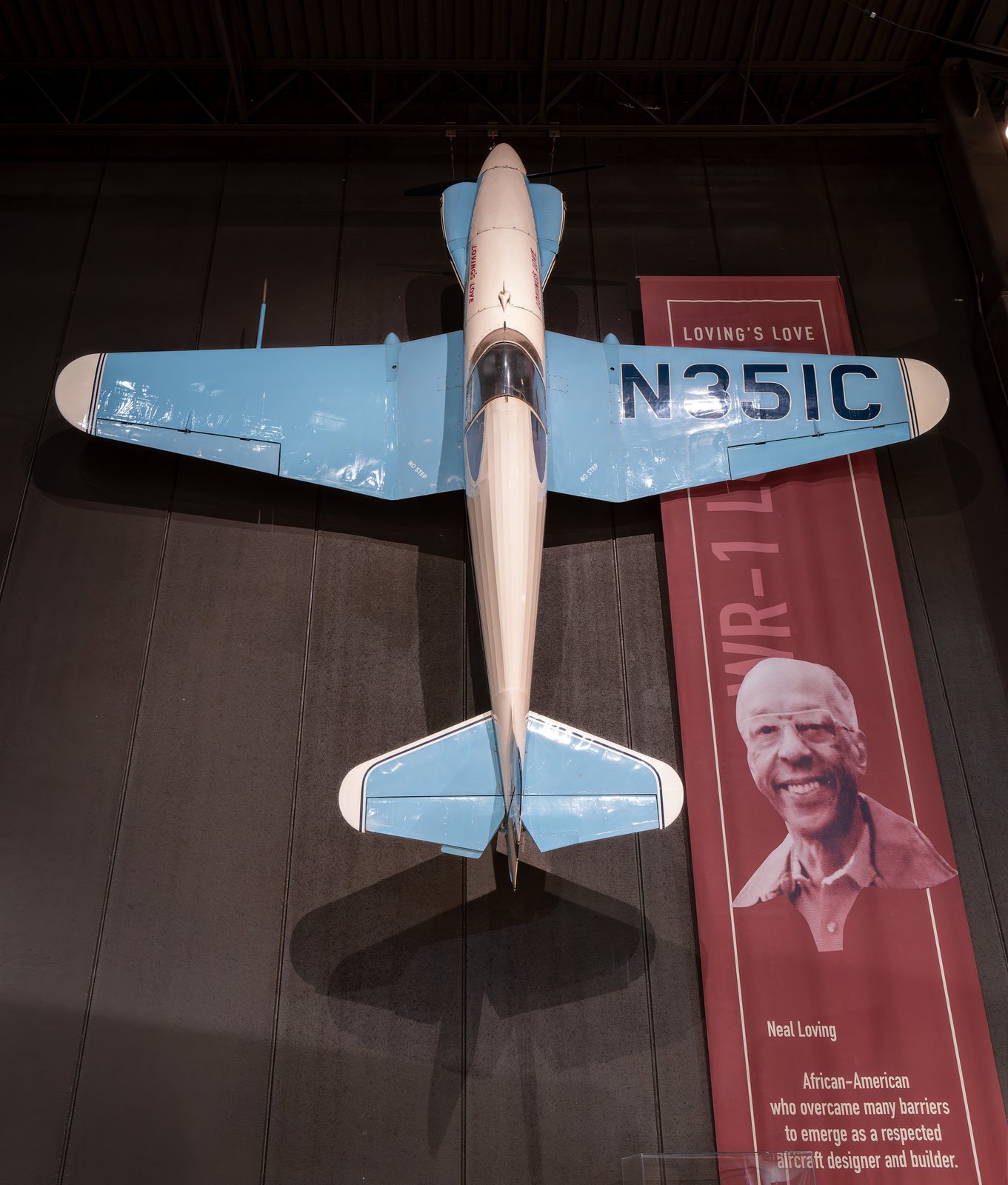
Breaking Barriers in Racing Aviation
The WR-1 Love represented far more than its impressive performance statistics suggested. Designer Neal V. Loving, a double amputee who lost both legs in a 1944 aircraft accident, refused to abandon his aviation dreams and instead channeled his expertise into creating an affordable midget-class racer for average-income builders and pilots. His achievement as the first African American certified airplane racer occurred during an era when both racial and disability barriers severely limited opportunities in aviation.
Design Innovation and Construction
Construction began in January 1949 in Detroit, with Loving emphasizing practical innovation over costly materials. The aircraft's most distinctive feature was its inverted gull-wing design, which positioned the fixed landing gear at the wing's lowest point to minimize drag. Rather than conventional wheel fairings, Loving enclosed the gear in elaborate "giant wheelpant" fairings that became a signature visual element.
The structural approach balanced performance with affordability. A wood truss fuselage framework received fabric covering, while the wings featured plywood skinning for greater strength and smoother airflow. This mixed-construction method allowed builders to source materials locally rather than requiring specialized aviation components.
Racing Performance and Achievements
Following Professional Racing Pilots Association approval in 1948, the WR-1 demonstrated exceptional performance capabilities. At the 1951 National Air Races, Loving qualified the aircraft with a diving speed of 266 miles per hour, though the attempt resulted in propeller damage that prevented race completion. The Continental C-85-12 engine consistently delivered speeds exceeding 3,800 rpm during level flight, producing the aircraft's maximum speed of 215 miles per hour.
The aircraft's climbing performance proved equally impressive, achieving 2,100 feet per minute while maintaining a service ceiling of 18,000 feet. These specifications placed the WR-1 among the most capable midget racers of its era, despite its modest 85-horsepower powerplant.
Long-Distance Demonstration
In December 1953, Loving undertook the aircraft's most ambitious flight: a 2,200-mile journey from Detroit, Michigan, to Kingston, Jamaica. This remarkable voyage included a 215-mile overwater segment, demonstrating both the aircraft's reliability and Loving's exceptional piloting skills. The flight maintained an average ground speed of 127.5 miles per hour despite the aircraft's small 15-gallon fuel capacity, requiring precise navigation and fuel management.
Wayne Aircraft Company Legacy
Wayne Aircraft Company, established in late 1941 by Loving and partner Earsly Taylor, operated as Detroit's first Black-owned aircraft manufacturing facility. The company initially produced gliders including the S-1 and S-2 models during World War II. Following the war's conclusion, the partners transitioned their focus to education, establishing the Wayne School of Aeronautics in 1946. The WR-1 represented the company's final aircraft production before concentrating entirely on aviation training.
Technical Specifications and Equipment
The WR-1's instrumentation exceeded typical midget racer standards, incorporating an accelerometer, stall warning system, radio communications, and an electric lap counter for racing timing. The Continental C85 engine, manufactured by Continental Motors from 1946 to approximately 1979, powered over 100,000 aircraft across various applications. This four-cylinder, horizontally-opposed, air-cooled design provided exceptional reliability for experimental and light aircraft operations.
With an empty weight of 613 pounds and gross weight of 815 pounds, the aircraft achieved remarkable power-to-weight ratios. The 66-square-foot wing area and compact 4-foot 4-inch height contributed to reduced drag and enhanced racing performance.
Recognition and Preservation
The Experimental Aircraft Association recognized the WR-1's innovative design with its Most Outstanding New Homebuilt Design award in 1954 at Rockford, Illinois. Aviation publications including The Experimenter and Mechanix Illustrated featured detailed coverage of the aircraft's construction and performance achievements.
Neal Loving donated the sole WR-1 example to the EAA Aviation Museum in Oshkosh, Wisconsin, in 1964, where it remains preserved as aircraft N351C. The donation ensured the aircraft's historical significance would be maintained for future generations studying both experimental aviation development and the contributions of minority pioneers in aerospace.
Historical Impact
The WR-1 Love stands as a testament to individual determination overcoming societal barriers. Loving's achievement as both designer and pilot demonstrated that innovation and skill transcend physical limitations and racial prejudice. The aircraft's successful long-range flights and racing qualifications proved that homebuilt experimental designs could achieve performance levels rivaling professionally manufactured racing aircraft, inspiring countless future builders in the experimental aviation community.