
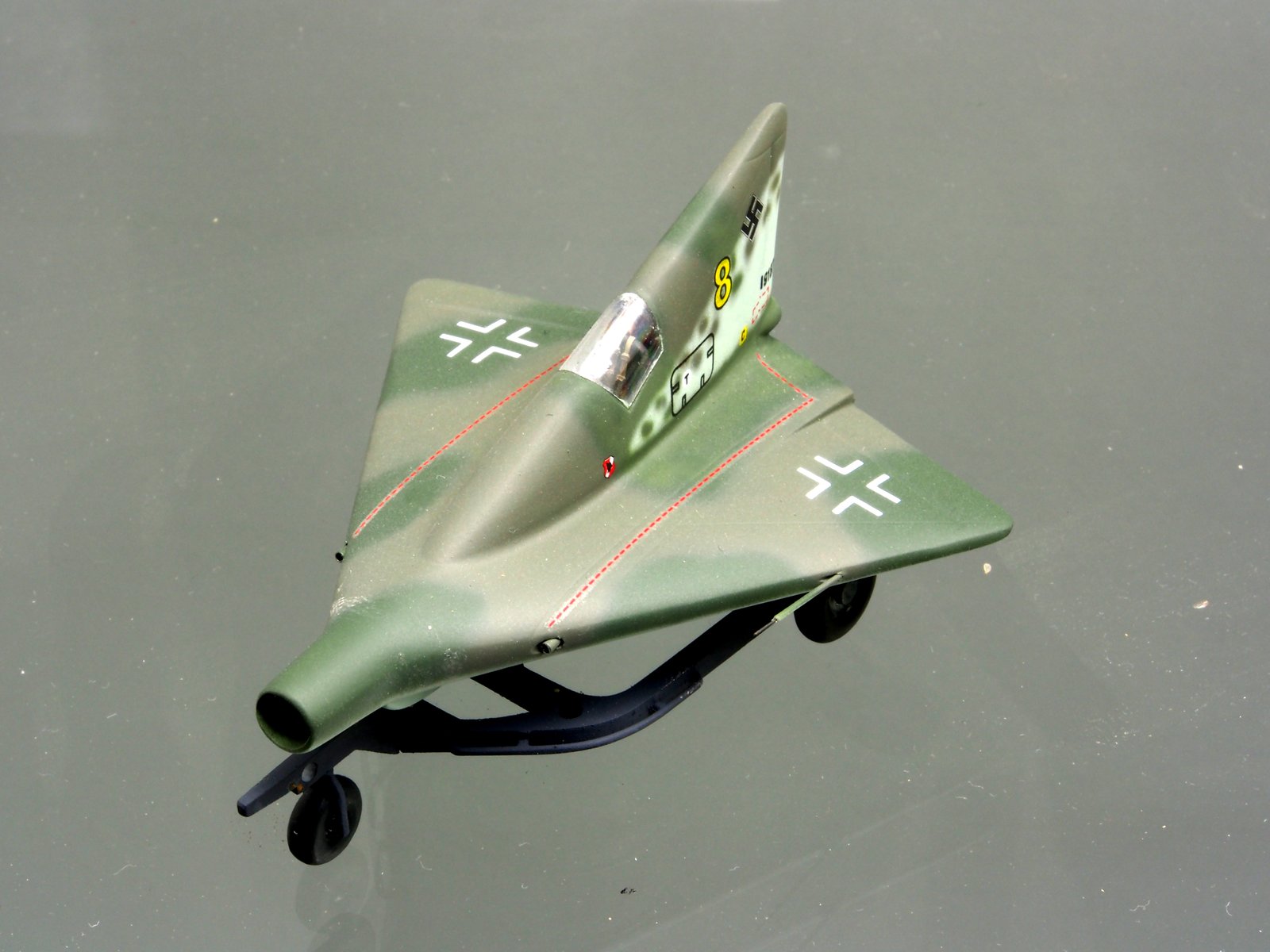
The Lippisch P.13a was a conceptual high-speed interceptor developed in 1944 under the direction of Dr. Alexander Martin Lippisch. Designed during the resource-starved final years of World War II, the P.13a was part of a broader series of studies (including the P.12 and P.13b) aimed at creating a simple, rapidly producible aircraft for the Luftwaffe's home defense. The design was characterized by a compact, semi-tailless delta-wing configuration with approximately 60° leading-edge sweep, optimized for high-speed flight and extreme simplification.
Technically, the P.13a was designed to be powered by a single Kronach Lorin coal-burning ramjet. This air-breathing engine lacked a mechanical compressor and relied on forward speed for thrust, necessitating a tow or rocket-assisted launch, such as the HWK 109-509 RATO units. To address severe fuel shortages, the engine utilized powdered brown coal or lignite dust carried in an internal wire-mesh basket. The burning coal generated producer gas that mixed with bypass air to create combustion. Design estimates suggested a maximum speed of up to 1,650 km/h and a range of approximately 1,000 km, though these figures remained unverified in flight. The aircraft was intended to be an unarmed interceptor, relying on reinforced wing leading edges to perform ramming attacks against Allied heavy bombers.
While the powered P.13a never reached production, a full-scale research glider known as the DM-1 was constructed by Lippisch Flugzuegbau G.m.b.H. as a low-speed aerodynamic testbed. The DM-1 was developed in part by students from Munich and Darmstadt universities. Although scale models were successfully tested at Spitzerberg Airfield near Vienna in 1944, the DM-1 was captured unfinished by American forces in 1945. It was later completed under U.S. direction and subjected to extensive wind-tunnel testing at the NACA Langley facility in 1946 to study delta-wing vortex lift and handling.
Today, the P.13a exists only as a design legacy. The original DM-1 glider is preserved in the Smithsonian National Air and Space Museum, and a full-size static replica of the P.13a is displayed at the Military Aviation Museum in Virginia Beach, Virginia. Dr. Lippisch's subsequent work in the United States, including his time at the Collins Radio Company, continued to explore the delta-wing and wingless concepts pioneered during the P.13a project.