
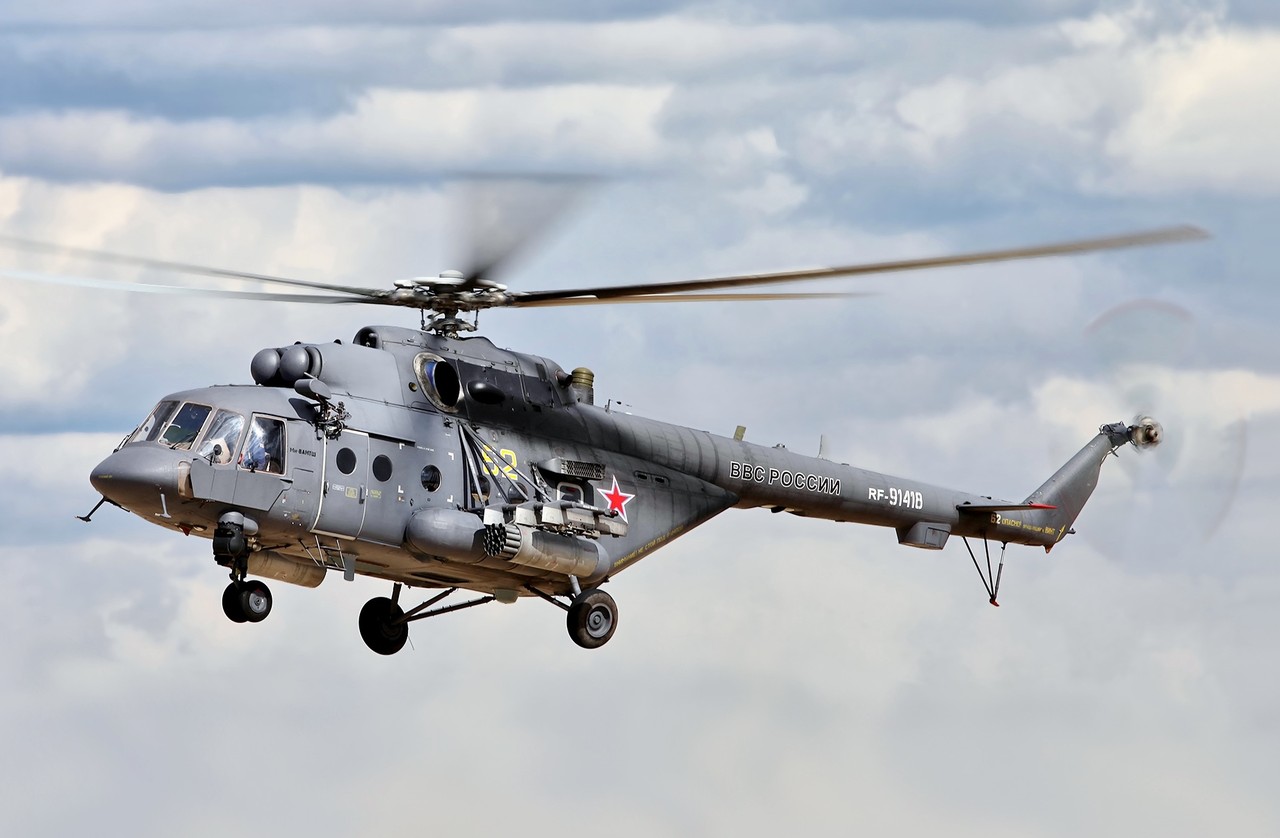
Design and Development
The Mi-172 emerged from the Mil Moscow Helicopter Plant's strategy to diversify the enormously successful Mi-8/17 military transport helicopter into civilian markets. Building upon the twin-turbine Mi-8M configuration introduced in 1975, engineers focused on passenger comfort and transport efficiency rather than military versatility. The design team reconfigured the cabin to accommodate 26 passengers in airline-style seating, a significant departure from the cargo-oriented military variants.
Manufacturing and Production
Kazan Helicopters, established in 1954 and later incorporated into Russian Helicopters holding company under Rostec in 2007, served as the primary production facility for the Mi-172. The first aircraft rolled off the production line in November 1994 with construction number 356C01, marking the beginning of limited but steady manufacturing. Production continued into the 2000s, with documented examples including construction number 862M43 completed in 2008.
Licensed production briefly expanded to China through Sichuan Lantian Helicopter Company beginning in 2008. The Chinese facility assembled 20 units that year from Russian-supplied kits, though this arrangement ended by 2021 as China shifted focus to its domestic Z-20 helicopter program.
Powerplant and Technical Specifications
The Mi-172 relies on twin Klimov TV3-117MT turboshaft engines, continuing the proven powerplant lineage that has driven the entire Mi-8/17 family for decades. These engines, manufactured by Klimov (now part of United Engine Corporation), deliver the reliability essential for civilian passenger operations. The turboshaft configuration provides the power-to-weight ratio necessary for the helicopter's substantial maximum takeoff weight of 265,352 kilograms.
The aircraft's five-bladed main rotor system spans 51.75 meters in diameter, generating lift for both the three-person crew and passenger complement. At 16.79 meters in height, the Mi-172 maintains the robust proportions characteristic of the Mi-17 family while optimizing internal volume for passenger comfort.
Operational Service
Unlike its military siblings, the Mi-172 found primary employment in civilian transport roles across diverse geographic markets. Indian operators, including aircraft registered as VT-SKE, demonstrated the helicopter's capability in commercial passenger service. The 26-seat configuration proved particularly suitable for regional transport in areas lacking adequate runway infrastructure for fixed-wing aircraft.
Venezuela's Bolivarian Military Aviation acquired at least one Mi-172, construction number 862M43, delivered on August 15, 2008. This aircraft, initially assigned serial number 1402, completed its first noted flight on August 21, 2008. By July 31, 2018, Venezuelan military authorities had renumbered the helicopter as 61029, indicating continued operational status within their transport fleet.
Legacy and Current Status
The Mi-172 represents a specialized branch of the world's most produced helicopter family. While exact production numbers for the Mi-172 variant remain undocumented, its contribution to the overall Mi-8/17 program's success is measurable in operational longevity and geographic distribution. As of 2024, Kazan Helicopters continues manufacturing Mi-8/17 variants, though current production focuses primarily on military and government configurations.
The helicopter's role in extending civilian access to rotorcraft transportation during the 1990s and 2000s demonstrates the enduring versatility of the basic Mi-8 design philosophy. With tracked examples remaining active in both military transport and civilian service as recently as 2018, the Mi-172 validates the fundamental soundness of adapting proven military platforms for commercial applications.
Today, the Mi-172 occupies a unique position within helicopter aviation history as evidence of Russian industry's attempt to penetrate civilian markets during the post-Cold War economic transition. While never achieving the production volumes of its military counterparts, the Mi-172 successfully proved that the Mi-8/17 platform could serve passenger transport markets with appropriate modifications and operational procedures.