
Evolution from Military Origins
The M-55 Geophysica emerged from a secretive Soviet program that began with the mysterious "Subject 34" prototype, destroyed during taxi tests in December 1978 when it unexpectedly lifted off and struck a hillside in zero visibility conditions. This setback led to the development of the M-17 Stratosphera, which first flew on May 26, 1982, originally designed to intercept high-altitude reconnaissance balloons penetrating Soviet airspace. The M-55 represented a fundamental transformation of this military concept into a dedicated scientific research platform.
Record-Breaking Performance
On September 21, 1993, test pilot Victor Vasenkov from the 8th State Research and Development Institute of the Air Force achieved the M-55's most celebrated milestone, reaching 21,360 meters altitude in the C-1j category for landplanes weighing 20,000 to 25,000 kilograms. This flight established one of 15 Fédération Aéronautique Internationale world records that remain unbroken today, cementing the aircraft's position among the world's most capable high-altitude platforms.
The Myasishchev Design Bureau Legacy
OKB Myasishchev, the design bureau responsible for the M-55, had established itself as a specialist in extreme-performance aircraft during the Cold War era. The bureau's approach to the M-55 emphasized reliability and endurance over the pure altitude capability of its M-17 predecessor. This philosophy manifested in the decision to employ twin engines rather than the M-17's single powerplant configuration, providing crucial redundancy for extended missions over remote terrain.
Innovative Engineering Solutions
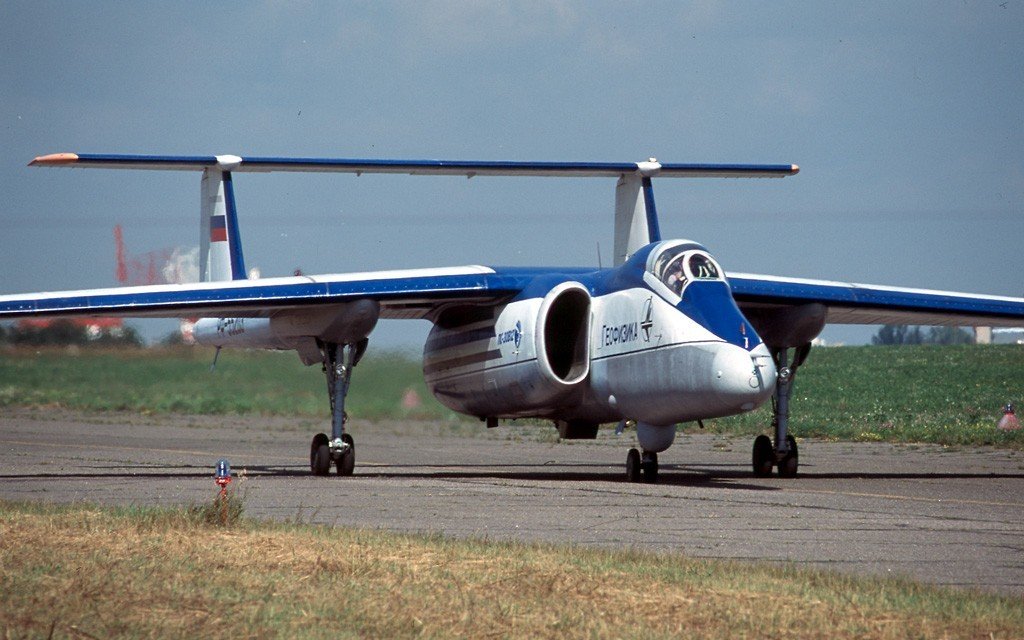
The M-55's distinctive appearance resembled an oversized motorized glider, with straight wings featuring high aspect ratios optimized for generating lift in the rarefied stratosphere. The twin-boom fuselage design positioned the pilot in an elongated central pod that housed comprehensive sensor packages and research equipment. The butterfly tail configuration provided directional stability while minimizing structural weight at the aircraft's operational altitude ceiling.
Powerplant Transformation
Replacing the M-17's single Kolesov RD-36-51 turbojet (68.6 kilonewtons thrust), derived from Tu-144 supersonic transport technology, the M-55 employed two Soloviev D-30-10V unreheated turbofans. Each engine generated 92 kilonewtons of thrust and shared heritage with powerplants used in MiG-31 interceptors and various Soviet passenger aircraft. This twin-engine arrangement enabled the M-55 to maintain flight operations even with single-engine failure, crucial for missions lasting over six hours at altitudes where emergency landing options were nonexistent.
Scientific Mission Capabilities
The M-55's operational profile centered on atmospheric research missions requiring sustained flight at 20,000 meters altitude for more than four hours. The aircraft's 5,000-kilometer range enabled comprehensive data collection across vast geographical areas. Between 1996 and 1997, M-55 aircraft conducted detailed Arctic stratosphere studies, followed by similar atmospheric experiments over Antarctica during 1999. These missions provided crucial data for understanding ozone depletion and climate change mechanisms.
Production and Variants
Manufacturing at the Kumertau helicopter plant in Bashkirya proceeded deliberately, with five M-55 aircraft completed between 1988 and 1994. The basic M-55 Geophysica featured single-seat configuration optimized for research missions, while the M-55UTS variant incorporated tandem seating for pilot training purposes. A proposed Geophysica 2 improvement never progressed beyond planning stages as political and economic changes affected Soviet aerospace programs.
Operational Characteristics
Pilots described the M-55's handling as surprisingly benign despite its exotic appearance and extreme operating environment. The aircraft's glider-like characteristics provided excellent stability during long-duration scientific missions, while the twin-engine configuration offered reassuring redundancy. The pressurized cockpit and life support systems enabled pilots to operate effectively at altitudes exceeding commercial airliner service ceilings by substantial margins.
Contemporary Status
The M-55 Geophysica remains active in scientific research roles, representing one of the few specialized high-altitude research platforms available to the international scientific community. Its unique combination of altitude capability, endurance, and payload capacity continues providing valuable atmospheric data collection services. The aircraft's 15 world records stand as testimony to Soviet aerospace engineering capabilities and the successful transition from military reconnaissance to peaceful scientific applications.
The M-55's legacy extends beyond its technical achievements, demonstrating how military aerospace technology could be successfully repurposed for environmental research during the post-Cold War era.