
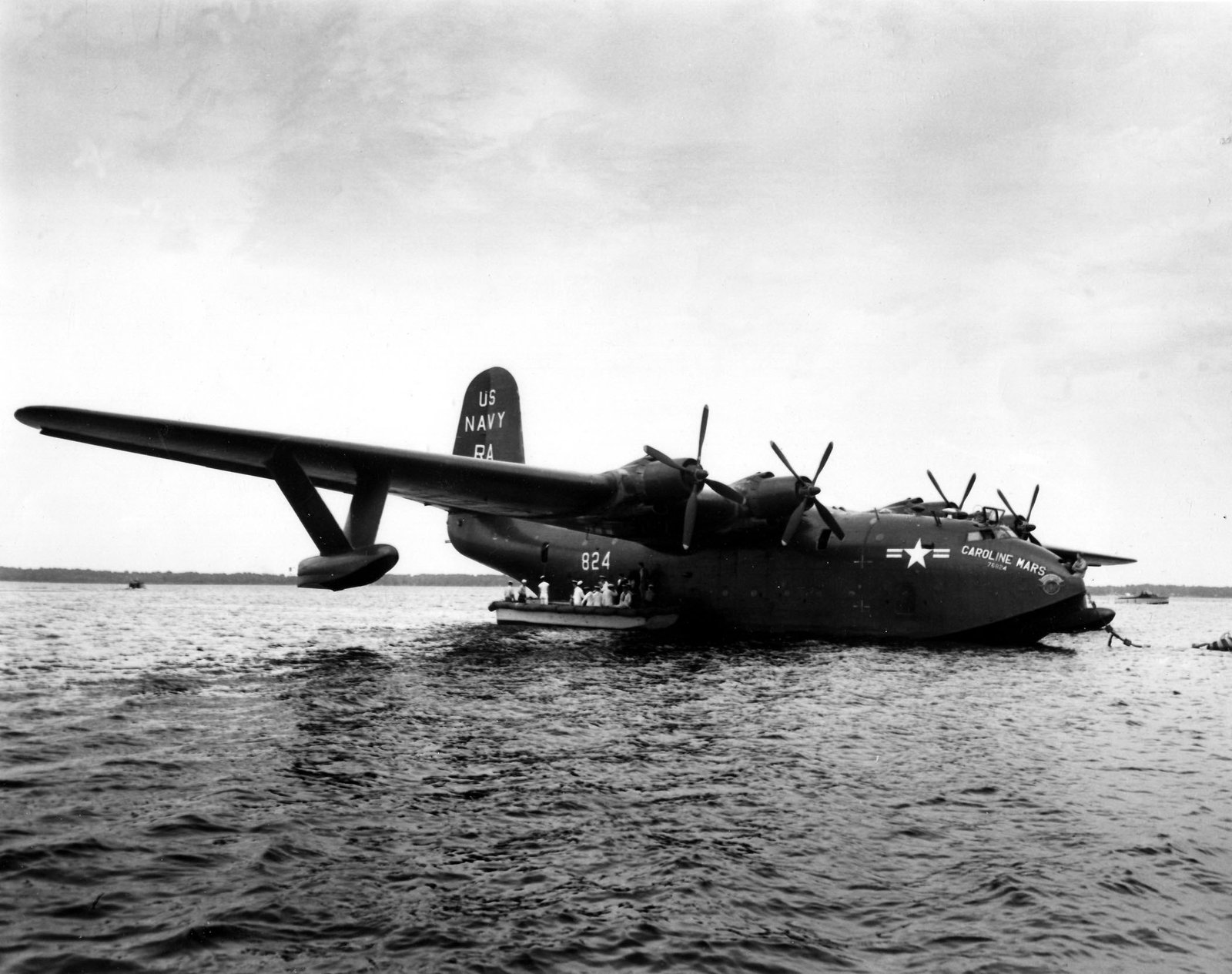
Production and Manufacturer History
The Martin JRM Mars was developed by the Glenn L. Martin Company at their facility in Middle River, Maryland, located on Dark Head Creek near Baltimore. A total of seven airframes were produced, consisting of one prototype (the XPB2M-1) and five production transport aircraft. The production transports included four JRM-1 and one JRM-2 variant, all of which were eventually upgraded to the JRM-3 standard. These airframes were completed between 1945 and 1948. The original manufacturer, the Glenn L. Martin Company, later merged with the American-Marietta Corporation in 1961 to form Martin Marietta, which subsequently merged with Lockheed in 1995 to become the modern aerospace conglomerate Lockheed Martin.
Design and Technical Specifications
Originally contracted in 1938 as the XPB2M-1 for long-range ocean patrol, the aircraft was a scaled-up version of the PBM Mariner. As the requirements of the U.S. Navy shifted during World War II, the design was converted into a dedicated cargo transport. The JRM transport version first flew on June 23, 1942, although the prototype XPB2M-1 is recorded as flying on July 3, 1942, following repairs from a ground-test accident.
The JRM-3 configuration featured a high-wing design with a length of 120 ft 3 in and a wingspan of 200 ft. It was powered by four Wright R-3350-24WA "Duplex-Cyclone" 18-cylinder radial piston engines. These supercharged, direct-fuel-injected engines produced 2,500 horsepower each at 2,900 rpm. The aircraft had a maximum speed of 211 knots at 15,600 ft and a cruise speed of 135 knots, providing a range of 3,790 nautical miles. Its massive hull allowed for a cargo capacity of 32,000 lb or the transport of 133 combat troops.
Service History
The Mars entered U.S. Navy service on November 30, 1943, and began ferrying cargo to Hawaii and the Pacific Islands on January 23, 1944. While it did not see combat during World War II, it served a vital logistical role. The five production aircraft were named after Pacific island groups: Marianas Mars, Hawaii Mars, Philippine Mars, Marshall Mars, and Caroline Mars. Notable milestones include the Caroline Mars carrying a record 269 passengers from San Diego to San Francisco on March 4, 1949. Tragedy struck on April 5, 1950, when the Marshall Mars suffered an engine fire and crashed at Ke’ehi Lagoon off Diamond Head, Hawaii; the wreck was rediscovered in 2004 at a depth of 1,400 ft.
Following its retirement from the U.S. Navy in 1956, several aircraft were converted into aerial firefighting water bombers in British Columbia, Canada. Operated by Forest Industries Flying Tankers (FIFT) and later Coulson Flying Tankers, these modified aircraft could drop over 7,200 U.S. gallons of water. The Hawaii Mars and Philippine Mars remained active in this role into the 21st century, with the type finally retiring from civil service in 2024.