
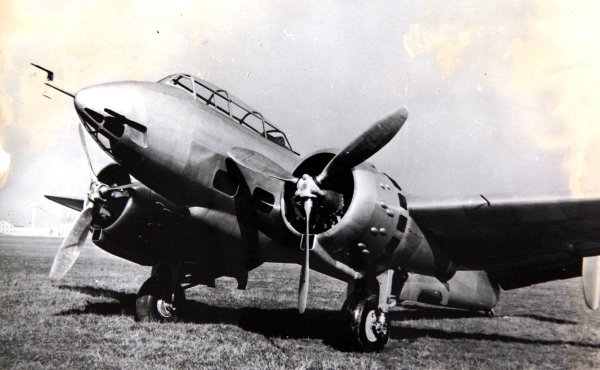
Design and Development
The Bloch MB.170 family was developed by Société des Avions Marcel Bloch in response to a 1936 French Air Ministry program seeking a multi-role bomber-combat-reconnaissance (BCR) aircraft. The design was led by Henri Deplante's team under the direction of Marcel Bloch. The MB.170 prototype first flew on February 15, 1938. This baseline design evolved into two primary operational versions: the MB.174, optimized for long-range high-altitude photo-reconnaissance, and the MB.175, designed as a light bomber. The MB.174 prototype made its first flight on January 5, 1939, at Villacoublay, piloted by René Le Bail.
Production and Manufacturing
Production of the MB.174 began in November 1939 at Mérignac, managed by SNCASO (Société nationale des constructions aéronautiques du Sud-Ouest), the nationalized entity that absorbed Bloch's southwestern factories. While production totals vary across sources—with estimates ranging from 56 to 227 aircraft—it is verified that over 100 units of the MB.170 series were produced. Following World War II, SNCASO produced a naval torpedo-bomber variant, the MB.175T (later re-designated as the SO.175T), starting in 1945.
Technical Specifications
The aircraft featured a low-wing monoplane configuration with retractable landing gear and an enclosed cockpit for a crew of three, consisting of a pilot, observer/bombardier, and rear gunner. It was powered by twin Gnome-Rhône 14N series piston radial engines. The MB.174 specifically utilized Gnome-Rhône 14N-48 and 14N-49 engines. Armament for the MB.174/175 typically included two wing-mounted 7.5 mm MAC 34 machine guns with 1,000 rounds each, two twin MAC 34 mounts for rear defense, and three ventral MAC 34 guns, with a bomb capacity of up to 400 kg.
Operational History
The MB.170 series entered service in March 1940, seeing combat with the French Air Force in units such as GR I/33, GR II/33, GR I/52, GR I/36, and GR II/52. Its high speed allowed it to evade Bf 109 and Bf 110 interceptors, with only three aircraft lost to enemy fighters during the Battle of France. Following the June 1940 armistice, many aircraft were moved to North Africa, where they served with Vichy forces, often conducting reconnaissance over Gibraltar. After Operation Torch in November 1942, these aircraft joined the Free French in the North African campaign and the Battle of Tunisia. Some captured airframes were later used by the Luftwaffe for pilot training. Post-war, the SO.175T served with the French Navy's 6F and 10S squadrons and the Rochefort training school until 1960.
Legacy
The MB.170 is historically significant as one of the few effective BCR aircraft to enter service before the 1940 collapse. It also holds a cultural legacy through the writer Antoine de Saint-Exupéry, who flew MB.174 missions with GR II/33; his 1940 experiences with the aircraft formed the basis of his memoir "Pilote de guerre" (Flight to Arras).