
Design and Development
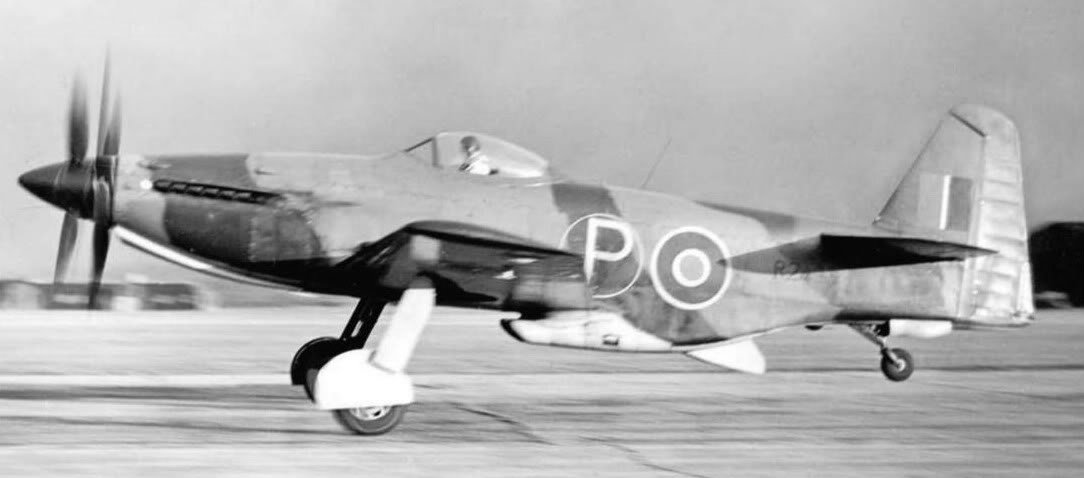
The Martin-Baker MB 5 was developed in response to Air Ministry Specification F.18/39, which sought a successor to the Supermarine Spitfire and Hawker Hurricane. Designed under the leadership of James (J.A.) Martin, the MB 5 was a comprehensive redesign following the MB 3 project. While it utilized similar wing panels to the MB 3, the MB 5 introduced a novel steel-tube fuselage framework with stressed skin, a departure from standard high-performance fighter construction of the era. This structure was intended to simplify maintenance and provide easier access to internal systems.
Technical Specifications and Performance
The sole prototype, serial R2496, first flew on May 23, 1944, piloted by Bryan Greensted, the chief test pilot for Rotol. It was powered by a liquid-cooled V-12 Rolls-Royce Griffon 83 engine producing approximately 2,340 hp. A defining technical feature was the use of two three-bladed contra-rotating propellers supplied by Rotol, which eliminated torque effects and improved acceleration and climb performance. The aircraft was armed with four 20 mm Hispano cannons mounted in the wings, outboard of the wide-track retractable undercarriage.
Performance evaluations indicated a top speed of 460 mph at 20,000 ft, an initial climb rate of 3,800 ft/min, and a service ceiling of 40,000 ft. Its range was estimated to exceed 1,000 miles, with some calculations suggesting up to 1,120 miles. Test pilots praised the aircraft for its stability as a gun platform, high maneuverability, and an excellent all-round view provided by its bubble canopy.
Service History and Legacy
Despite its capabilities, the MB 5 never entered operational service. It underwent official trials at the RAF's Armament Experimental Establishment (A&AEE) at Boscombe Down starting in February 1946. It was later used for training and servicing development by the Air Ministry Servicing Development Unit (SDU) at RAF Wattisham. By 1950, the aircraft was transferred to RAF Bircham Newton, where it served as a ground target until it was burned in 1963.
The aircraft failed to reach production primarily due to timing; by the time it was ready for evaluation in 1946, the RAF had shifted its strategic priority toward jet fighters like the Meteor and Vampire. This marked the end of Martin-Baker's venture into complete aircraft manufacture. Following a 1944 request from the Ministry of Aircraft Production to investigate ejection systems, the company transitioned into a specialist manufacturer of escape systems, a role the Martin-Baker Aircraft Company Ltd continues to hold today.