
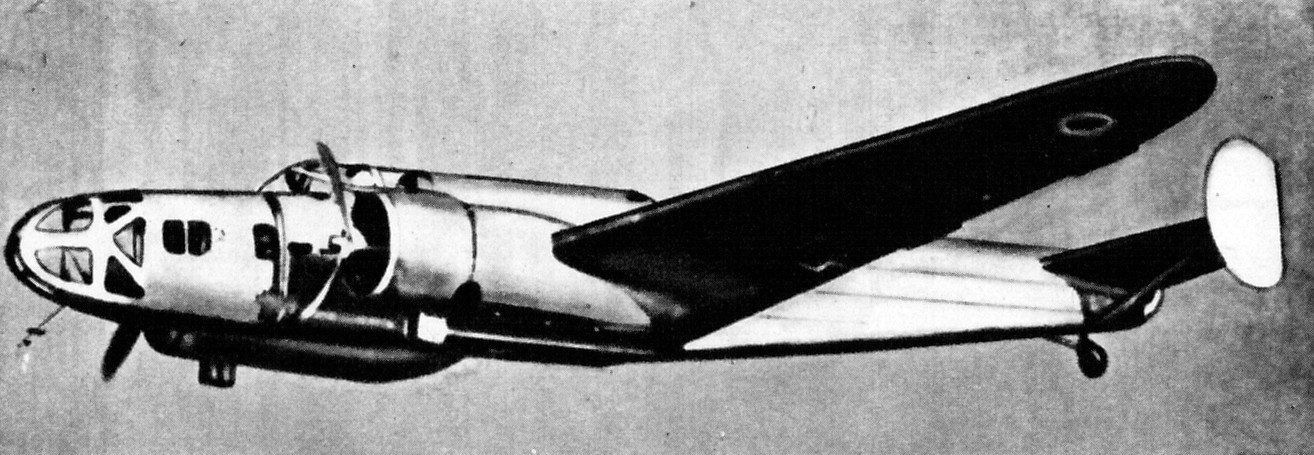
The Bloch MB.131 was a French twin-engine reconnaissance-bomber developed by Société des Avions Marcel Bloch under the leadership of founder Marcel Bloch. The aircraft evolved from the MB.130 prototype, which first flew on June 29, 1934. The MB.131 prototype itself made its first flight on August 12, 1936, followed by a second prototype on May 7, 1937, which introduced modifications to the dorsal turret and expanded the crew capacity to five. The resulting production design was a modern all-metal, low-wing monoplane, representing a significant shift away from the biplane and mixed-construction layouts common in earlier French reconnaissance aircraft.
Production of the MB.131 took place in France between approximately 1937 and 1940, with a first series production contract signed on April 1, 1936. According to Dassault Aviation, the corporate successor to Bloch, the Armée de l’Air accepted a total of 141 aircraft, a figure that includes three earlier prototypes (MB.130, MB.132, and MB.133) that were reworked to the MB.131 standard. The aircraft were powered by two Gnome-Rhône 14Kirs/Kjrs 14-cylinder, air-cooled radial piston engines, each producing 870 hp. In terms of performance, the MB.131 RB4 variant was capable of a range of approximately 2,200 km when carrying a 900 kg bomb load.
Entering squadron service in June 1938, the MB.131 was utilized by the Armée de l’Air in both R4 (reconnaissance) and RB4 (reconnaissance-bomber) roles. By September 1939, 109 aircraft were active across several reconnaissance groups, including GR I/14, GR II/14, GR I/21, GR II/22, GR I/35, GR I/36, GR II/36, GR I/55, GR II/55, and GR I/61. However, the aircraft proved inadequate for unescorted daytime missions against the Luftwaffe's Messerschmitt Bf 109. Consequently, by October 1939, most MB.131s were withdrawn from front-line service and reassigned to training, target towing, and fire-fighting duties. By May 10, 1940, 64 aircraft were in training units and 35 remained in auxiliary reconnaissance service. Between September 3, 1939, and June 24, 1940, the type suffered eight losses—four in combat and four in accidents—resulting in ten crew fatalities. Following the June 1940 Armistice, 53 aircraft remained in Vichy France, 21 of which were captured and scrapped by German forces in 1942. No complete airframes are known to survive today.