
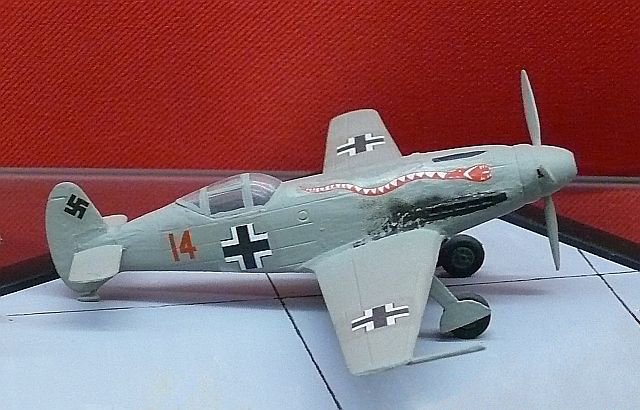
The Messerschmitt Me 209 designation encompasses two unrelated aircraft projects developed by Messerschmitt AG under the leadership of chief designer Willy Messerschmitt. The first was a specialized racing aircraft built between 1938 and 1939, intended solely to capture the absolute world air-speed record. To associate this success with the Luftwaffe's primary fighter, German propaganda referred to the aircraft as the "Me 109 R." The Me 209 V1 first flew on August 1, 1938, and by May 1939, four prototypes (V1–V4) had been completed at the Augsburg works. The design featured an extremely compact airframe with the cockpit positioned far aft to reduce drag, along with a retractable main gear and a rear skid. It utilized a specialized Daimler-Benz DB 601ARJ liquid-cooled V-12 engine, which produced approximately 1,775–1,800 hp, and could reach up to 2,300 hp using methanol-water injection. On April 26, 1939, test pilot Fritz Wendel flew the Me 209 V1 (registration D-INJR) over a 3 km course at Augsburg, achieving a certified speed of 755.14 km/h (469.22 mph). This record remained unbeaten for roughly 30 years, until August 16, 1969. Despite its speed, the aircraft's poor handling made it unsuitable for combat, and attempts to militarize the design failed.
In 1943, Messerschmitt developed a second, unrelated aircraft also designated as the Me 209. This project was an attempt to evolve the Bf 109 into a higher-performance fighter to compete with the Ta 152 and Fw 190 D. The prototype, Me 209 V5 (code SP+LJ), first flew on November 3, 1943, utilizing approximately 65% of the components from the Bf 109 G-5. The V5 underwent several engine changes, starting with a Daimler-Benz DB 603 A-1, followed by a DB 603 G on November 12, 1943, and finally a DB 605 B, which was flown on February 19, 1944. The projected Me 209 A-1 production variant was intended to carry a 30 mm MK 108 motor-cannon, two 20 mm MG 151/20 wing cannons, and two MG 131 fuselage machine guns. However, the V5 reached a maximum speed of only 699 km/h, failing to outperform its contemporaries. The program was terminated, and the V5 was subsequently damaged during an air raid on Augsburg. No original airframes from either the 1938 or 1943 projects are known to survive today.