
Combat Debut and Wartime Service
The Meteor entered operational service with RAF No. 616 Squadron on July 12, 1944, making history just fifteen days later when it began combat operations against German V-1 flying bombs on July 27, 1944, operating from RAF Manston in Kent. This marked the first time an Allied jet aircraft engaged in combat operations, giving Britain a technological edge in the final year of World War II.
The aircraft proved highly effective in its interceptor role, with pilots discovering that ramming V-1 flying bombs with their wingtips was often more reliable than cannon fire, as the early jet's guns sometimes jammed at high speeds. By war's end, Meteor pilots had successfully engaged numerous V-1 rockets, though the aircraft never encountered German jets in combat.
International Service and Korean War Operations
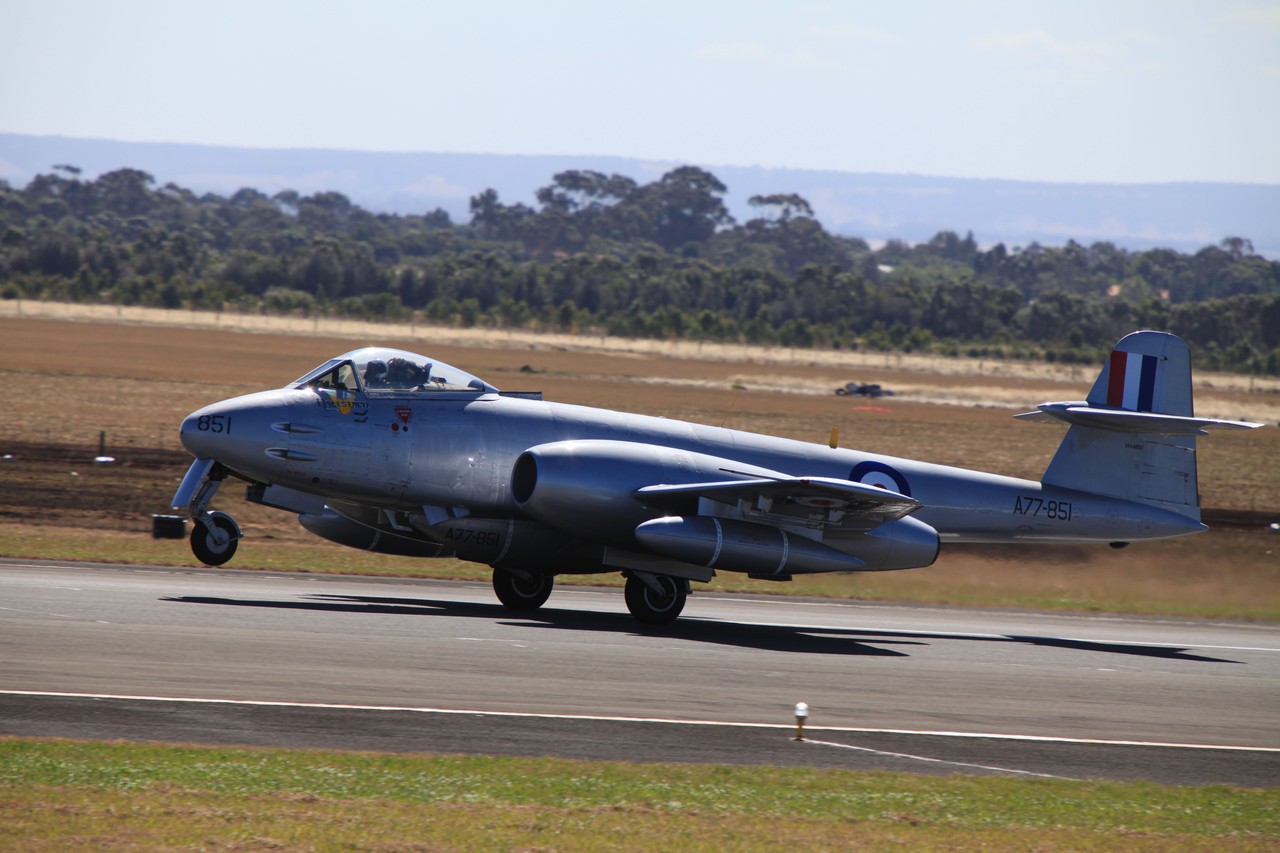
The Royal Australian Air Force became the first international operator when aircraft A77-1 arrived in June 1946. The RAAF acquired 93 F.8 variants and 4 T.7 trainers for Korean War service, with No. 77 Squadron becoming the first RAAF jet unit to enter combat on July 29, 1951. Australian Meteor pilots flew ground-attack missions and air-to-air combat against North Korean and Chinese forces.
The Indian Air Force signed its first direct purchase agreement on February 1, 1953, acquiring 11 F.8 fighters and 4 T.7 trainers to establish regional jet superiority. Egypt's air force operated 23 Meteors by 1952, while numerous other nations adopted the type throughout the 1950s.
The Gloster Aircraft Company Legacy
Gloster Aircraft Company, operating from 1917 to 1961, transformed from a biplane manufacturer known for aircraft like the Gladiator into Britain's premier jet pioneer. Chief designer W. George Carter led the development team that responded to Air Ministry specification F.9/40 in November 1940, Britain's first specification for an operational jet aircraft.
The company manufactured aircraft primarily at its Hucclecote airfield facility in Gloucestershire, England. In 1961, Gloster merged into the Bristol Aeroplane Company and later became part of British Aircraft Corporation, with elements eventually forming today's BAE Systems.
Engine Development and Technical Innovation
Early Meteors were powered by Rolls-Royce Welland engines producing 1,700 pounds of thrust each, evolved from Frank Whittle's pioneering turbojet designs. The initial prototype flew with less powerful Rover B.23 engines generating 1,526 pounds of thrust each, but production aircraft received the more reliable Welland powerplants.
Later variants, particularly the F.8 day fighter, utilized Rolls-Royce Derwent 8 engines producing 3,500 pounds of thrust each. This powerplant combination gave the F.8 variant a maximum speed of 590 mph at sea level, a service ceiling of 40,000 feet, and a range of 980 miles. The aircraft's empty weight was 10,622 pounds, with a maximum takeoff weight of 19,100 pounds.
Variants and Specialized Roles
Production encompassed numerous variants beyond the basic day fighter. The T.7 trainer accommodated two crew members and featured dual controls for pilot instruction, with aircraft like WA591 entering service in 1949. Armstrong Whitworth developed night fighter variants including the NF.11, NF.12, NF.13, and NF.14, featuring radar equipment and extended fuselages.
Reconnaissance variants included the FR.9 fighter-reconnaissance aircraft and the PR.10 photo-reconnaissance model. The F.4 served as an interim model between early and late production aircraft, while the F.8 became the definitive day fighter variant.
Production Achievement and Current Preservation
Total production reached between 3,875 and 3,947 aircraft according to various sources, with BAE Systems confirming 3,875 as the official count. This made the Meteor the most-produced British jet fighter of its era, with the final NF.14 variant delivered in May 1955.
Today, at least ten airframes remain registered worldwide, including flyable examples. The Planes of Fame Air Museum in California operates T.7 WA591, manufactured in 1949 with serial number 45-356460, as a flying memorial to Britain's jet aviation breakthrough. Other preserved examples include G-AKPK and G-BPOA in the United Kingdom, F-ZABM in France, and various museum displays across former operating nations.
The Meteor's significance extends beyond its production numbers, representing the successful transition from propeller-driven to jet-powered military aviation and establishing the technological foundation that would define air combat for decades to come.