
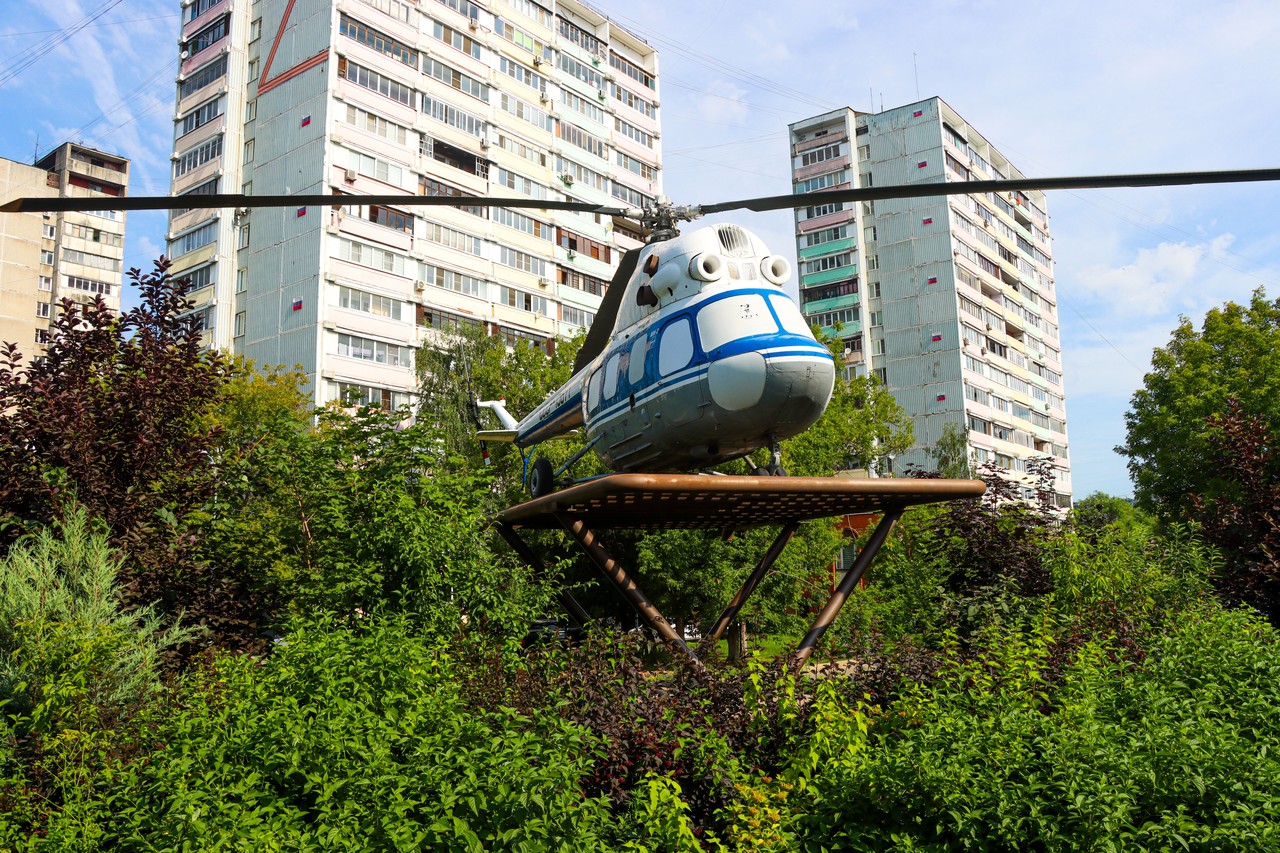
Revolutionary Design Philosophy
Mikhail Mil's design team at the Mil Moscow Helicopter Plant conceived the Mi-2 in the early 1960s as a turbine-powered successor to the reliable but limited Mi-1 "Hare." The breakthrough lay in replacing the single piston engine with two Isotov GTD-350 turboshaft engines mounted side-by-side above the cabin. Each engine initially produced 400 shaft horsepower, later uprated to 450 shp from 1974, providing unprecedented power-to-weight ratio for aircraft in this class.
The first Polish-built example took flight on November 4, 1965, marking the beginning of an extraordinary production run that would span over three decades. The design incorporated advanced features including fiberglass rotor blades introduced in 1974, hydraulic rotor hub dampers, bleed-air anti-ice intake systems, and electro-thermal de-icing equipment.
Production Legacy in Poland
In a unique Cold War arrangement, the Soviet Union transferred exclusive production, development, and marketing rights to WSK PZL-Świdnik in January 1964 as part of a Comecon rationalization program. The Polish factory in Świdnik, which had previously license-built 1,700 Mi-1 helicopters from 1955, became the sole manufacturer of this Soviet-designed aircraft.
Production continued until the early 1990s, with various sources citing suspension in 1991 pending privatization, though manufacturing may have continued until 1999. By the end of production, approximately 5,500 units had been completed, with PZL-Świdnik records showing 5,497 aircraft delivered. Roughly one-third of total production served military users, while the remainder entered civil service worldwide.
Military Service and NATO Designation
The Mi-2 received the NATO reporting name "Hoplite" and served extensively with Soviet bloc air forces. East German forces employed the type for artillery spotting and electronic warfare missions, while other Warsaw Pact nations utilized it across diverse military roles. The aircraft proved adaptable to numerous combat variants including anti-armor configurations, gunship versions, photographic reconnaissance platforms, and search-and-rescue aircraft.
Twelve distinct series emerged during the production run, each tailored to specific operational requirements. Military operators included Nicaragua and Syria among numerous Soviet allies, though the aircraft saw limited direct combat compared to larger military helicopters of the era.
Engine Innovation
S. P. Isotov developed the GTD-350 turboshaft at the Isotov Design Bureau specifically for light helicopter applications. The twin-engine configuration provided crucial redundancy while the compact turboshaft design freed significant cabin space compared to piston engines. The powerplant installation represented a 40 percent increase in available power while reducing engine weight by half compared to the Mi-1's piston engine.
This power advantage translated directly into operational capability. The Mi-2 could carry eight passengers in standard configuration or ten in the later Mi-2M wide-body variant. As an agricultural aircraft, it handled 450 kilograms of dry chemicals or 500 liters of liquid spray. Medical evacuation variants accommodated four stretchers with attendant medical equipment.
Performance Achievements
On June 20, 1965, test pilot Tatyana Russyan established a class speed record of 269.38 kilometers per hour in an Mi-2, surpassing an earlier 254 km/h record set in 1963. These achievements demonstrated the aircraft's performance superiority over contemporary light helicopters and validated Mil's turboshaft design approach.
The cargo compartment measured 2.27 meters in length, extending to 4.05 meters including the cockpit area, with 1.2 meters width and 1.4 meters height. While overall dimensions remained similar to the Mi-1, the internal volume proved far more versatile due to the relocated powerplant.
Civil Applications
Civil operators embraced the Mi-2 for passenger transport, air ambulance service, television relay missions, agricultural spraying, and surveying operations. Export versions including the Kania/Kitty Hawk and Taurus variants were developed specifically for Western markets, expanding the type's global reach beyond traditional Soviet sphere customers.
The aircraft's versatility made it particularly valuable for operators requiring multi-role capability from a single airframe type. Airlines used it for short-haul passenger service, while specialized operators configured it for unique missions ranging from offshore support to utility line inspection.
Current Status and Museum Preservation
Many Mi-2 helicopters remained in service as of 1999, though exact numbers of currently airworthy aircraft are not precisely documented. The type's robust construction and straightforward maintenance requirements have enabled extended service lives in numerous countries.
Notable preserved examples include SP-SAY (constructor number 529538125, built 1985) displayed at The Helicopter Museum in the United Kingdom. This aircraft represents the thousands of Mi-2s that served civilian and military operators across six continents during the Cold War and beyond.
The Mi-2's influence extended beyond its own production run, as PZL-Świdnik used knowledge gained from the program to develop the indigenous W-3 Sokół helicopter, which first flew in 1979 with new engines, rotors, and enlarged cabin based on Mi-2 experience.