
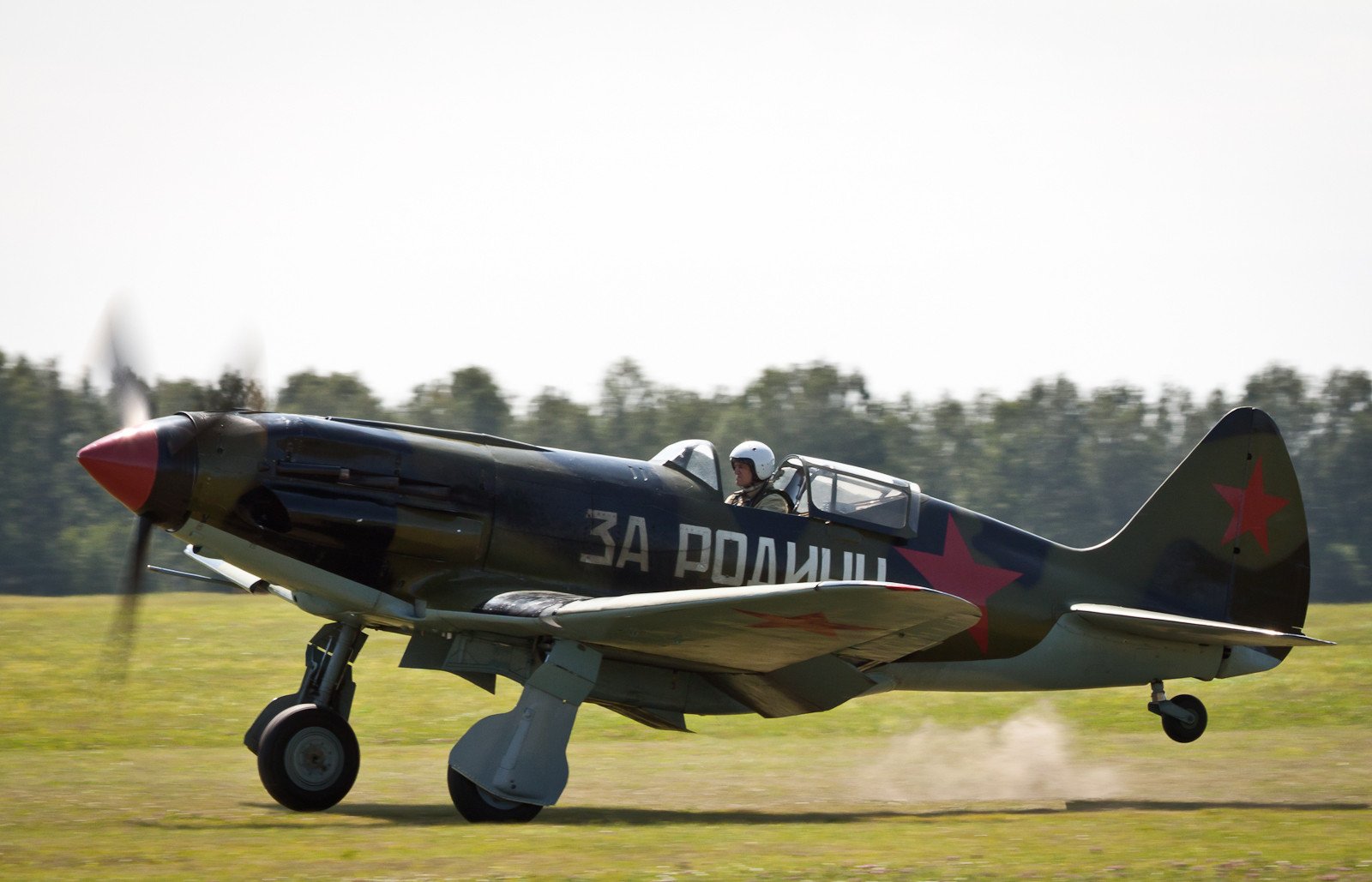
The Mikoyan-Gurevich MiG-3 was a single-seat, single-engine fighter developed in the Soviet Union as a high-altitude interceptor. Designed by the Mikoyan-Gurevich Design Bureau (OKB-155) under the leadership of chief designer Artem Ivanovich Mikoyan and lead engineer Mikhail Iosifovich Gurevich, the aircraft was a refinement of the earlier I-200/MiG-1 project. The prototype I-200 first flew in April 1940, specifically on April 5 or 6, while the production-standard MiG-3 began flying in late 1940.
Production of the MiG-3 took place from late 1940 until December 1941 at Factory No. 1 in Moscow, also known as Zavod No. 1 imeni Aviakhima or Zavod No. 1 im. Stalin. Due to fragmentary wartime records, production totals vary; however, most sources estimate approximately 3,172 MiG-3 airframes were built, with some estimates ranging between 3,100 and 3,200. Production was terminated in December 1941 as the plant was evacuated east to avoid advancing German forces, with manufacturing shifting toward the simpler LaGG-3.
Technically, the MiG-3 was optimized for speed and altitude. It was powered by a single Mikulin AM-35A liquid-cooled, supercharged V-12 piston engine producing roughly 1,300 to 1,350 hp for take-off. This powerplant allowed the aircraft to reach a service ceiling of over 12,000 meters and a maximum speed of 640–650 km/h at an altitude of approximately 7,000 meters. Its all-metal stressed-skin airframe featured a long, narrow fuselage and small wings, which provided high-altitude efficiency but resulted in demanding handling characteristics at lower altitudes.
During World War II, the MiG-3 served primarily with the Soviet Air Forces (VVS) and the Soviet Air Defence Forces (PVO). It was deployed extensively during the German-Soviet War, particularly in the defense of Moscow in 1941 and 1942, where its high-altitude capabilities were used against reconnaissance aircraft and bombers. While it was a formidable interceptor, it was poorly suited for the low-to-medium altitude dogfights common on the Eastern Front, leading to its gradual withdrawal from frontline service by late 1942 in favor of the Yak and La series. Standard armament typically included one 12.7 mm Berezin UB machine gun and two 7.62 mm ShKAS machine guns.
Today, the MiG-3 is remembered as the aircraft that established the MiG brand, which evolved into the Russian Aircraft Corporation MiG under the United Aircraft Corporation (UAC). Very few examples survive, mostly as reconstructed museum pieces in Russia, with at least one restored to airworthy condition in the 21st century.