
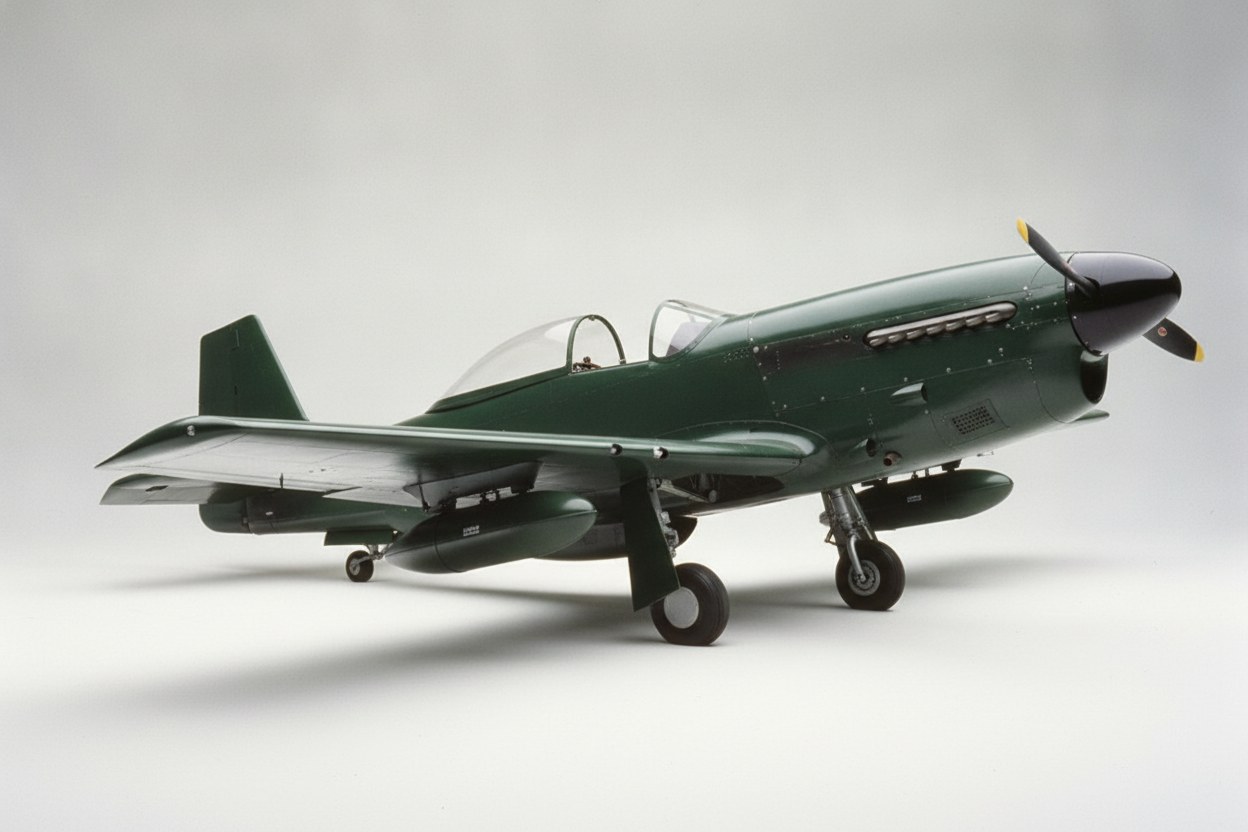
Development and Design Philosophy
Marcel Jurca, a Romanian-born aircraft designer and former Henschel Hs 129 pilot during World War II, conceived the Gnatsum series as an accessible pathway for homebuilders to own a high-performance warbird replica. Operating his French design firm from the 1960s until his death in 2001, Jurca created the name "Gnatsum" by reversing "Mustang," reflecting his intent to capture the essence of the legendary fighter in a scaled-down package.
The MJ-77 represented the middle ground in Jurca's three-variant approach: the MJ-7 at two-thirds scale, the MJ-77 at three-quarters scale, and the full-scale MJ-70. This scalability allowed builders to choose their desired size based on available engines, construction space, and performance requirements. The design featured fabric-covered wooden construction with a cantilever low-wing layout, enclosed cockpit, and manually retractable tailwheel landing gear derived from Jurca's earlier Sirocco design.
Construction and Manufacturing
Unlike mass-produced aircraft, the MJ-77 existed solely as plans-built and kit aircraft for amateur constructors. More than 25 Gnatsum series aircraft across all variants have been completed since 1969, with at least four to five confirmed MJ-77 examples reaching flying status. Construction occurred primarily in France by individual builders, though the design's appeal spread internationally.
Falconar Aircraft of Canada acquired manufacturing rights and became a significant distributor of Jurca plans. Founded around 1956-57 by Christopher Barnard Falconar, the company had established itself as a major plans distributor by the early 1960s, selling nearly 1,500 sets of plans between 1959 and 1965 for various aircraft types, including French designs. This partnership extended the Gnatsum's reach throughout North America, though Falconar is no longer active in Gnatsum production.
Notable Examples and International Spread
Several documented MJ-77 examples showcase the type's international appeal and varied powerplant options. Aircraft number 004, registered F-PANG and later G-PSIR, was built in France with a 260-horsepower Potez 4D34C engine driving a three-blade constant-speed propeller. Number 034, registered N751JR and construction number 34P51B-01J.R.M., was completed in 1996 and had accumulated more than 62 flight hours by the 2010s.
In the United States, aircraft number 053 (N51MJ) made its maiden flight in 1999 under the guidance of Mr. Reichert in Owosso, Michigan. Number 055 (N151MS) achieved first flight in 1983 with builder-pilot Marvin Skinner in Fort Pierce, Florida, powered by a Lycoming IO-series engine. The design even reached Australia, where J.J. Holmes of Ulverstone, Tasmania, constructed VH-ZYC (construction number JJH4) powered by a General Motors LQ-9 V-8 engine driving a four-blade Ivoprop propeller.
Engine Flexibility and Performance
The MJ-77's design accommodated a remarkable range of powerplants from 250 to 600 horsepower, including V-8, inline, and radial piston engines. This flexibility reflected Jurca's understanding that homebuilders needed options based on availability, cost, and desired performance. Beyond the documented installations, suitable engines included the Ranger 6-440C-5 inline six-cylinder, de Havilland Gipsy Major I, Menasco C4, Rambler inline-six, and various General Motors aluminum V-8 configurations.
With a typical loaded weight of 2,860 pounds and wing area of 145 square feet, the MJ-77 achieved impressive performance figures. Maximum speed reached 289 mph, with a cruise speed of 230 mph and stall speed of 65 mph. The aircraft demonstrated a climb rate of 1,500 feet per minute and range of 500 miles with its 41.6 Imperial gallon fuel capacity.
Legacy and Current Status
The Gnatsum series represented a significant achievement in homebuilt aviation, proving that amateur constructors could build high-performance replicas of classic warbirds using traditional materials and techniques. The wooden construction, while requiring considerable skill, remained within the capabilities of dedicated homebuilders and offered the authentic feel of World War II-era aircraft.
While exact numbers of currently airworthy MJ-77 aircraft remain unknown, several examples continue flying decades after their completion. Plans remain available from Avions Marcel Jurca, ensuring the design's continued availability for future builders. The MJ-77's cultural significance lies in democratizing access to warbird-style performance and aesthetics, allowing enthusiasts to experience something approaching P-51 Mustang characteristics at a fraction of the cost of owning an original fighter.
The design's influence extended beyond individual ownership, contributing to the broader homebuilt warbird movement that emerged in the latter half of the 20th century. By proving that complex, high-performance replicas could be successfully constructed by amateurs, the MJ-77 Gnatsum helped establish a template that influenced numerous subsequent warbird replica projects.