
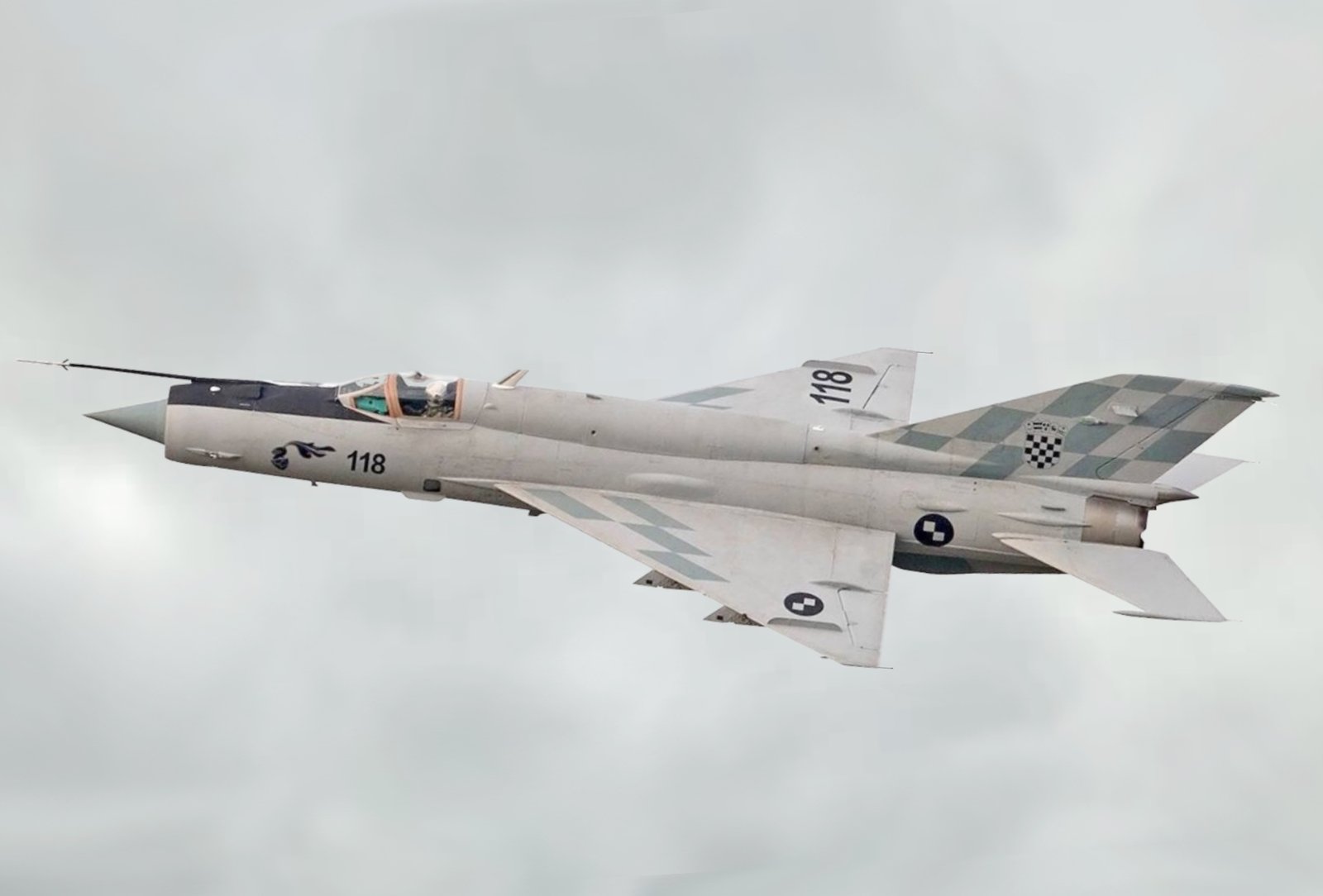
Design and Development
The MiG-21 was developed by the Mikoyan-Gurevich Design Bureau (OKB-155) under the leadership of chief designer Artem Ivanovich Mikoyan and his partner Mikhail Iosifovich Gurevich. The design process involved several prototypes; while the swept-wing Ye-2 flew in 1954, it was the delta-wing Ye-4, which first flew on June 16, 1955, that served as the direct ancestor to the production model. Pre-series aircraft, including the Ye-5 and Ye-6 family, flew between 1956 and 1957, leading to the official entry of the MiG-21 into service with the Soviet Air Forces by 1959.
Technical Specifications
Designed as a short-range supersonic interceptor, the aircraft is notable for its 57° leading-edge sweep delta wing and a nose intake featuring a central shock cone that houses radar equipment. This configuration allowed the aircraft to reach speeds exceeding Mach 2. The MiG-21 is powered by a single Tumansky axial-flow turbojet. Early variants utilized the R-11F-300, providing afterburning thrust between 5,600 and 6,000 kgf. Later versions, such as the MiG-21bis, employed the R-25-300 engine, which could reach up to 7,100 kgf in emergency mode. A representative MiG-21bis has a maximum takeoff weight of approximately 10,400 kg and a service ceiling of up to 18,000 meters.
Production History
Production occurred from 1959 to approximately 1985, with total estimates reaching over 11,000 aircraft. In the USSR, the Sokol Aircraft Plant (Aviation Plant No. 21) in Nizhny Novgorod was a primary manufacturer, alongside the Tbilisi Aircraft Manufacturing plant. Several nations produced the aircraft under license: AERO Vodochody in Czechoslovakia built the Aero S-106 (a MiG-21F-13 variant) in the mid-1960s, and Hindustan Aeronautics Limited (HAL) in India produced hundreds of units, including the MiG-21FL, M, and bis variants, from the 1960s into the early 1980s. Additionally, the Chengdu Aircraft Industry Group in China developed the J-7 (F-7 for export), a derivative based on the MiG-21F-13, with production continuing into the early 21st century.
Service and Legacy
Operated by over 30 air forces, the MiG-21 saw extensive combat in the Vietnam War, the Arab-Israeli conflicts (including the Six-Day War and Yom Kippur War), and the 1971 Indo-Pakistan War. It served in various roles, transitioning from a pure interceptor to a fighter-bomber in later versions like the MiG-21bis and the Indian-operated "Bison." While not designed for civil use, some aircraft now exist as privately owned warbirds. The design bureau's legacy continues through the Russian Aircraft Corporation "MiG," now part of the United Aircraft Corporation.