
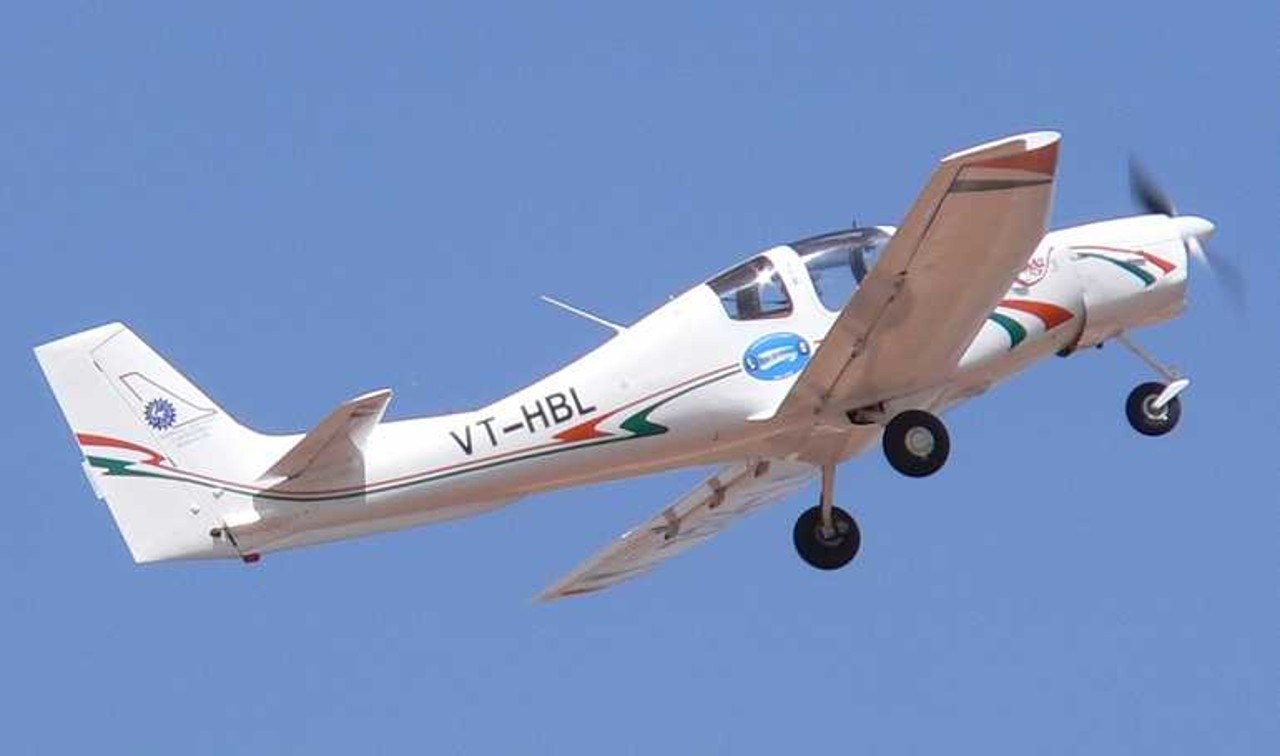
Development and Design Innovation
The Hansa program began in May 1989 under NAL's NALLA (NAL Light Aircraft) initiative, representing India's ambitious entry into modern aircraft design. NAL's engineering team evaluated three different concepts before settling on the Hansa-2 configuration after wind tunnel testing revealed problems with the original pusher-engine Hansa-1 design. The development cost reached $40 million by 1997, establishing the foundation for India's composite aircraft expertise.
The aircraft incorporated several groundbreaking features for Indian aviation manufacturing. As the country's first all-composite aircraft, it utilized advanced computational fluid dynamics for aerodynamic optimization and featured lightning protection systems for night operations. The design team achieved certification under FAR Part 23 Amendment 23-42/JAR-VLA standards on February 1, 2000, validating the aircraft for both day and night VFR operations.
Engine Evolution and Performance
The Hansa underwent significant powerplant changes throughout its development. The initial Hansa-2 prototype flew with a Continental O-200 engine producing 100 horsepower, but engineers upgraded to a Lycoming IO-240B generating 125 horsepower on January 26, 1996, in the Hansa-2RE variant. The production Hansa-3 adopted the Austrian-built Rotax 914-F3 turbocharged engine on May 11, 1998, providing 115-135 horsepower and enhanced high-altitude performance capabilities.
This engine selection proved crucial for the aircraft's training mission, offering reliability and fuel efficiency while maintaining docile handling characteristics essential for student pilots. The Rotax 914's turbocharging capability extended the aircraft's operational ceiling and performance envelope, making it suitable for diverse Indian geographic conditions.
Manufacturing and Production
Production manufacturing centered at Taneja Aerospace and Aviation Ltd. facilities in Bangalore, with specialized composite fuselage shells produced by Reinforced Plastics Industries beginning August 28, 2002. The first production aircraft was delivered on March 20, 2001, followed by DGCA acceptance on April 12, 2001, for delivery to Andhra Pradesh Aviation Academy.
Exactly 16 production-standard Hansa-3 aircraft were completed by 2004, plus four development prototypes. Notable deliveries included VT-HNT to Hyderabad on May 8, 2001, VT-HNU to Kerala Aviation Training Centre on March 22, 2002, and VT-HNS to IIT Kanpur's Aerospace Engineering Department the same day. Manufacturing ceased around 2004 after completing this limited production run.
Operational Service and Training Impact
The Hansa served exclusively in civilian training roles across Indian flying institutions. Primary operators included the Andhra Pradesh Aviation Academy, Kerala Aviation Training Centre, Trivandrum Flying Club, and various DGCA-affiliated training organizations. By 2004, the fleet had accumulated approximately 2,000 incident-free flight hours, demonstrating the design's safety and reliability for ab initio training missions.
Student pilots and instructors reported positive experiences with the aircraft's predictable handling characteristics and modern systems. The aircraft's unit cost of approximately 4.5 million rupees ($90,000) in 2001 made it economically attractive compared to imported alternatives, supporting India's goal of developing indigenous training capabilities.
The Manufacturer Legacy
National Aerospace Laboratories, established in 1959 under the Council of Scientific and Industrial Research, leveraged the Hansa program to develop expertise in composite materials and computational fluid dynamics that would benefit future projects. The organization continues operating today as CSIR-NAL in Bengaluru, applying lessons learned from Hansa to develop the Saras transport aircraft and Hansa-NG advanced trainer.
Taneja Aerospace and Aviation Ltd., founded in 1988, partnered with NAL throughout the late 1980s and 1990s but faced operational challenges after 2002. The company transferred manufacturing techniques to external contractors, and its current operational status remains unclear following the program's conclusion.
Modern Revival and Legacy
The Hansa legacy continues through the Hansa-NG program, which achieved first flight on September 3, 2021. This modernized variant incorporates digital engine controls, glass cockpit displays, and enhanced systems while maintaining the original's fundamental design philosophy. By 2023, flying clubs had submitted 72 letters of intent for the new aircraft, with Vman Aviation Services adding 10 additional orders at Aero India 2023.
At least 13-16 Hansa airframes existed by 2004, though current airworthiness status remains undocumented. The original Hansa-2 prototype VT-XIW was retired to the HAL museum after completing 128 flight hours, representing a tangible reminder of India's first successful composite aircraft program and its contribution to the nation's aerospace manufacturing capabilities.