
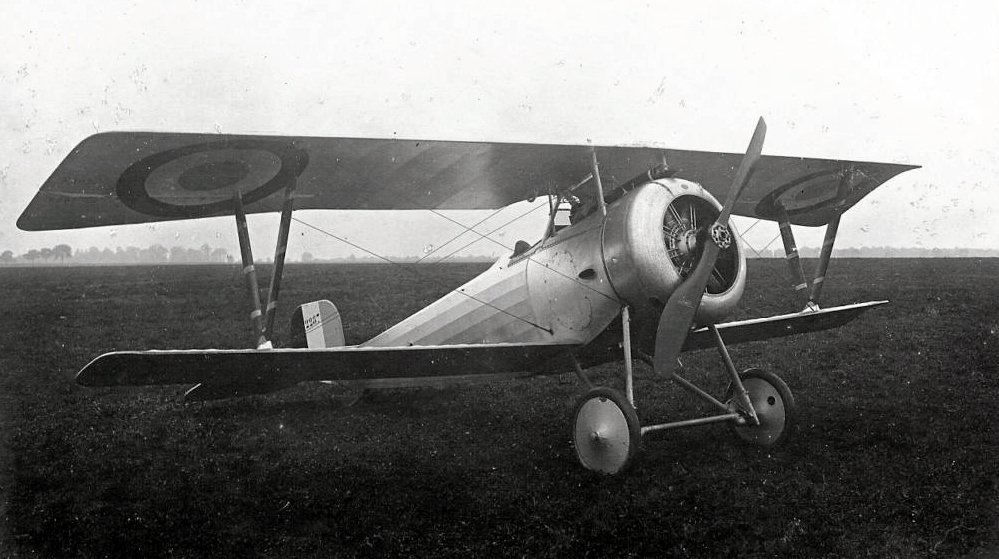
The Nieuport 17bis (Nieuport XVIIbis C.1) emerged in late 1916 as an enhanced version of the widely utilized Nieuport 17 sesquiplane. Designed by Société Anonyme des Établissements Nieuport, the aircraft maintained the characteristic sesquiplane configuration—featuring a large upper wing and a significantly smaller lower wing—which provided pilots with excellent downward visibility and high maneuverability. While the original Nieuport 17 first flew in January 1916, the 17bis refinement introduced several key technical upgrades, including increased fuselage fairing to improve aerodynamic streamlining.
At the heart of the 17bis was a 130 hp (97 kW) Clerget 9B nine-cylinder rotary piston engine, providing a power increase over the 120 hp Le Rhône engine used in the standard Nieuport 17. This powerplant enabled a maximum speed of 175 km/h (109 mph) at sea level and 172 km/h (107 mph) at an altitude of 3,000 meters (9,800 ft), with a service ceiling reaching 7,000 meters (23,000 ft). In terms of armament, British service aircraft were equipped with a synchronized 7.7 mm (.303 in) Vickers machine gun firing through the propeller arc, a departure from the over-wing Lewis guns common on earlier British Nieuports. Additionally, the aircraft was capable of carrying eight Le Prieur rockets for targeting ground objectives or balloons.
Production of the 17bis occurred in small numbers, primarily under license in the United Kingdom for the Royal Naval Air Service (RNAS). The RNAS was the primary operator, with 6 (Naval) Squadron being the only unit fully equipped with the type. Other units included 9 (Naval) Squadron, which utilized two aircraft in February 1917, and 11 (Naval) Squadron, which used the type as an operational training unit. The French Aéronautique Militaire operated only a small number of 17bis for testing and trials; notably, French ace Charles Nungesser flew one example bearing the serial number N1895. In frontline service, the 17bis replaced the Nieuport 10 and 11 before eventually being superseded by the Sopwith Camel. While the original Nieuport company is now defunct, the 17bis remains a significant example of the rapid evolution of Allied fighter aircraft during the 1916–1917 period.