
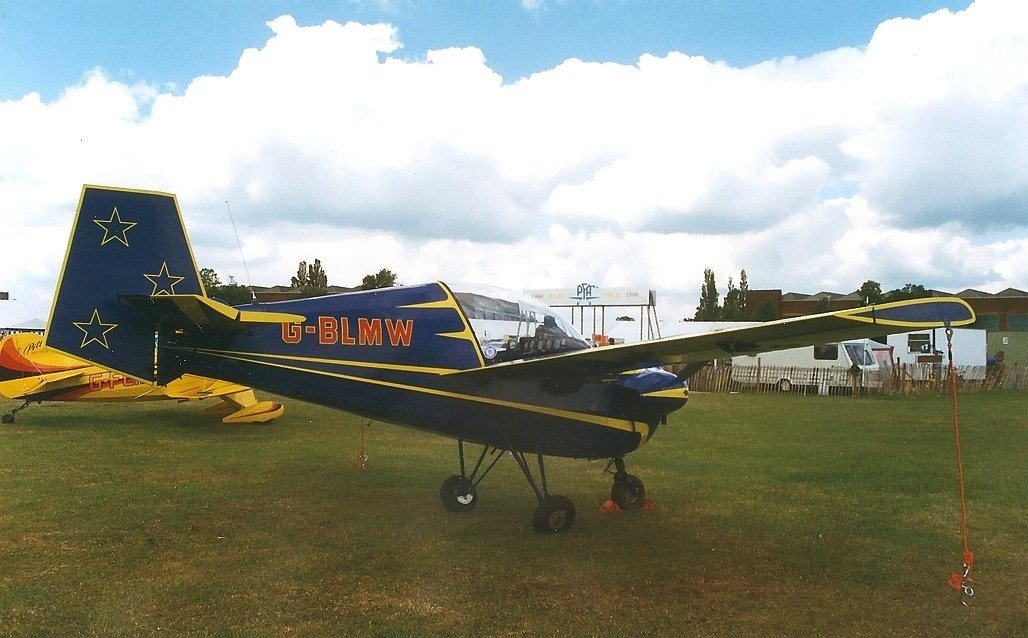
Design Philosophy and Origins
Ernest Oscar Tips, managing director of Avions Fairey SA, conceived the Nipper in 1952 as an answer to expensive aerobatic training aircraft. Tips, who named the aircraft after his first grandchild, established ambitious design objectives: create a simple, inexpensive aircraft that could perform basic aerobatics while remaining accessible to amateur builders. The prototype OO-NIP rolled out as construction number 01, with test pilot Bernard Neefs taking it aloft for the first time on December 12, 1957, from Gosselies, Belgium.
Production Journey Across Europe
Avions Fairey SA launched production in 1959, delivering 59 complete aircraft and 78 kits between 1959 and 1961 before shifting focus to F-104G Starfighter assembly for the Belgian Air Force. This transition effectively ended Fairey's Nipper production, but the design found new life through Cobelavia SA, which assembled 18 additional aircraft between 1962 and 1966. The production rights eventually crossed the English Channel to Nipper Aircraft Ltd., which contracted Slingsby Sailplanes at Kirkbymoorside to build approximately 28 Mk.III variants from 1966 to 1968. A devastating fire in November 1968 abruptly halted Slingsby's production line, but by then roughly 100 factory-built Nippers had emerged from European workshops.
Engineering Innovation on a Budget
The Nipper's structural philosophy emphasized simplicity without sacrificing capability. Tips designed a welded steel tube fuselage paired with a distinctive single-spar wooden wing featuring a constant-section plywood box construction reinforced with wooden strips. The wings could fold for hangar storage, while the fabric-covered control surfaces provided adequate authority for loops and rolls, though pilots needed to enter these maneuvers from dives due to the aircraft's modest power output.
Three engine variants powered different production batches: the Mk 1 used a 40-horsepower Pollman-Hepu conversion of the Volkswagen flat-four, the Mk 2 featured the 45-horsepower Stark Stamo variant, and the later Mk III incorporated the Rollason Ardem Mk10, certified in 1967. These automotive-derived powerplants, while underpowered for sustained aerobatics, proved reliable and economical for the aircraft's intended training role.
The Manufacturer's Legacy
Avions Fairey SA traced its roots to the early 1920s, establishing itself as a significant player in European aviation through production of military aircraft including the Fairey Fox and Battle bombers before World War II. Under Tips' post-war leadership, the company pivoted toward civilian aircraft and gliders, with the Nipper representing the culmination of this philosophy. When Belgian Air Force contracts demanded attention in 1961, Fairey's civilian aircraft ambitions took a backseat to military production requirements. The company eventually evolved into SONACA S.A., which continues operations today, though far removed from its light aircraft heritage.
Global Distribution and Service
The Nipper found enthusiastic operators worldwide, particularly in Australia where several examples established service records. VH-CGA, construction number 36, received its Australian registration in January 1961, while VH-CGB began a more troubled career, suffering damage on its second flight in June 1961. Other notable examples included VH-CCH, which operated between Australia and the United Kingdom from 1963 to 1964, and VH-EOK, construction number 123, which began its career in the UK in 1969 before migrating to Australia.
Performance and Pilot Experience
Despite its modest power output, the Nipper delivered respectable performance for its era. The aircraft achieved a basic range of 400 kilometers, extendable to 720 kilometers with optional wingtip fuel tanks carrying 63.6 liters. While cruise speeds and service ceilings remain poorly documented, contemporary reports praised the aircraft's docile handling characteristics and forgiving nature during training operations.
Enduring Legacy
By 2007, at least two Nippers remained airworthy on Australia's Recreational Aviation Australia register: construction number 1630 (originally S123), re-engined with an 85-horsepower Jabiru 2200 and based at The Oaks, New South Wales, and construction number 35, also Australian-registered. In the United States, N5387T maintained its FAA registration with validity extending through 2027.
The Nipper's cultural significance extends beyond its modest production numbers. Raymond Cuypers documented the aircraft's story in "The Tipsy Nipper Story," preserving the history of Tips' final design contribution to aviation. As homebuilt aircraft gained popularity in subsequent decades, the Nipper stood as an early example of how thoughtful design could make aerobatic capability accessible to amateur builders and budget-conscious pilots, establishing principles that would influence kit aircraft development for generations.