
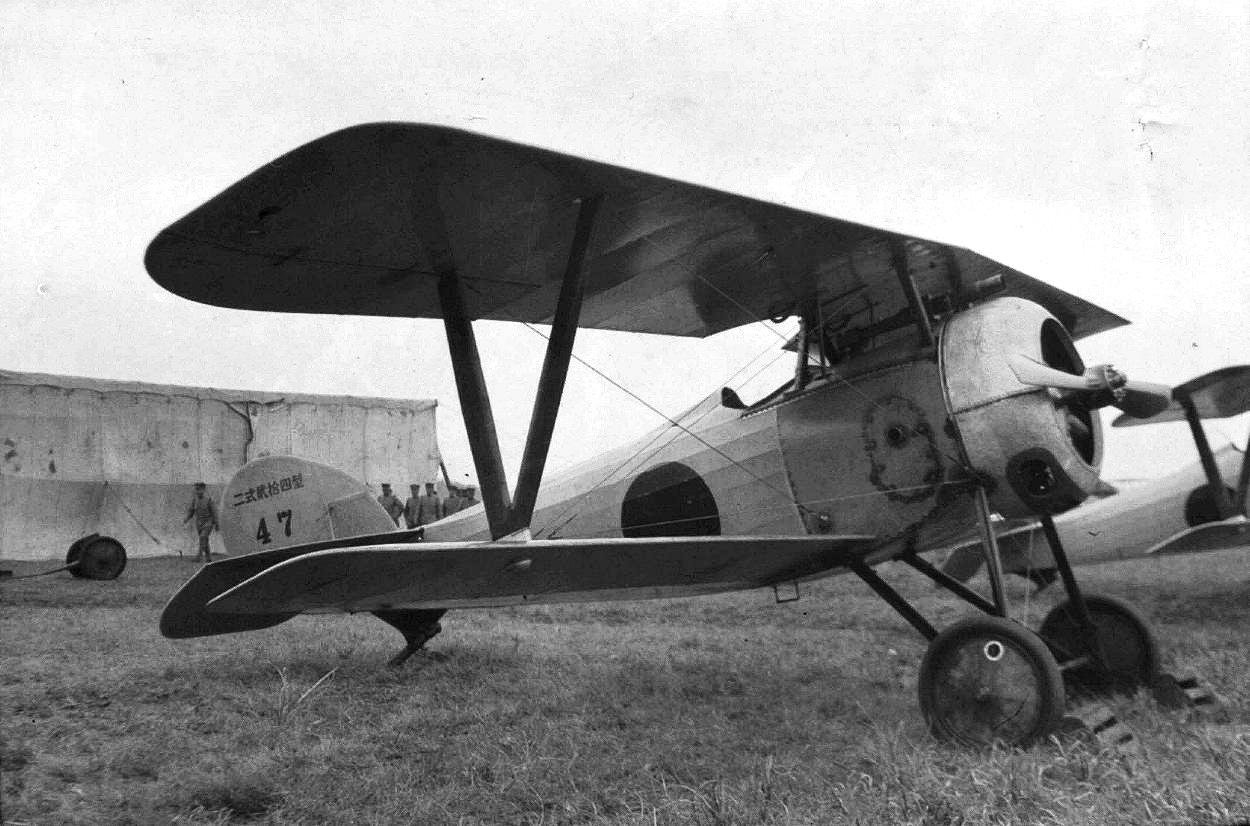
Designed by Gustave Delage, the Nieuport 24 (Nieuport XXIV C.1) was introduced in early 1917 as a refinement of the Nieuport 17 and 23 airframes. The aircraft first underwent flight tests in February 1917. Its most defining characteristic was the sesquiplane wing configuration, consisting of a full-span upper wing and a significantly narrower lower wing, which provided the aircraft with exceptional maneuverability during dogfights. To improve aerodynamics over previous models, Delage implemented a more rounded, streamlined fuselage. Some units were further enhanced with a "cone de pénétration," a non-rotating pointed nose fairing patented by Nieuport in 1916 to reduce drag.
Technical specifications for the original aircraft include a length of 5.80 meters, a wingspan of 8.15 meters, and a wing area of 14.75 square meters. With an empty weight of 375 kg and a gross weight of 560 kg, the fighter was powered by a 9-cylinder, air-cooled Le Rhône 9Ja or 9Jb rotary piston engine. This powerplant enabled a maximum sea-level speed of 176 km/h and a service ceiling of 6,900 meters. While agile, the aircraft initially suffered from heavy lateral control forces, necessitating modifications to the aileron hinge installation.
During World War I, the Nieuport 24 served as a frontline fighter for France, Belgium, Italy, and the United Kingdom. The British Royal Flying Corps and Royal Air Force typically armed their units with a single 7.7 mm Lewis gun on a Foster mounting. In contrast, French and Italian configurations often utilized a synchronized 7.7 mm Vickers machine gun. A notable combat achievement occurred on the night of October 19–20, 1917, when Nieuports of Escadrille N152 were credited with destroying the Zeppelins L49 and L50. The aircraft was also produced under license by Nieuport-Macchi in Italy and by Dux (later GAZ No. 1) in Moscow, Russia.
As combat tactics shifted toward speed and dive performance, the Nieuport 24 was largely replaced by SPAD fighters by the spring of 1918. Consequently, it transitioned into a role as an advanced trainer, particularly for the United States, where many aircraft were flown unarmed. Some examples remained in service as late as 1925, including those operated by the Afghan Military Air Arm. Today, the legacy of the Nieuport 24 persists through high-fidelity reproductions, such as the 1992-built 24bis displayed at the Museum of Flight in Seattle.