
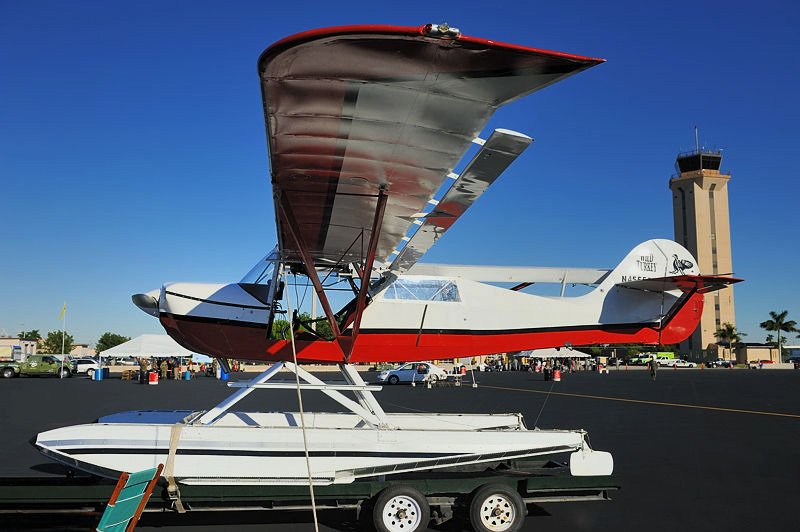
Design Philosophy and Development
The O'Neill Magnum emerged from a systematic analysis of bush flying requirements rather than theoretical design concepts. O'Neill Aircraft Company surveyed Alaskan charter pilots, receiving responses from approximately 22 percent of all operators in the state. This research-driven approach identified specific operational challenges that existing aircraft failed to address adequately.
Initially, O'Neill considered modifying the Aristocraft II six-place homebuilt aircraft by installing a 350-horsepower radial engine. However, the company ultimately pursued a clean-sheet design that could match the legendary de Havilland Beaver's capabilities while incorporating modern construction techniques suitable for homebuilding.
Innovative Technical Solutions
The Magnum's most distinctive feature was its dual-main, four-wheel landing gear with castoring front wheels. This unconventional configuration provided exceptional ground maneuverability with a minimum turning radius of just 14 feet, crucial for operating in confined bush strips. The castoring wheels also facilitated conversion to float operations, a common requirement in Alaska's lake-rich terrain.
The aircraft incorporated a swing-open tail section for cargo loading, eliminating the need for expensive ground equipment in remote locations. Wings folded similar to the Fairchild FB-2C design, enabling storage in smaller hangars and transport to distant locations. Perhaps most remarkably, the fuel tank system featured an emergency release mechanism that allowed pilots to jettison fuel during forced landings, significantly reducing fire risk.
Engine Configuration and Performance
The prototype initially flew with a Jacobs R-755S seven-cylinder air-cooled radial engine producing 350 horsepower, driving a three-bladed Hartzell B3P20 propeller. This powerplant choice reflected the bush flying community's preference for proven, reliable radial engines capable of sustained operation in harsh conditions.
In 1986, O'Neill made an unusual modification, replacing the radial engine with a Ford 351W automobile engine equipped with a McCulloch VS57 supercharger sourced from snowmobile applications. This automotive conversion produced 380 horsepower at 4,500 rpm, demonstrating the experimental nature of homebuilt aircraft development and the constant search for improved power-to-weight ratios.
Performance Characteristics
The Magnum achieved respectable performance figures for its mission profile. With a maximum takeoff weight of 3,800 pounds and an empty weight of 2,050 pounds, the aircraft provided substantial payload capacity. Cruise speed reached 122 knots at sea level, while the stall speed of 60 knots enabled operations from short, unprepared strips typical of bush flying.
Range capabilities included 347 nautical miles with standard 56-gallon fuel capacity, extending to 608 nautical miles with the optional 90-gallon auxiliary tank system. These figures, calculated with 45-minute reserves, provided adequate range for typical Alaskan charter missions while maintaining safety margins.
The O'Neill Aircraft Company
O'Neill Aircraft Company operated from the design phase through 1996, focusing exclusively on the Magnum project. The company represented the entrepreneurial spirit common in experimental aircraft development, where small teams attempted to address specific market niches overlooked by major manufacturers.
Despite the innovative design and clear operational advantages, the company struggled with limited interest and insufficient funding for full development. The homebuilt aircraft market, while enthusiastic, often lacks the financial resources necessary for comprehensive certification and production scaling.
Public Demonstration and Reception
The prototype made its public debut at the 1984 EAA Airshow, where it attracted attention from both homebuilders and commercial operators. The aircraft demonstrated its design objectives effectively, showcasing the tight turning radius, cargo loading capabilities, and general bush flying suitability.
However, the complexity of construction and the specialized nature of its mission limited broader market appeal. Unlike simpler homebuilt designs that attracted recreational builders, the Magnum required significant expertise and resources to construct successfully.
End of Development
By 1996, O'Neill Aircraft Company faced the harsh reality of insufficient market demand and development funding. The company ceased operations and sold the prototype for an intended turboprop conversion, though details of this modification remain unclear.
The Magnum's fate reflected broader challenges in the experimental aircraft industry, where innovative designs often fail to achieve commercial viability despite technical merit. The specialized bush flying market, while appreciative of the design's advantages, proved too limited to sustain dedicated aircraft production.
Legacy and Significance
The O'Neill Magnum represents an important chapter in homebuilt aviation history, demonstrating how systematic market research could drive innovative design solutions. Its unique landing gear configuration, cargo loading system, and folding wings addressed real operational challenges identified by working pilots.
While the aircraft never achieved production success, it showcased the potential for purpose-built bush aircraft designed specifically for extreme operating conditions. The Magnum's technical innovations continue to influence modern bush aircraft design concepts, particularly in landing gear configurations and cargo handling systems.