
Design Innovation and Development
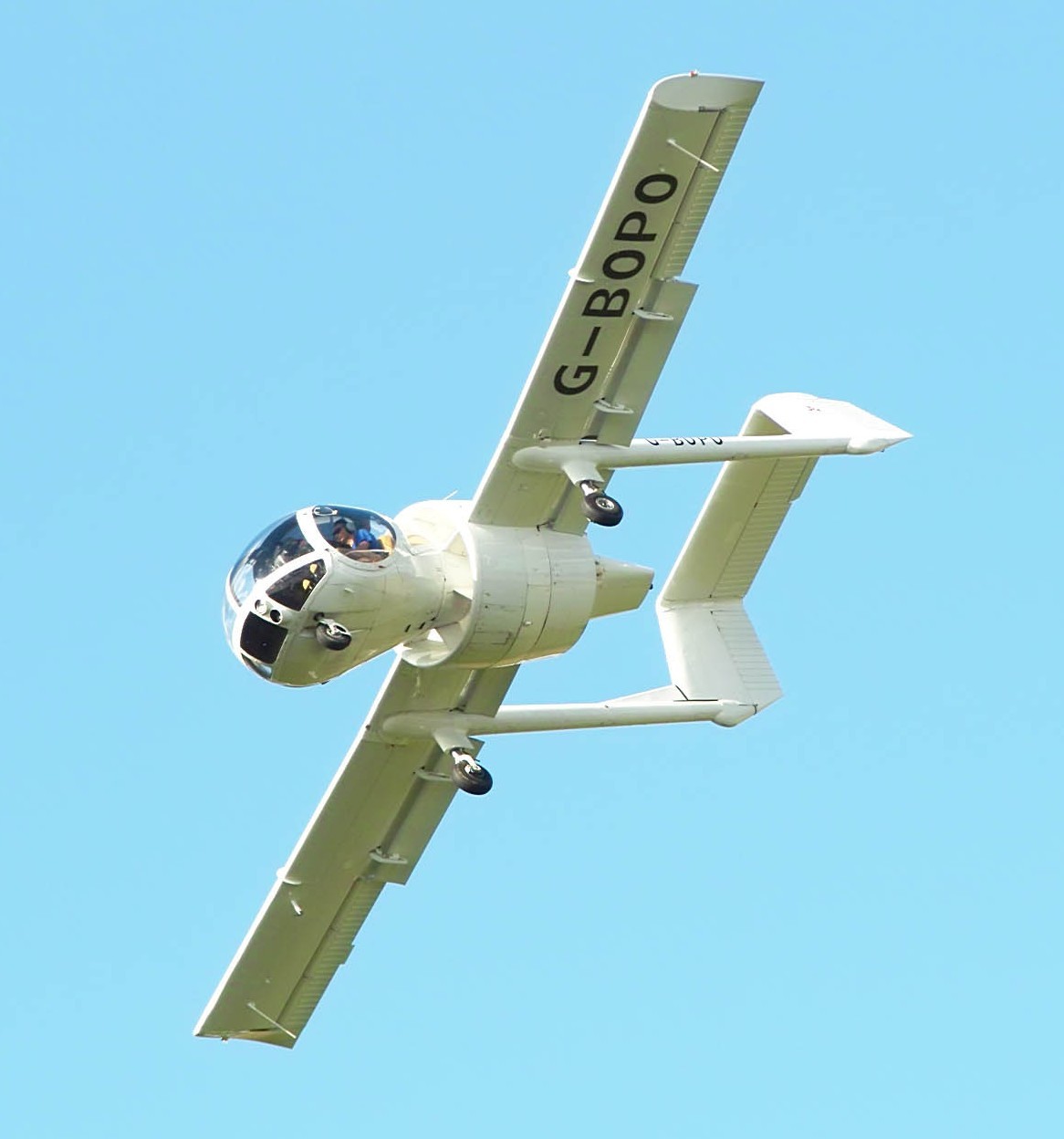
John Edgley, a post-graduate student at Imperial College of Science & Technology in London, conceived the Optica in 1974 as a solution to the observation aircraft market's fundamental compromise between visibility and operating costs. His design placed the cockpit ahead of the wing and employed a five-bladed ducted fan in pusher configuration, creating what became known as the world's quietest powered aircraft. The insect-eye-shaped cabin provided near-vertical downward vision while maintaining the economic advantages of fixed-wing flight.
Construction of the prototype began in 1976, with final assembly completed at Cranfield College of Aeronautics. Wind tunnel testing in 1975 validated Edgley's aerodynamic concepts, leading to the first flight on December 14, 1979, with test pilot Angus McVitie at the controls of G-BGMW.
Manufacturing Challenges and Company Evolution
Edgley Aircraft purchased Old Sarum airfield near Salisbury with £2.3 million in funding, planning to produce 200 aircraft at £55,000 each starting in mid-1983. The company achieved UK CAA certification on February 12, 1985, and delivered its first production aircraft to Air Foyle in March 1985. However, tragedy struck on May 15, 1985, when G-KATY, leased to Hampshire Constabulary for police trials, crashed due to pilot error just one day after delivery.
This incident, combined with financial difficulties, forced Edgley Aircraft into receivership in October 1985. Optica Industries formed in December 1985 to continue production, completing 15 additional aircraft by 1986 and introducing the OA7 Series 300 with 46 refinements including wing fences and IFR certification capability.
Disaster struck again on January 16, 1987, when arson destroyed the Old Sarum factory along with eight completed Opticas. The company reformed as Brooklands Aircraft in February 1987, later renamed Brooklands Aerospace, and managed to build five more aircraft (construction numbers 016-020) including the Scoutmaster surveillance variant developed jointly with ASTA of Australia.
Technical Specifications and Variants
Early production Opticas utilized the Avco Lycoming O-320-B2 engine producing 160 horsepower, later upgraded to the Lycoming IO-360 generating 180 horsepower. The specialized Scoutmaster variant employed the more powerful Textron Lycoming O-540 six-cylinder engine rated at 260 horsepower for enhanced surveillance capabilities.
The aircraft's innovative design featured all-metal construction with tricycle fixed landing gear and STOL capabilities for operations from soft ground. The three-abreast seating arrangement accommodated one pilot and two passengers, with additional space for baggage and observation equipment. Low wing loading contributed to gentle handling characteristics and low stall speeds essential for observation missions.
Operational Service and Market Reception
Despite its technical innovations, the Optica struggled to establish market presence. H.C. Sleigh Aviation Ltd of Australia placed an order for 25 aircraft in 1981, representing the largest commercial interest in the type. The aircraft targeted aerial photography, surveillance, traffic reporting, and powerline inspection roles, with Edgley estimating a potential market of 8,000 observation aircraft worldwide.
The combination of helicopter-like visibility with fixed-wing economics positioned the Optica uniquely in general aviation, but production difficulties and company instability prevented market penetration. The type's 9-hour endurance capability and exceptionally quiet operation made it ideal for extended surveillance missions, yet only specialized operators recognized these advantages.
Production End and Legacy Attempts
Brooklands Aerospace entered receivership in March 1990, leading to acquisition by FLS Aerospace (Lovaux) Ltd. The project relocated to Lovaux Ltd at Hum in July 1990 with ambitious plans for production resumption that never materialized. Agreements with Utva in Yugoslavia in 1992 for subcontracting and assembly similarly produced no additional aircraft.
Total production reached exactly 22 aircraft: the prototype plus 21 production examples built between 1984 and 1990. In 2008, original designer John Edgley reacquired the program rights, though no new production has commenced. The surviving prototype G-BGMW escaped the 1987 arson and represents one of the few airworthy examples remaining.
Cultural Impact and Aviation Significance
The Optica achieved brief celebrity status starring in a 1989 film, showcasing its distinctive appearance to audiences worldwide. More importantly, it demonstrated the viability of unconventional aircraft configurations in addressing specific market needs. The ducted fan pusher arrangement, while not widely adopted, proved the concept of combining rotorcraft visibility with fixed-wing efficiency.
Today, the Optica stands as a testament to innovative thinking in aircraft design, representing both the potential for revolutionary concepts and the challenges facing small aircraft manufacturers. Its influence on subsequent observation aircraft development, while subtle, established precedents for unconventional configurations in specialized aviation roles.