
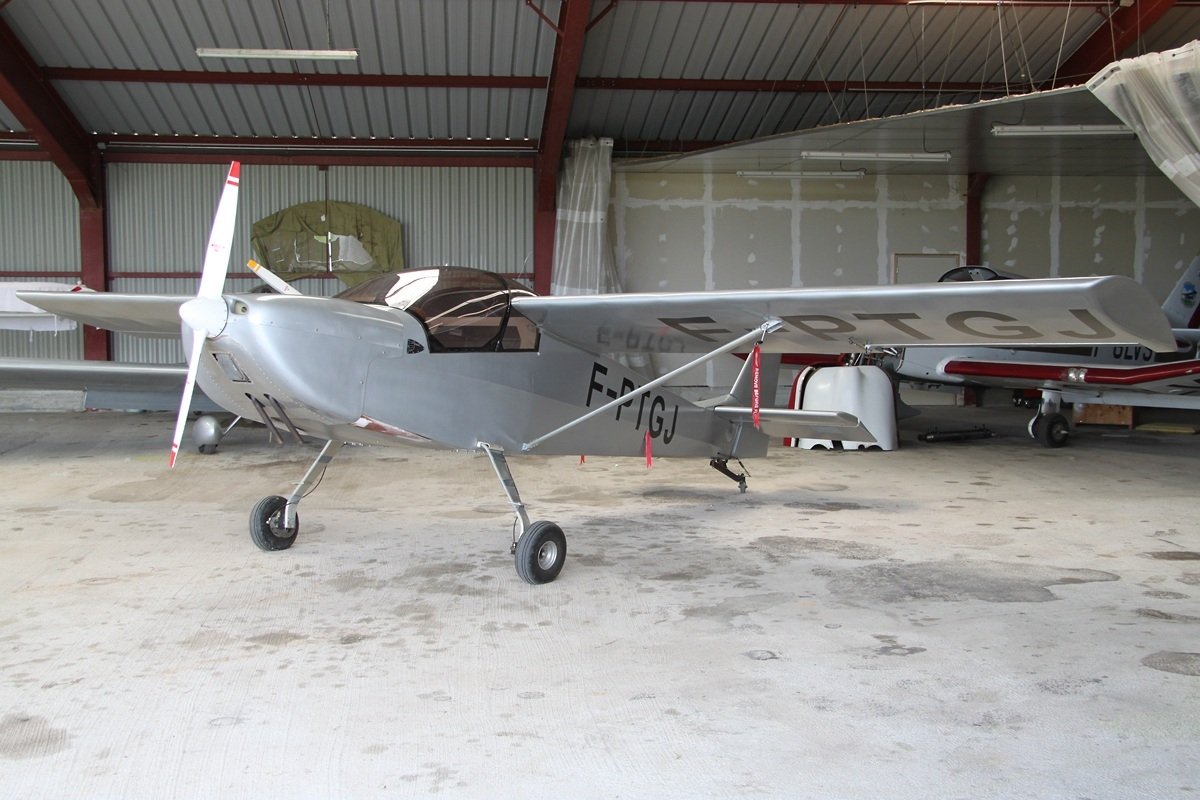
Designer and Development
Jean Pottier established himself as one of France's most prolific light aircraft designers, creating numerous designs specifically intended for amateur construction throughout his career. The P.100 emerged from his design philosophy emphasizing conventional construction methods that home builders could successfully replicate without requiring advanced manufacturing facilities or specialized tooling.
Development of the P.100 began in the late 1970s with the goal of creating a practical two-seat utility aircraft. Pottier chose a straightforward high-wing configuration that would provide good low-speed handling characteristics and simplify the construction process for amateur builders. The first P.100TS prototype, registered F-WYJC, took to the air on October 16, 1980, marking the successful culmination of Pottier's design efforts.
Production and Construction
Unlike commercial aircraft manufacturers, Pottier operated under a different business model entirely. Rather than establishing production lines, he created detailed plans and construction manuals that individual builders could purchase and follow. Jacques Chalard constructed the first P.100 example, demonstrating that the design could indeed be successfully completed by amateur builders.
The extremely limited production numbers reflect the aircraft's nature as a homebuilt design rather than any shortcoming in the aircraft itself. Only one P.100 is definitively known to have been completed, though Pottier's plans may have enabled additional constructions that were not widely documented. After receiving its Certificate of Airworthiness, the prototype was reregistered as F-PYJC on February 4, 1981.
Technical Specifications and Performance
Pottier selected the Continental O-200 engine to power the P.100, a proven four-cylinder, horizontally-opposed powerplant producing 100 horsepower. This air-cooled engine had demonstrated reliability in numerous general aviation applications since the 1940s, making it an ideal choice for amateur-built aircraft where serviceability and parts availability were crucial considerations.
The aircraft's dimensions reflected careful optimization for its intended role. With an empty weight of 959 pounds and a maximum gross weight of 1,500 pounds, the P.100 could carry a useful load of 541 pounds. The 100-square-foot wing area provided a wing loading of 15 pounds per square foot at maximum weight, contributing to gentle handling characteristics.
Performance figures demonstrated the aircraft's utility capabilities. Maximum speed reached 160 miles per hour, while the rate of climb measured an impressive 1,220 feet per minute. Range extended to 400 miles, providing adequate capability for cross-country flights. The service ceiling and other performance parameters reflected the aircraft's design as a practical touring machine rather than a high-performance sportplane.
Design Variants
Pottier expanded the basic P.100 concept into a small family of related designs. The P.110 featured a fuselage stretched by 20 inches to accommodate a third seat, along with increased wingspan for improved performance with the higher weight. The P.105 represented a hybrid approach, combining the two-seat P.100 fuselage with the longer wings of the P.110.
Each variant received a "TS" designation, though the specific meaning of this suffix is not definitively documented. The variants demonstrated Pottier's systematic approach to aircraft design, creating a scalable platform that builders could adapt to their specific mission requirements.
The Designer's Legacy
Jean Pottier continued developing aircraft designs well into the 2000s. His final design, the P.320UL, represented his adaptation to the ultralight aircraft category that gained popularity in later decades. The prototype, registered 79-BC, was displayed at the RSA Rally at Chambley in 2002, demonstrating Pottier's continued involvement in the experimental aircraft community.
Tragedy struck on September 3, 2003, when Pottier was killed in the crash of a P.320 that apparently suffered an in-flight structural failure. His death marked the end of a prolific design career that had spanned several decades and produced numerous aircraft specifically tailored for amateur construction.
Current Status and Historical Significance
The P.100 occupies a modest position in aviation history, representing the dedicated community of amateur aircraft builders who pursued flight through their own construction efforts. While the design never achieved the widespread adoption of more successful homebuilt aircraft like the Van's RV series or Burt Rutan's designs, it demonstrated the accessibility of aircraft design and construction to determined individuals.
No information exists regarding the current status of the original P.100 prototype F-PYJC. Whether it remains airworthy, has been restored, or survives in a museum collection is unknown. The aircraft's significance lies not in its operational impact but in its representation of the experimental aircraft movement that flourished during the 1970s and 1980s, when designers like Pottier made aviation accessible to amateur builders worldwide.