
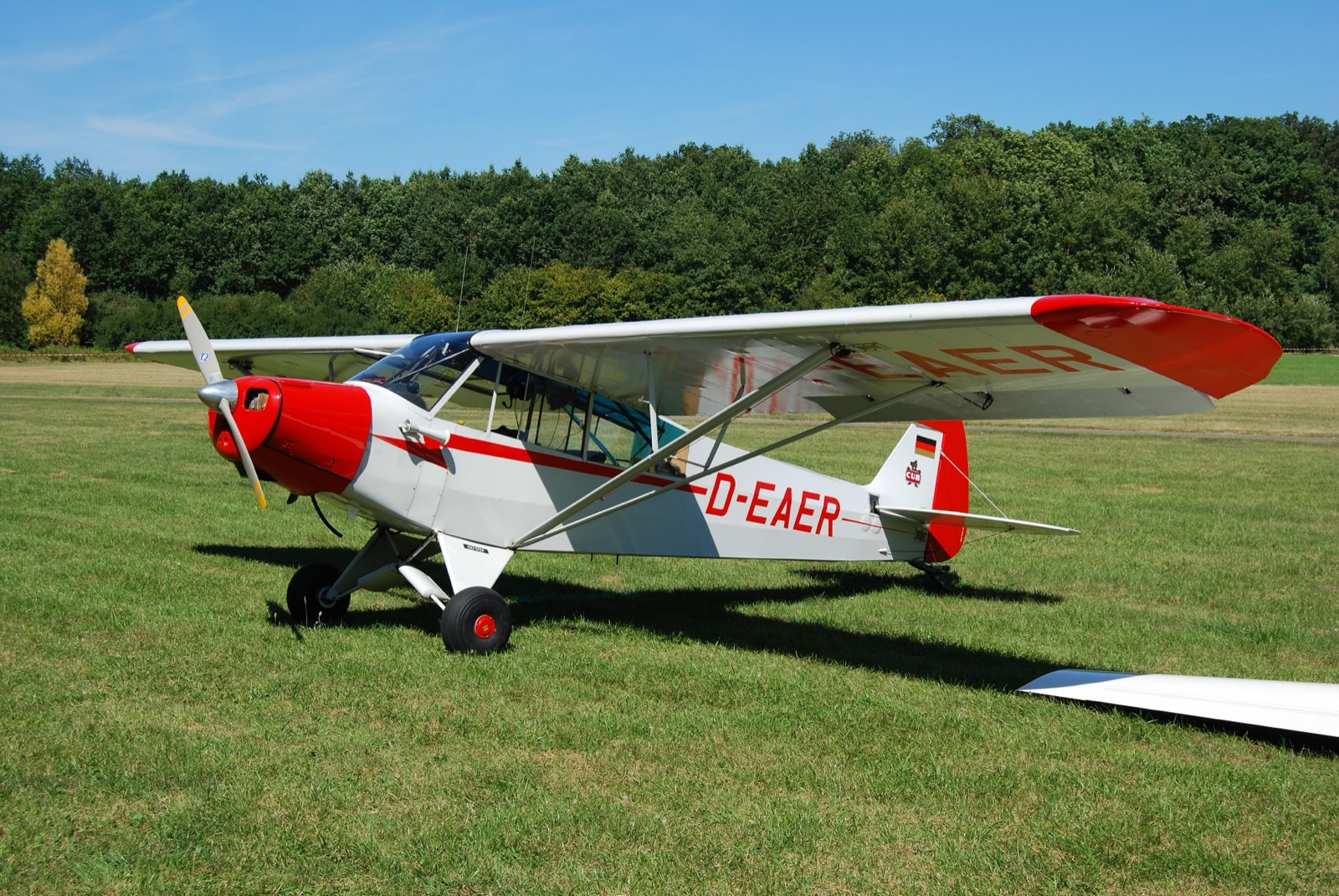
The Super Cub Lineage
The Piper PA-18 Super Cub, introduced in 1949, developed from the earlier J-3 Cub into one of the most enduring utility and backcountry aircraft ever built. Its welded steel-tube fuselage, fabric covering, high wing, and tandem seating give it exceptional slow-flight and short-field capability. Factory Super Cubs were powered exclusively by piston engines, commonly the Lycoming O-290 (125–135 hp) and O-320 (150–160 hp).
What "PA-18T" Reflects
"PA-18T" is not a Piper factory designation. On the FAA registry it is associated with Super Cub airframes converted to the Lycoming O-360 series — a four-cylinder, 360-cubic-inch, air-cooled, horizontally opposed piston engine. Lycoming's own engine documentation lists the O-360-C4P specifically for the "PA-18 Super Cub, conversion." These re-engining projects are carried out under supplemental type certificates (STCs), typically raising output to roughly 180–200 hp for improved climb, load, and high-density-altitude performance. The exact meaning of the "T" suffix as it appears on registry records is not documented in factory sources.
Engine: Piston, Not Turbine
Despite the "T" in the registry designation, the PA-18T is a reciprocating (piston) aircraft, not a turbine or turboprop. The Lycoming O-360-C4P is a direct-drive, air-cooled piston engine; there is no turbine variant of the PA-18 Super Cub associated with this designation. Its FAA engine classification and its real-world powerplant are both piston.
Registry Presence
Only a small number of PA-18T aircraft appear on the U.S. registry. That scarcity is consistent with their nature as individually modified and converted Super Cubs rather than a series-produced type, each reflecting an owner's choice to upgrade a classic Super Cub to O-360 power.