
Production and Design
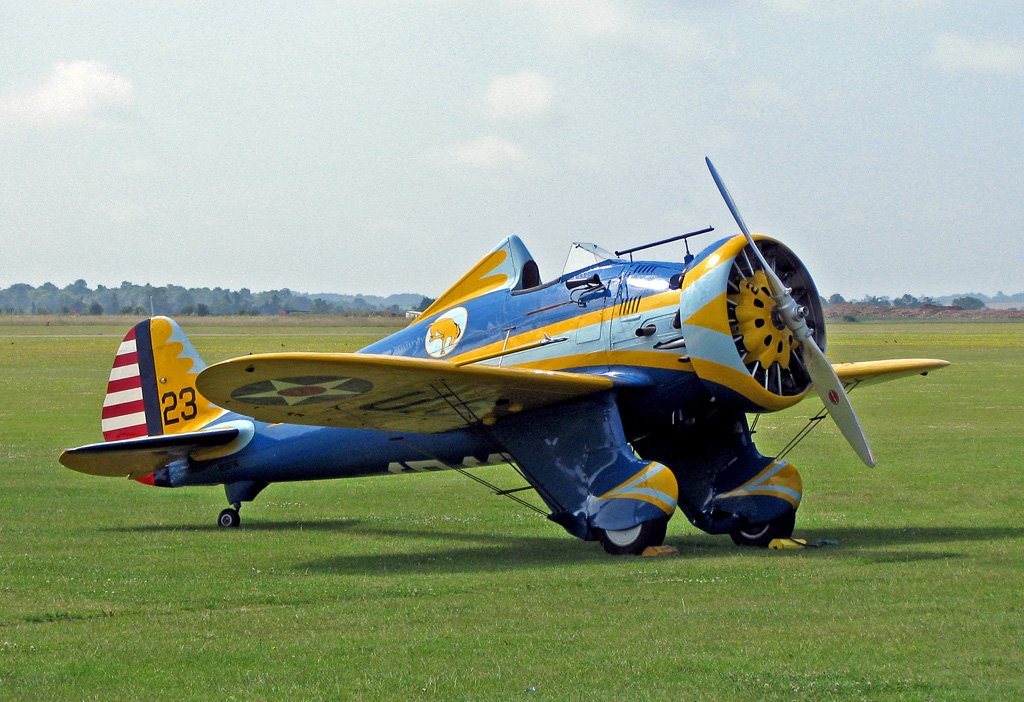
Developed as the self-funded Boeing Model 248, the P-26 "Peashooter" represented a pivotal shift in American military aviation. Design work began in September 1931, leading to the construction of three prototypes. The first prototype flew in March 1932, with most technical records specifying March 20, 1932, as the date of first flight, though some sources cite March 10. The aircraft was manufactured by the Boeing Airplane Company in Seattle, Washington. Production spanned from 1932 to 1936, with a total of 151 aircraft built, including prototypes and export versions. Deliveries to the U.S. Army Air Corps (USAAC) commenced in December 1933.
Technically, the P-26 was a transitional aircraft. While it featured an all-metal, low-wing monoplane structure—a significant advancement over the Boeing P-12 biplanes—it retained several archaic features, including an open cockpit, fixed spatted landing gear, and external wing bracing wires. It was powered by a single 9-cylinder, air-cooled Pratt & Whitney R-1340 "Wasp" radial piston engine producing 500 hp. This configuration allowed for a maximum speed of 234 mph and a service ceiling of 27,400 feet.
Military Service
The P-26 served as the USAAC's primary frontline fighter until 1938, when it was superseded by the Seversky P-35 and Curtiss P-36A. At its peak in 1936, six squadrons were equipped with the type, though 22 squadrons operated it over its lifespan. By 1938, remaining U.S. aircraft were relegated to training or stationed in the Philippines, Panama, and Hawaii.
Internationally, the P-26 saw extensive and varied combat. The Republic of China Air Force operated 11 aircraft in the 1930s against Japanese forces. In the Spanish Civil War, a single export demonstrator (Model 281) operated by the Spanish Republican Air Force was shot down on October 21, 1936. During the early stages of the Pacific War in December 1941, the Philippine Army Air Corps utilized 12 P-26s to defend airfields. Notably, Captain Jesús A. Villamor is credited with downing two Mitsubishi A6M Zeros during these engagements. The aircraft's longest service was in Guatemala, where the Fuerza Aérea Guatemalteca operated seven P-26s from 1942 until 1956, with the type seeing its final combat use during the 1954 coup d'état.
Legacy
Only two original P-26 airframes survive today, both originating from Guatemala. One is preserved at the Smithsonian National Air and Space Museum's Steven F. Udvar-Hazy Center. A full-scale flying replica, completed in 2006, is maintained by the Military Aviation Museum in Virginia.