
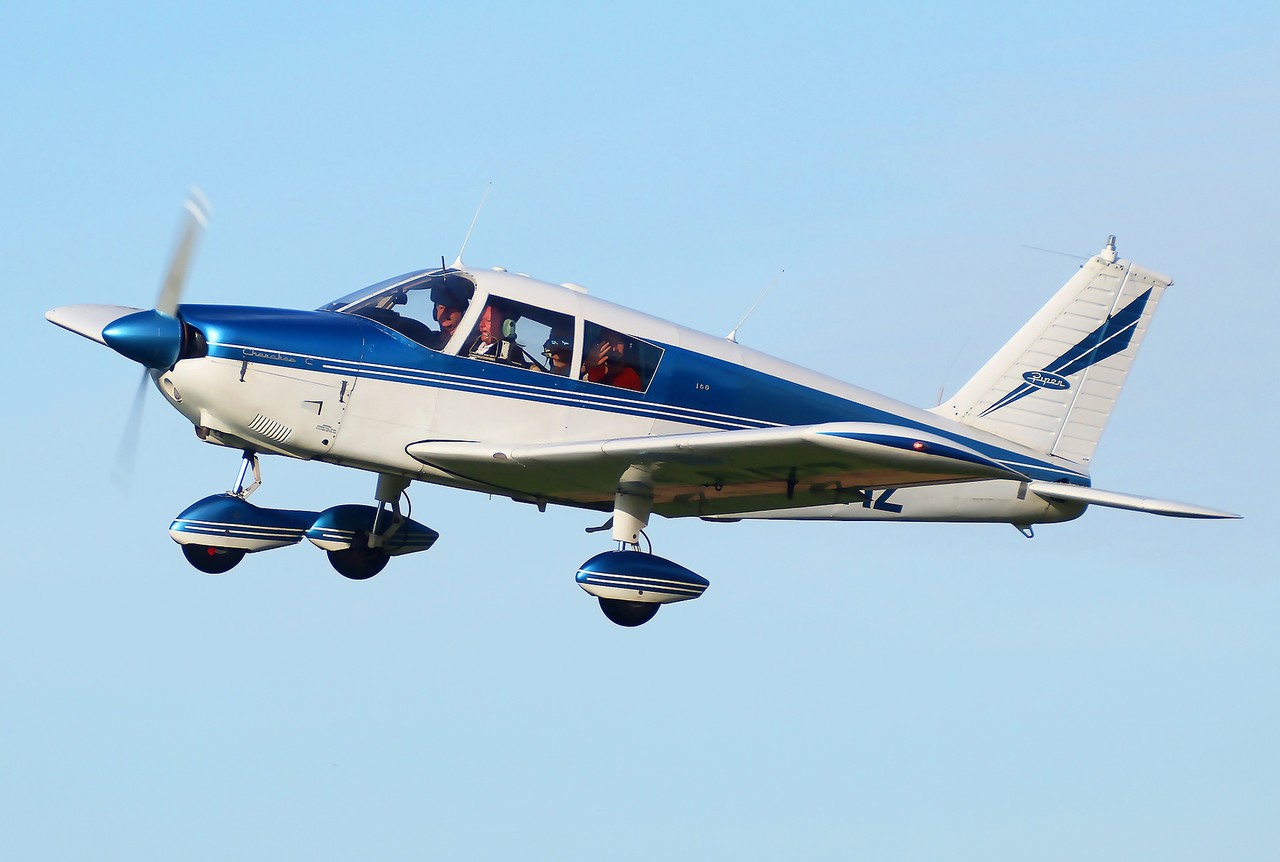
Dominating General Aviation
The Cherokee series achieved unprecedented success in the general aviation market, with production peaking at approximately 7,000 aircraft annually in the late 1960s. More than 30,200 fixed-gear variants alone were constructed by 2004, making it one of the most numerous aircraft types ever built. The PA-28-180 and PA-28-181 variants became the most popular, with well over 10,000 examples produced, establishing the Cherokee as the backbone of flight training schools and flying clubs across America.
The series directly challenged Cessna's dominance with the 172, offering pilots an alternative low-wing design that provided different handling characteristics and ground stability. Flight schools embraced the PA-28-140 as a dedicated two-seat trainer, while the four-seat variants served private owners seeking reliable, economical transportation.
International Production Success
Beyond American manufacturing, the Cherokee achieved global reach through international licensing agreements. AICSA and CHINCUL manufactured the type in Argentina, while Brazilian companies EMBRAER and NEIVA produced variants designated as the EMB-712 Carioquinha and Tupi. This international production expanded the Cherokee's global footprint and demonstrated its universal appeal across different aviation markets.
Piper Aircraft Company Legacy
Piper Aircraft Company developed the PA-28 series to replace their earlier PA-22 Tri-Pacer and Colt models, seeking a modern, cost-effective design to compete directly with Cessna's offerings. The company established Vero Beach, Florida as the primary manufacturing hub for all American PA-28 production, a facility that continued Cherokee production for over six decades.
The Cherokee represented Piper's commitment to democratic aviation, providing an affordable entry point into aircraft ownership while maintaining the performance characteristics pilots demanded for both training and cross-country travel.
Engine Excellence and Reliability
Lycoming piston engines powered every Cherokee variant, creating one of aviation's most reliable powerplant combinations. The PA-28-140 utilized the 150-horsepower Lycoming O-320-E2A or O-320-E3D, while the popular PA-28-160 featured the O-320-D2A producing 160 horsepower. The PA-28-180 employed the proven O-360-A3A or O-360-A4A, delivering 180 horsepower that pilots praised for its balance of economy and performance.
The most powerful variants included the PA-28-235 Pathfinder with a six-cylinder Lycoming O-540-B4B5 producing 235 horsepower, and the PA-28-236 Dakota featuring the O-540-J3A5D of similar output. This engine reliability contributed significantly to the Cherokee's reputation for dependable operation across thousands of flight training hours.
Pilot's Perspective
Pilots consistently praised the Cherokee's stable, forgiving flight characteristics that made it ideal for student training while remaining engaging for experienced aviators. The low-wing configuration provided excellent ground stability and predictable handling throughout the flight envelope. The PA-28's wide-stance fixed landing gear offered confidence during taxi operations and crosswind landings.
Cruise performance varied by model, with the PA-28-180 achieving approximately 140 knots true airspeed at 75% power, while the turbocharged variants could reach 155-167 knots at altitude. The aircraft's 2,400-2,450 pound gross weight in four-seat configuration provided useful loads sufficient for practical cross-country travel with full fuel.
Evolution and Variants
The Cherokee family expanded strategically throughout the 1960s and 1970s. In 1967, Piper introduced the PA-28R-180 Cherokee Arrow featuring retractable landing gear and constant-speed propeller, leading to discontinuation of the 150 and 160 models. The 1972 PA-28-235 Pathfinder represented the series' most powerful iteration before Piper introduced the PA-28-236 Dakota in 1977.
Specialized variants included seaplane models PA-28S-160 and PA-28S-180 for water operations, plus the innovative PA-28RT-201 Arrow IV featuring a distinctive T-tail design. The series later evolved into the PA-28-161 Warrior and PA-28-181 Archer, continuing the Cherokee lineage into modern production.
Enduring Production Legacy
The Cherokee achieved what few aircraft accomplish: continuous production spanning over 65 years. The first PA-28 received FAA type certification in 1960, yet variants remain in production today, testament to the design's fundamental soundness. Production ceased for various models at different times, with the PA-28-140 ending in 1977, but the basic Cherokee design principles continued influencing subsequent Piper aircraft.
This remarkable longevity, combined with over 32,000 total production examples, established the Cherokee as one of aviation's most successful aircraft families. Today, thousands of Cherokee variants continue serving flight schools, private owners, and commercial operators worldwide, maintaining their reputation as reliable, economical aircraft that shaped generations of pilots.