
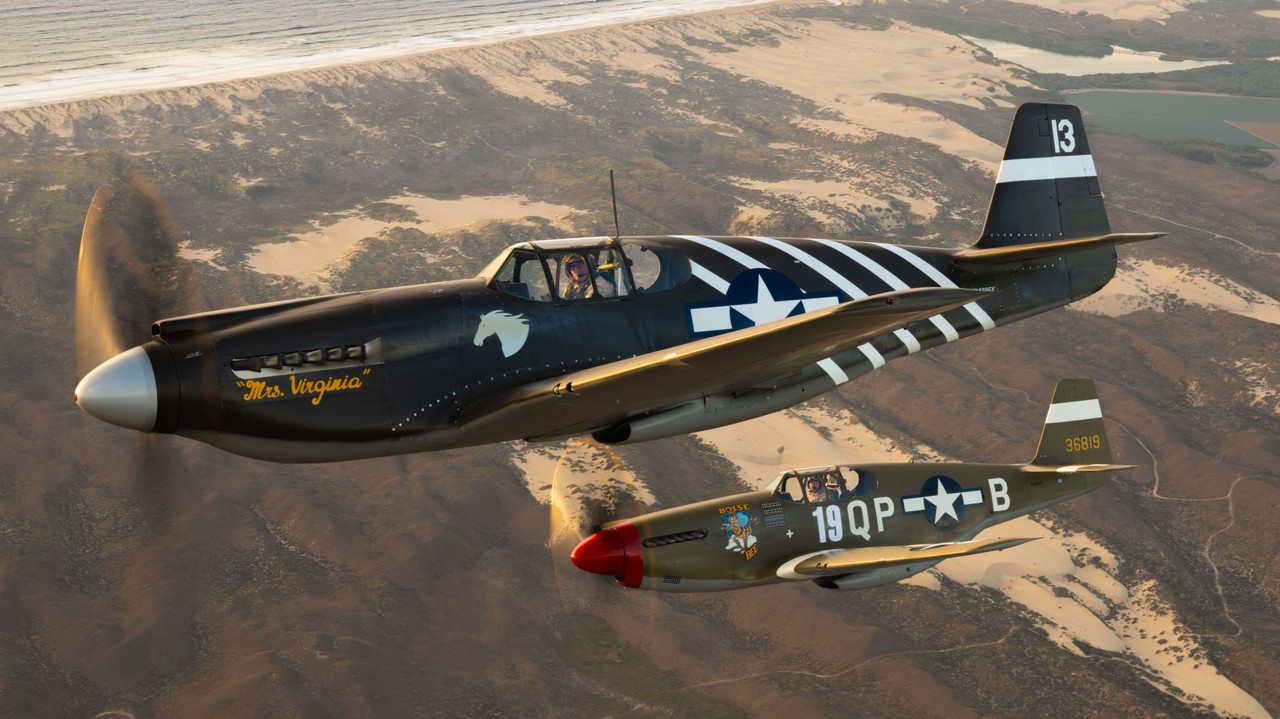
Combat Dominance
The P-51 Mustang fundamentally altered the course of the air war in Europe. By May 8, 1945, P-51 groups of the 8th, 9th, and 15th Air Forces had claimed approximately 4,950 aircraft destroyed in air-to-air combat—representing half of all USAAF aerial victories in the European theater and more than any other Allied fighter. An additional 4,131 enemy aircraft fell to Mustang guns on the ground, demonstrating the type's versatility as both air superiority fighter and ground attack aircraft.
The aircraft's strategic impact was perhaps best summarized by Reichsmarschall Hermann Göring himself, who reportedly declared: "When I saw Mustangs over Berlin, I knew the jig was up." This statement reflected the Mustang's ability to escort Allied bombers to targets previously beyond fighter range, effectively ending German air superiority over the Reich.
From British Request to American Legend
The Mustang's origins trace to a 1940 British Purchasing Commission request for North American Aviation to manufacture Curtiss P-40 fighters under license. Rather than produce an outdated design, company president James H. Kindelberger proposed creating an entirely new fighter. His design team accomplished the seemingly impossible: the prototype NA-73X rolled out just 102 days after the contract was signed and achieved first flight only 149 days into development—an unprecedented pace even by wartime standards.
Initial production variants powered by the unsupercharged Allison V-1710-F3R engine, rated at 1,100 horsepower, showed promise but limited high-altitude performance. The transformation came with the installation of the British Rolls-Royce Merlin engine, which dramatically improved performance above 15,000 feet. This engine change proved so successful that the USAAF ordered 400 P-51B aircraft in August 1942, three months before the first Merlin-powered prototype even flew.
Operational Service and Variants
The 354th Fighter Group became the first operational P-51 unit in the European Theater, with P-51Bs becoming available to the 8th and 9th Air Forces during the winter of 1943-1944. Production encompassed multiple variants: 310 P-51As built between March and May 1943, followed by 2,200 P-51Bs, and substantial numbers of P-51Cs and the definitive P-51D model.
The Royal Air Force operated 308 P-51Bs and 636 P-51Cs under the designation Mustang Mk III, with first units converting in late 1943 and early 1944. An additional 828 aircraft served as Mustang Mk IV and Mk IVa variants. Reconnaissance versions included 35 P-51As converted to F-6B configuration, equipped with cameras replacing armament.
Pacific Theater Success
In the Pacific, VII Fighter Command P-51 units conducted 51 ground-attack missions, with 41 classified as successful. Fighter pilots claimed destruction or damage of 1,062 aircraft and 254 ships, plus extensive infrastructure targets. American losses totaled 91 pilots killed and 157 Mustangs destroyed—a favorable exchange ratio that demonstrated the aircraft's survivability and effectiveness.
North American Aviation Legacy
North American Aviation, founded and led by James H. Kindelberger, established itself as a premier military aircraft manufacturer through the P-51's success. The company's Inglewood, California plant began P-51B production in June 1943, ultimately delivering 15,575 aircraft in the United States, with an additional 100 manufactured in Australia. North American Aviation later evolved through mergers into North American Rockwell and subsequently Rockwell International, though the original company's aviation legacy remained centered on the Mustang's wartime achievements.
Technical Excellence
The P-51's 32-foot length and 37-foot wingspan housed innovative design features that maximized fuel capacity and range—critical advantages over contemporary fighters. The Merlin engine installation transformed an already capable airframe into a superlative high-altitude interceptor and long-range escort fighter. This combination of American aerodynamics and British powerplant engineering created what many aviation historians consider the optimal piston-engine fighter configuration.
Enduring Recognition
The P-51 Mustang's wartime record established its reputation as perhaps the most significant fighter aircraft in aviation history. Its ability to accompany heavy bombers throughout their missions earned the affectionate nickname "Little Friends" from grateful bomber crews. The aircraft's combination of speed, range, maneuverability, and firepower proved decisive in achieving Allied air superiority, making it an indispensable weapon in the ultimate victory over Nazi Germany and Imperial Japan.