
Commercial Success and Market Dominance
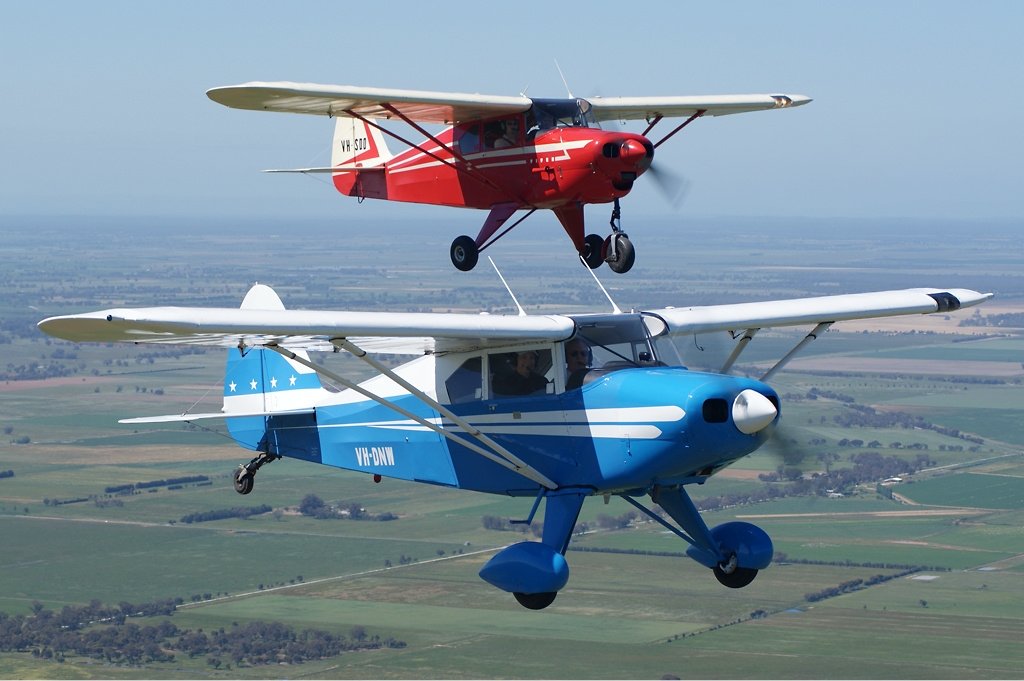
The PA-22 Tri-Pacer achieved remarkable commercial success during the post-war aviation boom, with Piper producing 9,490 aircraft over its 14-year production run from 1950 to 1964. By 1953, just three years after certification, the tricycle-gear Tri-Pacer was outselling its tailwheel predecessor, the PA-20 Pacer, by a ratio of six to one. This dramatic shift reflected pilots' strong preference for the easier ground handling characteristics of nosewheel aircraft, which eliminated the risk of ground loops that plagued conventional gear airplanes.
The aircraft's distinctive appearance, with its high wing and prominent tricycle landing gear, earned it the affectionate nickname "Flying Milk Stool" among pilots and aviation enthusiasts. Despite this somewhat ungainly moniker, the Tri-Pacer's practical design and forgiving flight characteristics made it extremely popular with flight schools, private owners, and small commercial operators throughout the 1950s.
Engine Evolution and Variants
Piper continuously improved the Tri-Pacer throughout its production life, offering multiple engine configurations to meet varying performance and economic requirements. The original PA-22, certified on December 20, 1950, featured a 125-horsepower Lycoming O-290-D engine. Halfway through the second production year, Piper upgraded to the 135-horsepower O-290-D2, which received certification on May 5, 1952.
The most significant powerplant upgrade came in 1955 with the introduction of the 150-horsepower Lycoming O-320-A1A engine. The PA-22-150 variant, certified on September 3, 1952, became available in both four-seat standard configuration and a two-seat utility version certified on May 24, 1957. Piper also offered a PA-22-160 variant with 160-horsepower O-320 series engines for operators requiring maximum performance.
In 1960, responding to market demand for a more economical trainer aircraft, Piper introduced the PA-22-108 Colt. This variant, powered by a 108-horsepower Lycoming O-235-C1 engine and certified on October 21, 1960, was designed as a two-seat trainer to compete directly with Cessna's popular Model 150.
Market Competition and Production End
The Tri-Pacer's market dominance faced a serious challenge with Cessna's introduction of the Model 172 in 1956. The 172's modern design, featuring a nosewheel configuration similar to the Tri-Pacer but with updated styling and systems, quickly captured market share. Cessna's aggressive marketing and competitive pricing allowed the 172 to outsell the Tri-Pacer so decisively that Piper discontinued the four-seat Tri-Pacer production in 1960.
Piper continued producing the two-seat PA-22-108 Colt variant through 1963, manufacturing approximately 1,800 examples before ending the entire PA-22 line. The final PA-22, a Colt model, rolled off the assembly line at Piper's Vero Beach, Florida facility on March 26, 1964. The facility then transitioned to manufacturing the PA-28 Cherokee 140, which would become Piper's answer to Cessna's continued market success.
The Piper Aircraft Legacy
Piper Aircraft Corporation established itself as one of America's premier general aviation manufacturers during the mid-20th century. The company's focus on practical, affordable aircraft for private owners and flight training operations made aviation accessible to thousands of pilots who might otherwise have been priced out of flying.
The PA-22 represented a crucial evolutionary step in Piper's product line, bridging the gap between the company's earlier tailwheel designs and the modern tricycle-gear aircraft that would dominate general aviation. Piper's willingness to offer multiple engine configurations and seating arrangements demonstrated the company's understanding of diverse market needs.
Technical Specifications and Performance
The PA-22-160, representing the most powerful standard production variant, demonstrated impressive capabilities for its era. With an empty weight of 1,110 pounds and maximum gross weight of 2,000 pounds, the aircraft offered substantial payload capacity. Its 36-gallon fuel capacity provided adequate range for cross-country flights, while the reliable Lycoming O-320 engine offered a generous 2,000-hour overhaul interval.
The high-wing configuration provided excellent ground visibility and inherent stability, characteristics that made the Tri-Pacer particularly suitable for flight training and recreational flying. The tricycle landing gear, while adding complexity compared to tailwheel designs, significantly reduced insurance costs and pilot training time.
Enduring Legacy
The PA-22 Tri-Pacer's lasting impact on general aviation is evidenced by its remarkable survival rate. As of 2018, 3,280 Tri-Pacers remained registered with the Federal Aviation Administration, representing approximately 35 percent of all aircraft manufactured. This exceptional preservation rate reflects both the aircraft's robust construction and its continued utility in modern general aviation.
The Tri-Pacer's influence extended beyond its production years, establishing design principles and market expectations that shaped subsequent general aviation aircraft development. Its success demonstrated the viability of tricycle landing gear in light aircraft and proved that pilots would pay premium prices for improved ground handling characteristics.