
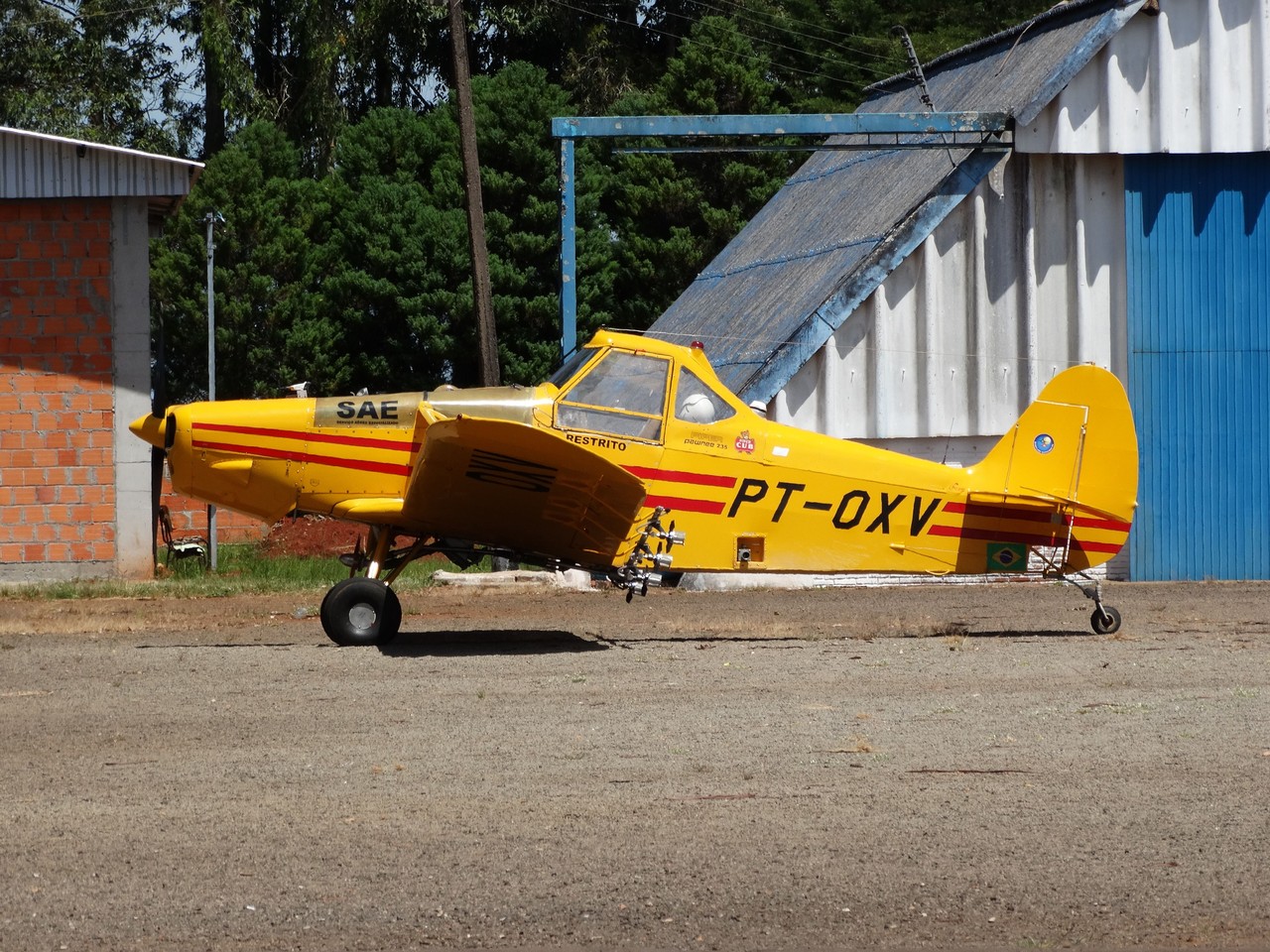
Agricultural Aviation Pioneer
The PA-25 Pawnee dominated agricultural aviation for over two decades, with more than 5,000 aircraft built establishing it as the most successful purpose-designed crop duster in history. By the 1970s, Pawnees comprised a significant portion of the world's agricultural aircraft fleet, enabling safer and more efficient aerial application of pesticides, herbicides, and fertilizers across millions of acres globally.
Design Innovation
Fred Weick, the legendary aeronautical engineer who previously designed the Ercoupe, led the Pawnee's development at Texas A&M University under a National Flying Farmers Association program supported by the Civil Aeronautics Administration. His initial AG-1 prototype first flew on December 1, 1950, followed by the refined AG-3 in November 1954. Weick's design objectives centered on pilot safety and operational efficiency, incorporating curved cockpit frames to deflect power lines, sharpened landing gear leading edges to cut through crop debris, and a high cockpit position behind the chemical hopper for better visibility and weight distribution.
The Manufacturer
Piper Aircraft Corporation, founded in 1927 by William T. Piper Sr. and George A. Page as Taylor Brothers Aircraft Manufacturing Company, hired Weick in 1957 and acquired his agricultural aircraft designs. The company, already famous for the J-3 Cub, redesignated the project as the PA-25 and began production in May 1959 at their Lock Haven, Pennsylvania facility, later moving operations to Vero Beach, Florida. Despite facing bankruptcy in 1991, Piper reorganized and continues operations today as Piper Aircraft, Inc.
Engine Evolution
The Pawnee's powerplant evolved significantly during its production run, addressing early concerns about insufficient power for heavy agricultural loads. Initial PA-25-150 models used the 150-horsepower Lycoming O-320-A1A engine from 1959 to 1962, priced at $8,995 basic or $9,670 with spraying equipment. From 1962, Piper upgraded to the 235-horsepower Lycoming O-540, followed by a high-compression 260-horsepower O-540 variant beginning in 1967. These reliable, air-cooled engines provided the power-to-weight ratio necessary for effective agricultural operations.
Technical Excellence
The Pawnee's design incorporated proven components from Piper's existing aircraft line to reduce costs and ensure reliability. The wings came from the Super Cub, while the tail surfaces were adapted from the PA-22 Tri-Pacer. The aircraft featured welded steel tube construction with fabric covering, conventional tricycle landing gear, and a 20-cubic-foot hopper capable of holding 145 gallons or 800 pounds of agricultural chemicals. Certified at 2,300 pounds gross weight, the Pawnee could handle the demanding cycle of heavy takeoffs and precision flying required in agricultural work.
Global Service Record
Pawnees found operators worldwide, from small family farming operations to large commercial aerial applicators. Notable examples included ADS (Aerial) Ltd. in the United Kingdom operating G-ASOV, a 1964 PA-25-235, and New Zealand operators like ZK-BZK, a 1960 PA-25-235 modified with wing tanks and an additional loader seat. The aircraft's versatility extended beyond agricultural work to glider towing operations, with organizations like Gliding Tasmania operating PA-25-150 VH-SCL and New Zealand's Ferrymead Aeronautical Society maintaining their own Pawnee for sailplane operations.
Production Legacy
Piper produced the PA-25 for 22 years, with more than 1,500 of the final PA-25D variant built during the last 15 years of production ending in 1981. The most popular variant was the PA-25-235, offering the optimal balance of power and operating economics for most agricultural applications. In 1988, Latino Americana de Aviación S.A. (later Laviasa) in Argentina acquired complete technical documentation and production rights, though large-scale manufacturing never resumed.
Enduring Impact
The Pawnee's influence on agricultural aviation extends far beyond its production numbers. As the first aircraft designed specifically for crop dusting rather than converted from other roles, it established safety and efficiency standards that influenced later designs including the Air Tractor AT-802 and PZL-106 Kruk. Many Pawnees remain in active service today, testament to their robust construction and continued utility in agricultural operations and glider towing worldwide. The aircraft's success proved that purpose-built designs could dominate specialized aviation markets, paving the way for the modern agricultural aviation industry.